Park Hong Sik, Cho Uiju, Im So Young, Yoo Chang Young, Jung Ji Han, Suh Young Jin, Choi Hyun Joo
Department of Hospital Pathology, St. Vincent's Hospital, College of Medicine, The Catholic University of Korea, Seoul, Korea.
Department of Surgery, St. Vincent's Hospital, College of Medicine, The Catholic University of Korea, Seoul, Korea.
J Pathol Transl Med. 2019 Mar;53(2):75-85. doi: 10.4132/jptm.2018.10.11. Epub 2018 Nov 14.
Human leukocyte antigen class I (HLA-I) molecules play important roles in regulating immune responses. Loss or reduction of HLA-I expression has been shown to be associated with prognosis in several cancers. Regulatory T-cells (Tregs) also play critical functions in immune response regulation. Evaluation of HLA-I expression status by the EMR8-5 antibody and its clinical impact in breast cancer have not been well studied, and its relationship with Tregs remains unclear.
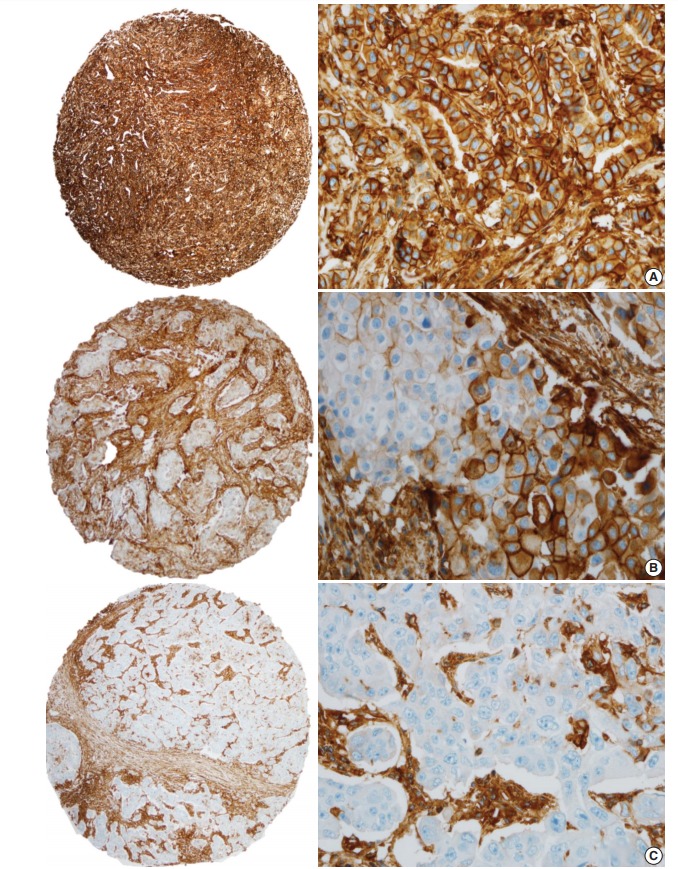
We evaluated HLA-I expression and Treg infiltration by immunohistochemistry in 465 surgically resected breast cancer samples. We examined the correlation between HLA-I expression and Treg infiltration and clinicopathologic characteristics and survival analyses were performed.
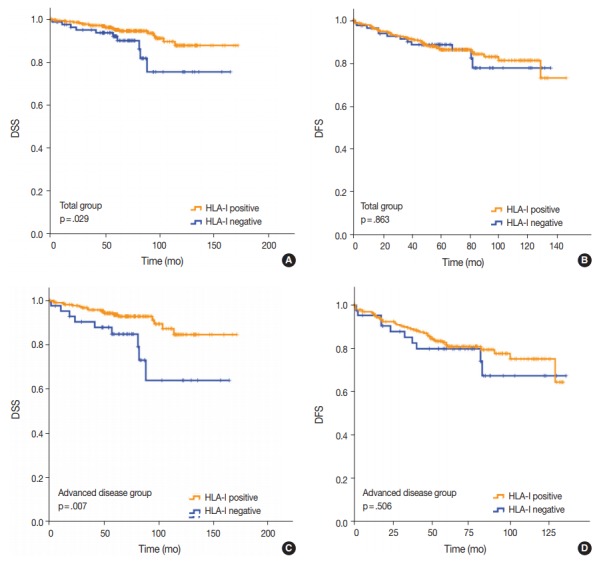
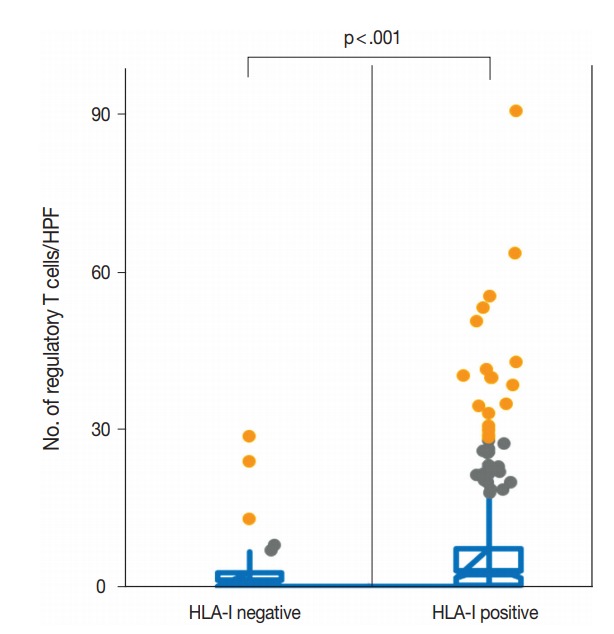
Total loss of HLA-I expression was found in 84 breast cancer samples (18.1%). Univariate survival analysis revealed that loss of HLA-I expression was significantly associated with worse disease-specific survival (DSS) (p = .029). HLA-I was not an independent prognostic factor in the entire patient group, but it was an adverse independent prognostic factor for DSS in patients with advanced disease (stage II-IV) (p = .031). Treg numbers were significantly higher in the intratumoral stroma of HLA-I-positive tumors than in HLA-I-negative tumors (median 6.3 cells/high power field vs 2.1 cells/high power field, p < .001). However, Tregs were not an independent prognostic factor in our cohort.
Our findings suggest that the loss of HLA-I expression is associated with poor prognosis in breast cancer patients, highlighting the role of HLA-I alterations in immune evasion mechanisms of breast cancer. HLA-I could be a promising marker that enables the application of more effective and precise immunotherapies for patients with advanced breast cancer.
人类白细胞抗原I类(HLA-I)分子在调节免疫反应中发挥重要作用。HLA-I表达的缺失或减少已被证明与多种癌症的预后相关。调节性T细胞(Tregs)在免疫反应调节中也发挥关键作用。EMR8-5抗体对HLA-I表达状态的评估及其在乳腺癌中的临床影响尚未得到充分研究,其与Tregs的关系仍不清楚。
我们通过免疫组织化学评估了465例手术切除的乳腺癌样本中的HLA-I表达和Treg浸润情况。我们研究了HLA-I表达与Treg浸润之间的相关性,并进行了临床病理特征分析和生存分析。
在84例乳腺癌样本(18.1%)中发现HLA-I表达完全缺失。单因素生存分析显示,HLA-I表达缺失与更差的疾病特异性生存(DSS)显著相关(p = 0.029)。在整个患者组中,HLA-I不是独立的预后因素,但在晚期疾病(II-IV期)患者中,它是DSS的不良独立预后因素(p = 0.031)。HLA-I阳性肿瘤的瘤内基质中的Treg数量显著高于HLA-I阴性肿瘤(中位值分别为6.3个细胞/高倍视野和2.1个细胞/高倍视野,p < 0.001)。然而,在我们的队列中,Tregs不是独立的预后因素。
我们的研究结果表明,HLA-I表达缺失与乳腺癌患者的预后不良相关,突出了HLA-I改变在乳腺癌免疫逃逸机制中的作用。HLA-I可能是一个有前景的标志物,可用于为晚期乳腺癌患者应用更有效、精确的免疫疗法。