IDLab, Ghent University - imec, Technologiepark 15, Ghent, 9052, Belgium.
Department of Neurology, Ghent University Hospital, Corneel Heymanslaan 10, Ghent, 9000, Belgium.
BMC Med Inform Decis Mak. 2018 Nov 13;18(1):98. doi: 10.1186/s12911-018-0679-6.
Headache disorders are an important health burden, having a large health-economic impact worldwide. Current treatment & follow-up processes are often archaic, creating opportunities for computer-aided and decision support systems to increase their efficiency. Existing systems are mostly completely data-driven, and the underlying models are a black-box, deteriorating interpretability and transparency, which are key factors in order to be deployed in a clinical setting.
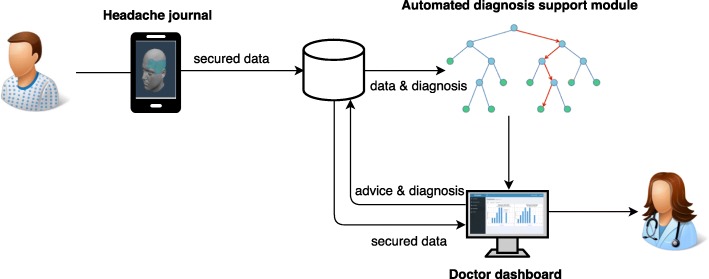
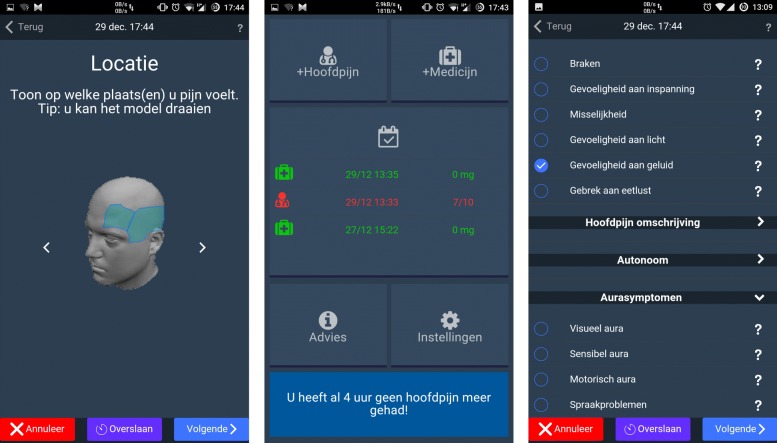
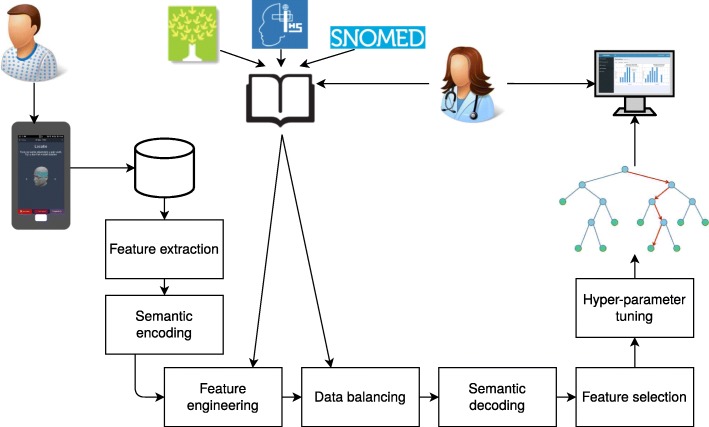
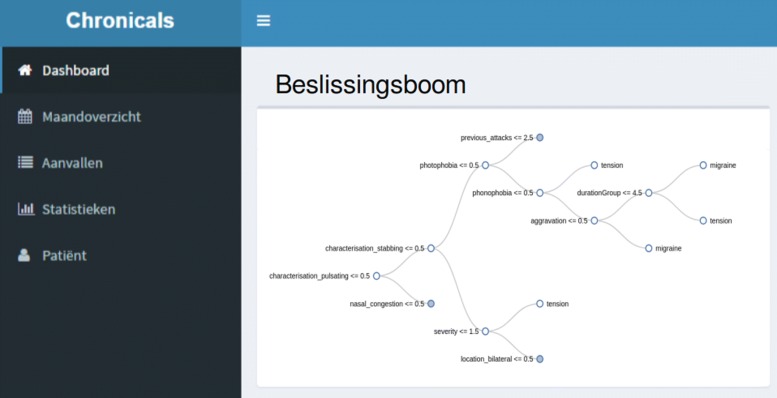
In this paper, a decision support system is proposed, composed of three components: (i) a cross-platform mobile application to capture the required data from patients to formulate a diagnosis, (ii) an automated diagnosis support module that generates an interpretable decision tree, based on data semantically annotated with expert knowledge, in order to support physicians in formulating the correct diagnosis and (iii) a web application such that the physician can efficiently interpret captured data and learned insights by means of visualizations.
We show that decision tree induction techniques achieve competitive accuracy rates, compared to other black- and white-box techniques, on a publicly available dataset, referred to as migbase. Migbase contains aggregated information of headache attacks from 849 patients. Each sample is labeled with one of three possible primary headache disorders. We demonstrate that we are able to reduce the classification error, statistically significant (ρ≤0.05), with more than 10% by balancing the dataset using prior expert knowledge. Furthermore, we achieve high accuracy rates by using features extracted using the Weisfeiler-Lehman kernel, which is completely unsupervised. This makes it an ideal approach to solve a potential cold start problem.
Decision trees are the perfect candidate for the automated diagnosis support module. They achieve predictive performances competitive to other techniques on the migbase dataset and are, foremost, completely interpretable. Moreover, the incorporation of prior knowledge increases both predictive performance as well as transparency of the resulting predictive model on the studied dataset.
头痛障碍是一个重要的健康负担,在全球范围内对健康经济造成了重大影响。目前的治疗和随访流程通常比较陈旧,为计算机辅助和决策支持系统提供了提高效率的机会。现有的系统大多完全是数据驱动的,其底层模型是一个黑盒,降低了可解释性和透明度,这是在临床环境中部署的关键因素。
在本文中,提出了一个决策支持系统,由三个组件组成:(i)一个跨平台的移动应用程序,用于从患者那里获取所需的数据来制定诊断,(ii)一个自动诊断支持模块,该模块根据用专家知识语义注释的数据生成可解释的决策树,以支持医生做出正确的诊断,(iii)一个 Web 应用程序,以便医生可以通过可视化的方式高效地解释捕获的数据和学习的见解。
我们展示了决策树归纳技术在一个名为 migbase 的公开可用数据集上达到了与其他黑盒和白盒技术相当的竞争准确率。Migbase 包含了来自 849 名患者的头痛发作的汇总信息。每个样本都被标记为三种原发性头痛障碍之一。我们证明,通过使用先前的专家知识平衡数据集,我们能够将分类错误减少 10%以上,具有统计学意义(ρ≤0.05)。此外,我们通过使用 Weisfeiler-Lehman 核提取的特征实现了高精度,这是完全无监督的。这使得它成为解决潜在冷启动问题的理想方法。
决策树是自动诊断支持模块的理想选择。它们在 migbase 数据集上的预测性能与其他技术相当,首先是完全可解释的。此外,在研究数据集上,纳入先验知识可以提高预测性能和结果预测模型的透明度。