Harki Jihan, Suker Mustafa, Tovar-Doncel M Sherezade, van Dijk Louisa Jd, van Noord Désirée, van Eijck Casper Hj, Bruno Marco J, Kuipers Ernst J, Ince Can
Department of Gastroenterology and Hepatology,
Department of Surgery, Erasmus MC University Medical Center Rotterdam, Rotterdam, the Netherlands.
Clin Exp Gastroenterol. 2018 Oct 18;11:405-414. doi: 10.2147/CEG.S159160. eCollection 2018.
Little is known about the microcirculatory alterations in patients with chronic mesenteric ischemia (CMI). We hypothesized that patients with CMI have an impaired microcirculatory function and show an oral microcirculatory response after caloric challenge compared to healthy controls.
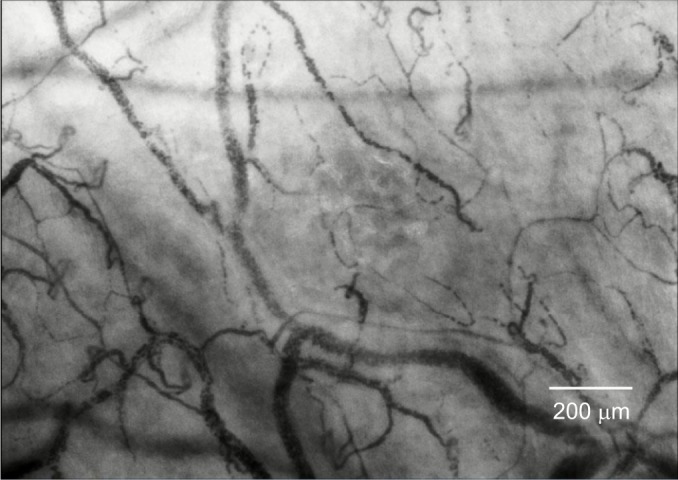
All patients and controls received the standard workup for CMI. Sublingual micro-circulation was evaluated before (T0) and 20 minutes after (T1) feeding. The total vessel density (TVD; mm/mm), perfused vessel density (PVD; mm/mm), proportion of perfused vessels (PPV; %) and microvascular flow index (MFI; AU) were assessed.
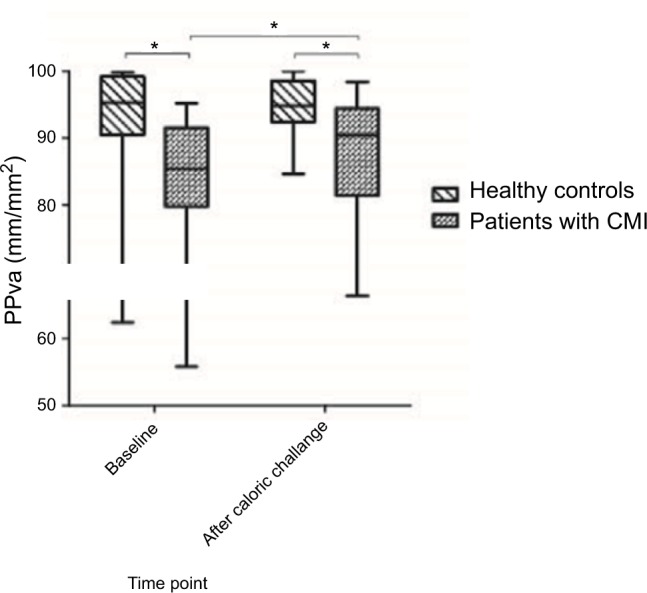
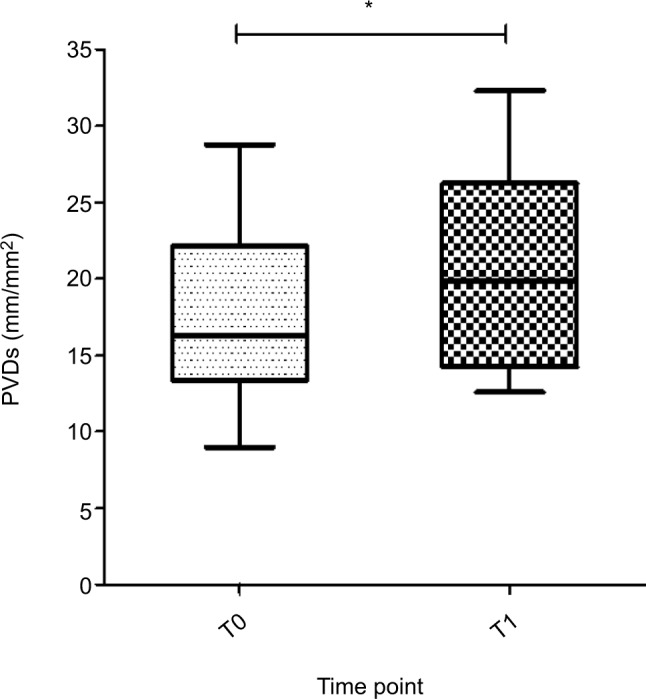
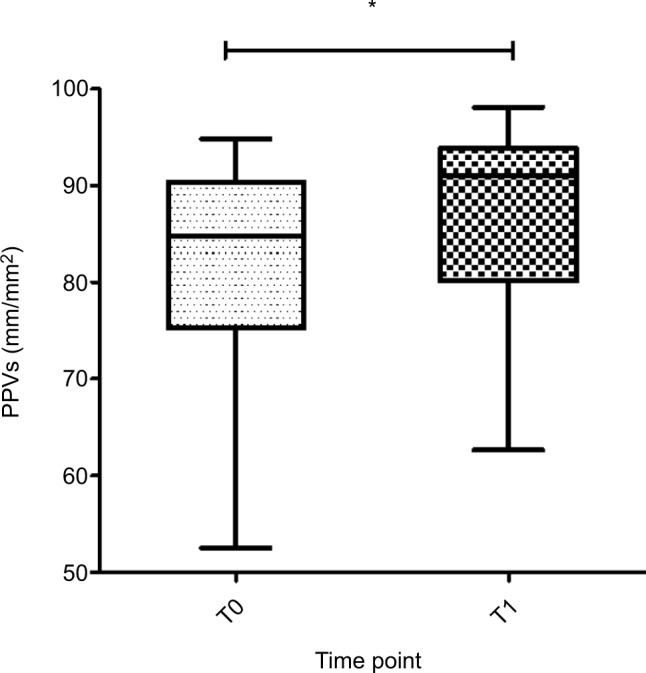
We included 12 patients (63.2 years [IQR 48.8-70.4 years], 67% males) and 12 controls (32.7 years [IQR 27.7-38.1 years], 42% males). At baseline, patients with CMI had a decreased PPV of the sublingual small vessels (median 84.8% vs 95.7%, =0.006), PPV of all vessels (PPV median 85.4% vs 95.3%, =0.007) and microvascular flow index of all vessels (MFIa; median 3.00 vs 2.80, =0.039) compared to healthy controls. After caloric challenge, PVD increased significantly in both small vessels (perfused vessel density of the small vessels [PVDs]) and all vessels (perfused vessel density of all vessels [PVDa]; PVDs [T0]) median 16.3 [IQR 13.3-22.1] vs [T1] median 19.9 [IQR 14.2-26.2], =0.008; PVDa [T0] median 19.1 [IQR 16.2-23.6] vs [T1] median 22.2 [IQR 16.5-28.9], =0.02; proportion of perfused vessels of the small vessels (PPVs; [T0] median 84.8% [IQR 75.3-90.4] vs [T1] median 91.0% [IQR 80.1-93.8], =0.010). In contrast, no significant changes in microcirculatory parameters were observed after caloric challenge in healthy controls.
Patients with CMI have an impaired sublingual microcirculation at baseline and show a significant response in the sublingual microcirculation after caloric challenge, whereas healthy controls have a normal microcirculation at baseline and show no reactive response upon a caloric challenge as seen in CMI patients. Sublingual microcirculation visualization may offer a rapid noninvasive method to identify patients at risk for having CMI.
关于慢性肠系膜缺血(CMI)患者的微循环改变,目前所知甚少。我们推测,与健康对照相比,CMI患者的微循环功能受损,且在热刺激后舌下微循环有反应。
所有患者和对照均接受CMI的标准检查。在进食前(T0)和进食后20分钟(T1)评估舌下微循环。评估总血管密度(TVD;mm/mm)、灌注血管密度(PVD;mm/mm)、灌注血管比例(PPV;%)和微血管血流指数(MFI;AU)。
我们纳入了12例患者(63.2岁[四分位间距48.8 - 70.4岁],67%为男性)和12例对照(32.7岁[四分位间距27.7 - 38.1岁],42%为男性)。在基线时,与健康对照相比,CMI患者舌下小血管的PPV降低(中位数84.8%对95.7%,P = 0.006),所有血管的PPV(PPV中位数85.4%对95.3%,P = 0.007)以及所有血管的微血管血流指数(MFIa;中位数3.00对2.80,P = 0.039)。热刺激后,小血管(小血管灌注血管密度[PVDs])和所有血管(所有血管灌注血管密度[PVDa])的PVD均显著增加;PVDs[T0]中位数16.3[四分位间距13.3 - 22.1]对[T1]中位数19.9[四分位间距14.2 - 26.2],P = 0.008;PVDa[T0]中位数19.1[四分位间距16.2 - 23.6]对[T1]中位数22.2[四分位间距16.5 - 28.9],P = 0.02;小血管灌注血管比例(PPVs;[T0]中位数84.8%[四分位间距75.3 - 90.4]对[T1]中位数91.0%[四分位间距80.1 - 93.8],P = 0.010)。相比之下,健康对照在热刺激后未观察到微循环参数的显著变化。
CMI患者在基线时舌下微循环受损,热刺激后舌下微循环有显著反应,而健康对照在基线时微循环正常,热刺激后未出现CMI患者所见的反应性变化。舌下微循环可视化可能提供一种快速无创的方法来识别有CMI风险的患者。