Zhou Hong, Ma Xuefeng, Pan Jinghua, Shuai Hanlin, Liu Shanshan, Luo Xin, Li Ruiman
Department of Obstetrics and Gynecology,
Department of General Surgery, The First Affiliated Hospital of Jinan University, Guangzhou 510632, China.
J Pain Res. 2018 Oct 18;11:2477-2489. doi: 10.2147/JPR.S172828. eCollection 2018.
Transversus abdominis plane (TAP) block can provide effective analgesia for abdominal surgery. However, many randomized controlled trials (RCTs) have shown controversial results in hysterectomy. We conducted a meta-analysis of RCTs to investigate the effectiveness of TAP block after hysterectomy.
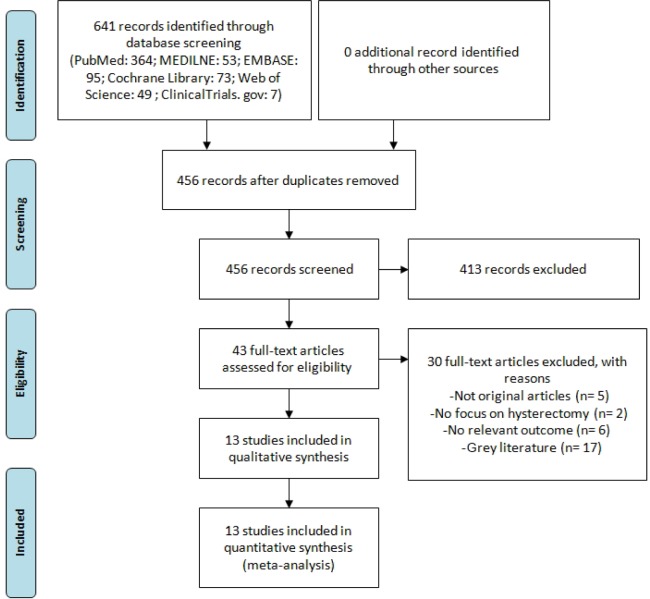
Studies were gathered from PubMed, MEDLINE, EMBASE, Cochrane Library, Web of Science, and ClinicalTrials.gov databases up to March 2018. RCTs involving TAP blocks in women undergoing hysterectomy were selected. The primary outcome of mean 24 hours morphine consumption and other outcomes, such as time to first request for analgesic, rest, and pain scores on movement at different times, and rates of nausea and vomiting, were compared between TAP block and no or sham block groups.
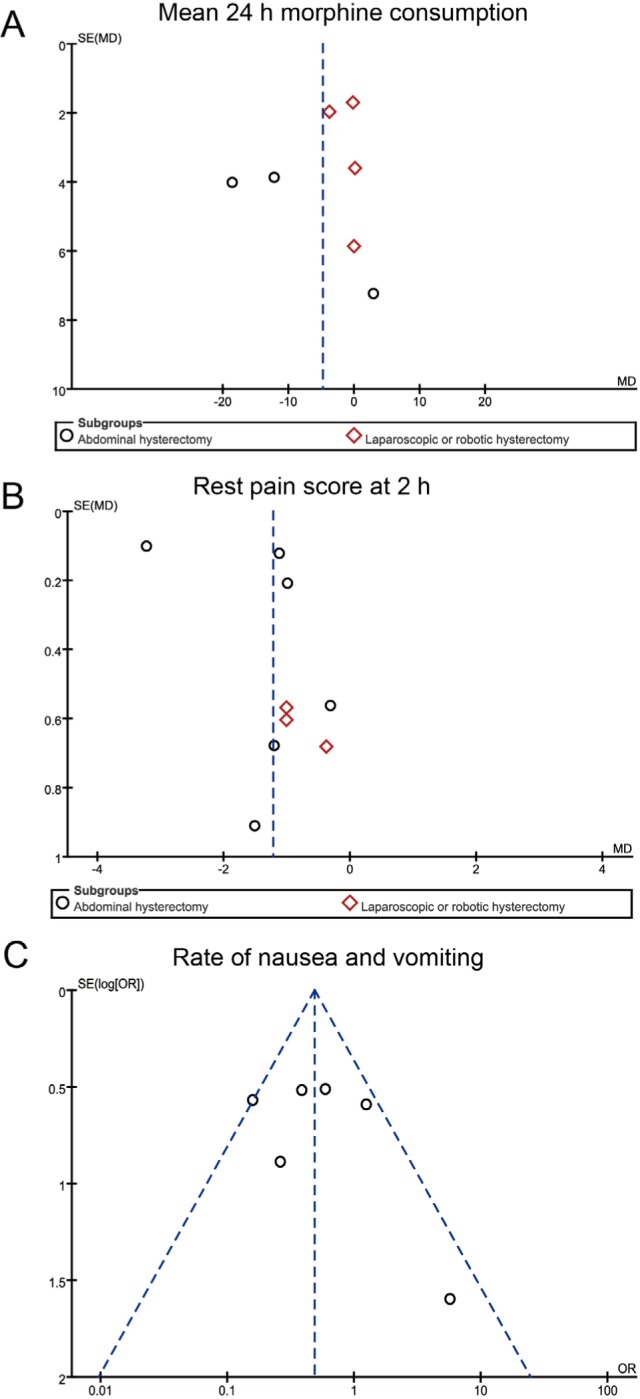
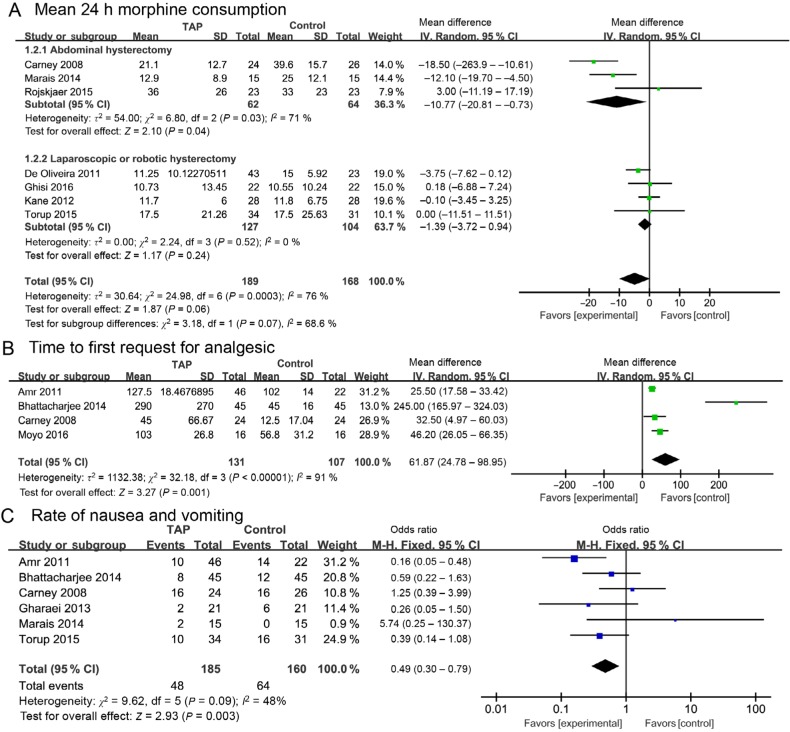
A total of 841 participants were included in the 13 selected RCTs. Compared with no or sham blocks, TAP block reduced mean 24-hour morphine consumption in abdominal hysterectomy (AH) (weighted mean difference [WMD] -10.77 mg, =0.04) but not in laparoscopic hysterectomy (LH)/robotic-assisted hysterectomy (RH) (WMD -1.39 mg, =0.24). TAP block in AH prolonged analgesic time and reduced nausea and vomiting rates. TAP block also reduced the postoperative pain score at rest and on movement at different times in the AH subgroup, but it did not significantly reduce the postoperative pain score at rest, 6-8, and 24 hours, as well as the pain score on movement at 2, 6-8, and 24 hours in the LH/RH subgroup.
TAP block is an effective analgesic for AH. TAP block can reduce postoperative morphine consumption in AH and pain scores at rest and on movement for AH without increasing side effects. However, TAP block has limited analgesic effects for women undergoing LH/RH, as it does not reduce postoperative morphine consumption and pain scores at rest and on movement.
腹横肌平面(TAP)阻滞可为腹部手术提供有效的镇痛效果。然而,许多随机对照试验(RCT)在子宫切除术中显示出有争议的结果。我们进行了一项RCT的荟萃分析,以研究子宫切除术后TAP阻滞的有效性。
从截至2018年3月的PubMed、MEDLINE、EMBASE、Cochrane图书馆、科学网和ClinicalTrials.gov数据库中收集研究。选择了涉及子宫切除术中TAP阻滞的RCT。比较了TAP阻滞组与无阻滞或假阻滞组之间24小时吗啡平均消耗量这一主要结局以及其他结局,如首次要求镇痛的时间、休息情况、不同时间的运动时疼痛评分以及恶心和呕吐发生率。
13项入选的RCT共纳入841名参与者。与无阻滞或假阻滞相比,TAP阻滞降低了腹式子宫切除术(AH)中24小时吗啡平均消耗量(加权平均差[WMD] -10.77 mg,P = 0.04),但在腹腔镜子宫切除术(LH)/机器人辅助子宫切除术(RH)中未降低(WMD -1.39 mg,P = 0.24)。AH中的TAP阻滞延长了镇痛时间并降低了恶心和呕吐发生率。TAP阻滞还降低了AH亚组不同时间休息时和运动时的术后疼痛评分,但在LH/RH亚组中,它并未显著降低术后休息时、6 - 8小时和24小时的疼痛评分以及2小时、6 - 8小时和24小时运动时的疼痛评分。
TAP阻滞对AH是一种有效的镇痛方法。TAP阻滞可降低AH术后吗啡消耗量以及休息时和运动时的疼痛评分,且不增加副作用。然而,TAP阻滞对接受LH/RH的女性镇痛效果有限,因为它未降低术后吗啡消耗量以及休息时和运动时的疼痛评分。