Ren Kuojun, Yin Yachao, He Fang, Shao Yi, Wang Shengying
Department of Head-Neck and Breast Surgery, Anhui Provincial Cancer Hospital, The First Affiliated Hospital of The University of Science and Technology of China (USTC), Division of Life Sciences and Medicine, USTC, Hefei, Anhui, People's Republic of China,
Department of Radiotherapy, Anhui Provincial Cancer Hospital, The First Affiliated Hospital of USTC, Division of Life Sciences and Medicine, USTC, Hefei, Anhui, People's Republic of China.
Cancer Manag Res. 2018 Oct 24;10:4891-4898. doi: 10.2147/CMAR.S180695. eCollection 2018.
The role of derived neutrophil-to-lymphocyte ratio (dNLR) in predicting the prognosis of patients with triple-negative breast cancer (TNBC) has not been well studied. Here, we attempted to investigate the significance of dNLR in predicting the prognosis of patients with surgical (nonmetastatic) TNBC.
A total of 281 patients diagnosed with surgical TNBC in The First Affiliated Hospital of University of Science and Technology of China from February 2005 to March 2015 were retrospectively included in this study. Kaplan-Meier curve analysis was used to assess the disease-free survival (DFS) and overall survival (OS). We used Cox regression model to assess the prognostic significance of pretreatment dNLR and other clinicopathological parameters in TNBC patients.
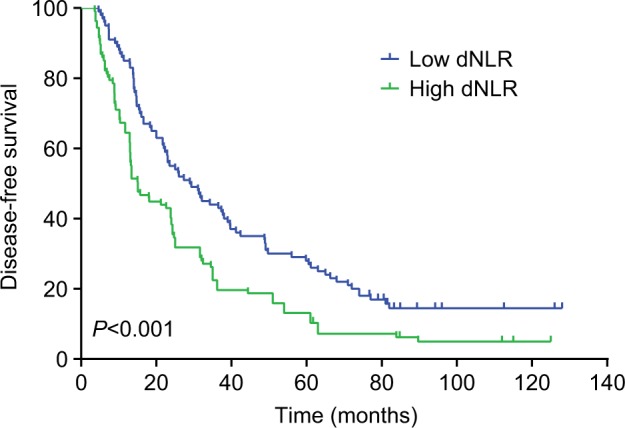
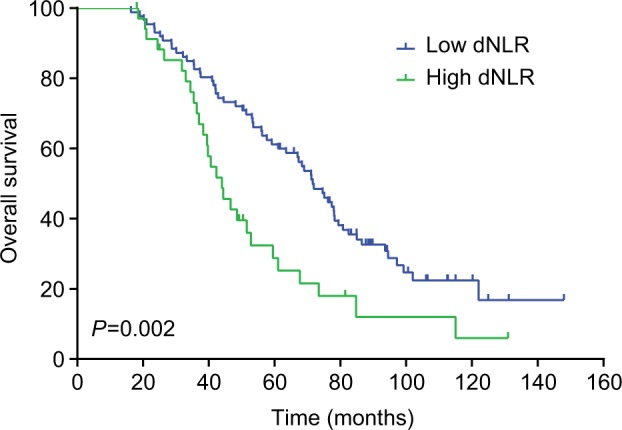
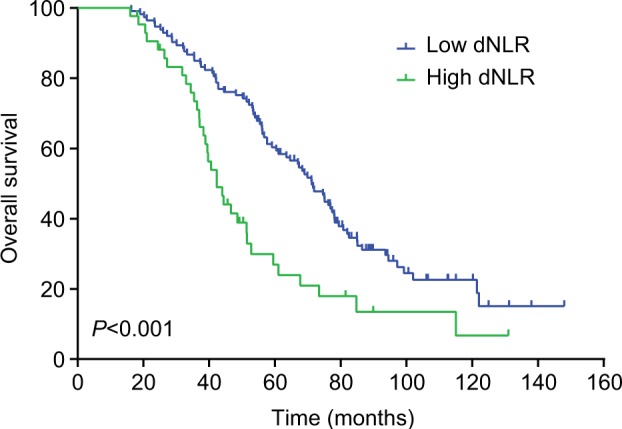
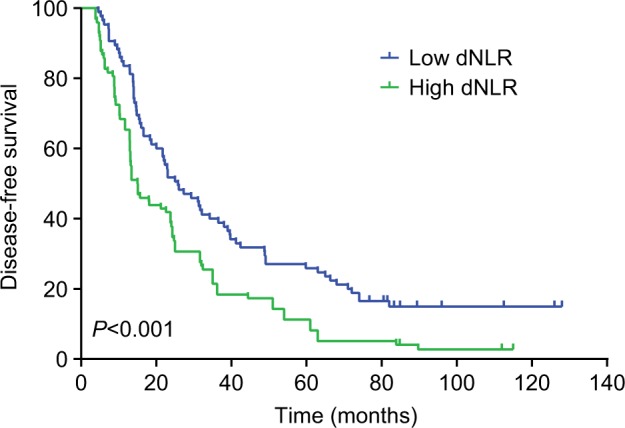
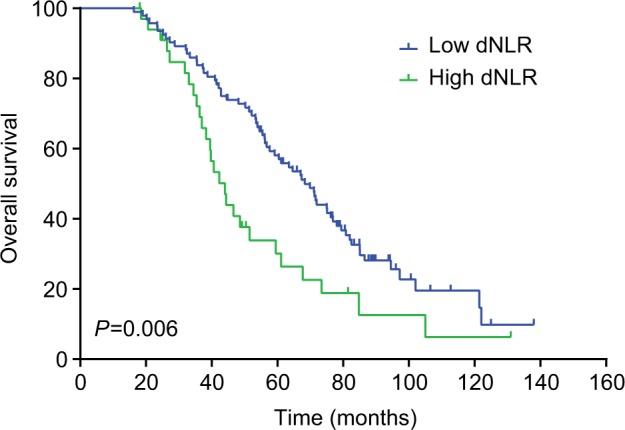
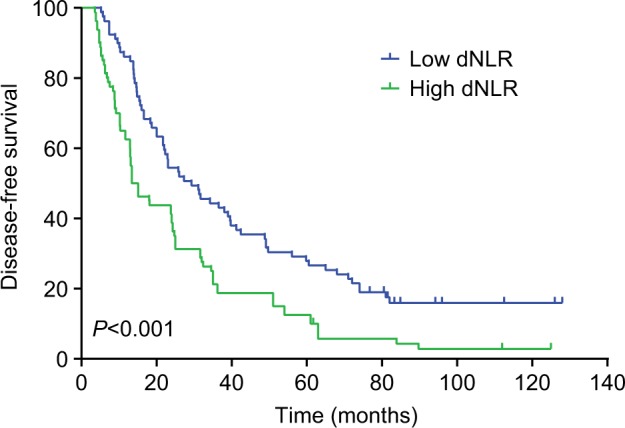
The median DFS in TNBC patients who had low dNLR and high dNLR was 28.9 and 15.1 months (<0.001), respectively, whereas the median OS in patients who had low dNLR and high dNLR was 71.2 and 42.3 months (<0.001), respectively. In patients aged ≤50 years and with invasive ductal carcinoma, a low dNLR predicted better DFS and OS compared with a high dNLR. Multivariate analysis demonstrated that the increased dNLR was a risk factor of poor DFS (HR=1.90, 95% CI: 1.52-2.46, =0.007) and OS (HR=2.56, 95% CI: 1.69-3.58, =0.001).
Pretreatment dNLR is an independent factor of prognosis for TNBC patients, which potentially allows clinical doctors to improve outcomes of patients with high dNLR by treating with aggressive therapy, such as high-dose adjuvant chemotherapy and radiotherapy.
衍生中性粒细胞与淋巴细胞比值(dNLR)在预测三阴性乳腺癌(TNBC)患者预后中的作用尚未得到充分研究。在此,我们试图探讨dNLR在预测手术(非转移性)TNBC患者预后中的意义。
回顾性纳入2005年2月至2015年3月在中国科学技术大学附属第一医院诊断为手术TNBC的281例患者。采用Kaplan-Meier曲线分析评估无病生存期(DFS)和总生存期(OS)。我们使用Cox回归模型评估TNBC患者治疗前dNLR和其他临床病理参数的预后意义。
dNLR低和高的TNBC患者的中位DFS分别为28.9个月和15.1个月(<0.001),而dNLR低和高的患者的中位OS分别为71.2个月和42.3个月(<0.001)。在年龄≤50岁且患有浸润性导管癌的患者中,与高dNLR相比,低dNLR预测的DFS和OS更好。多因素分析表明,dNLR升高是DFS不良(HR=1.90,95%CI:1.52-2.46,P=0.007)和OS不良(HR=2.56,95%CI:1.69-3.58,P=0.001)的危险因素。
治疗前dNLR是TNBC患者预后的独立因素,这可能使临床医生通过积极治疗,如大剂量辅助化疗和放疗,改善高dNLR患者的预后。