Department of Neurology, Beijing Tiantan Hospital, Capital Medical University, Beijing 100050, China.
China National Clinical Research Center for Neurological Diseases, Beijing 100050, China.
Biomed Res Int. 2018 Oct 22;2018:5381239. doi: 10.1155/2018/5381239. eCollection 2018.
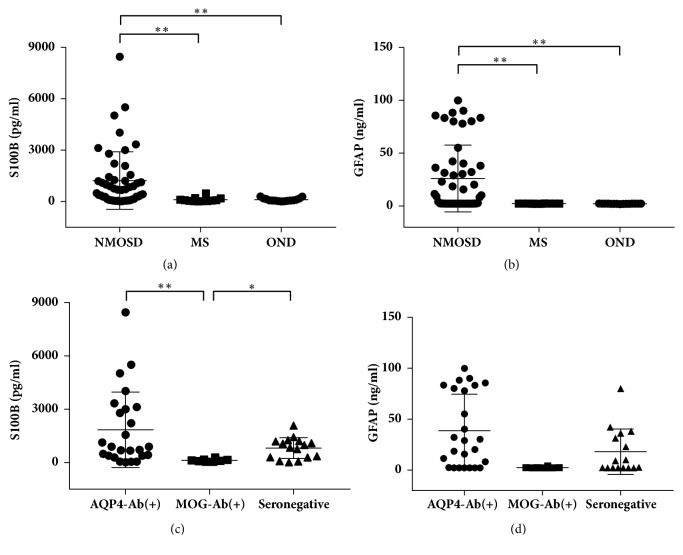
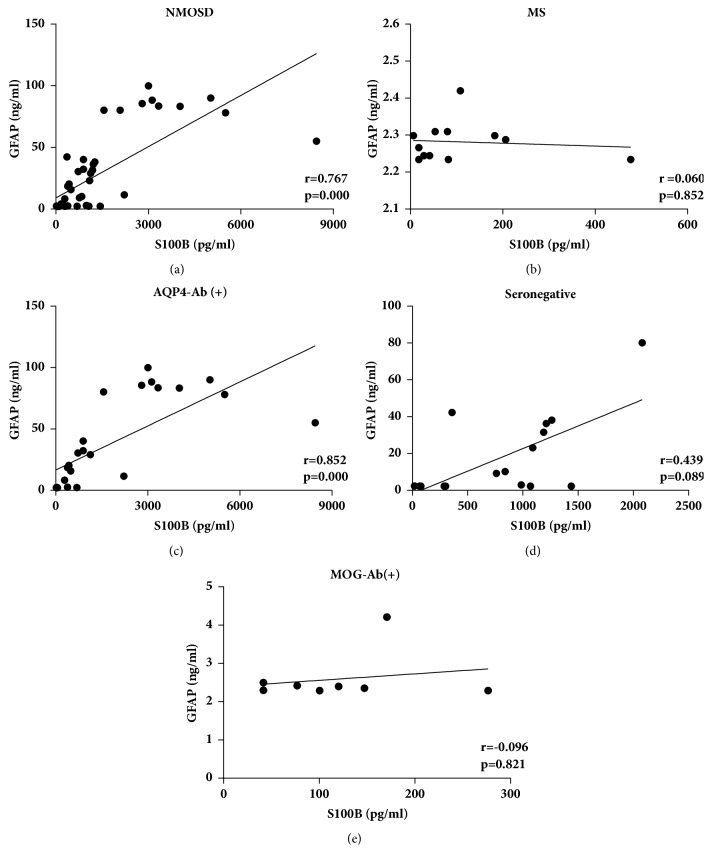
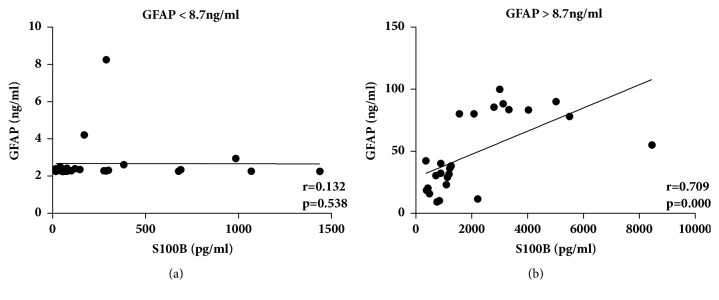
Astrocytic impairment is a pathologic feature of neuromyelitis optica spectrum disorder (NMOSD). S100B and glial fibrillary acidic protein (GFAP) are the two most commonly used astrocytic markers. The aim of this study was to evaluate whether CSF-S100B could serve as a marker of NMOSD. We enrolled 49 NMOSD patients [25 aquaporin-4 antibody (AQP4-Ab)-positive, 8 myelin-oligodendrocyte glycoprotein antibody (MOG-Ab)-positive, and 16 seronegative patients], 12 multiple sclerosis (MS) patients, and 15 other noninflammatory neurological diseases (OND) patients. The CSF levels of S100B and GFAP were measured by ELISA. Both CSF-S100B and GFAP levels significantly discriminated NMOSD from MS [area under curve (AUC) = 0.839 and 0.850, respectively] and OND (AUC = 0.839 and 0.850, respectively). The CSF-S100B levels differentiated AQP4-Ab-positive NMOSD from MOG-Ab-positive NMOSD with higher accuracy than the CSF-GFAP levels (AUC=0.865 and 0.772, respectively). The CSF-S100B levels also significantly discriminated MOG-Ab-positive patients from seronegative patients (AUC = 0.848). Both CSF-S100B and GFAP levels were correlated with the Expanded Disability Status Scale (EDSS) during remission. Only the CSF-S100B levels were correlated with the CSF WBC count and the EDSS during attack. The levels of CSF-S100B seemed to have a longer lasting time than the levels of CSF-GFAP, which may benefit patients who present late. As a result, CSF-S100B might be a potential candidate biomarker for NMOSD in discriminating, evaluating severity, and predicting disability.
星形胶质细胞损伤是视神经脊髓炎谱系疾病(NMOSD)的病理特征。S100B 和胶质纤维酸性蛋白(GFAP)是两种最常用的星形胶质细胞标志物。本研究旨在评估 CSF-S100B 是否可作为 NMOSD 的标志物。我们纳入了 49 名 NMOSD 患者[25 名水通道蛋白 4 抗体(AQP4-Ab)阳性,8 名髓鞘少突胶质细胞糖蛋白抗体(MOG-Ab)阳性,16 名血清阴性患者],12 名多发性硬化症(MS)患者和 15 名其他非炎症性神经系统疾病(OND)患者。通过 ELISA 法测量 CSF-S100B 和 GFAP 水平。CSF-S100B 和 GFAP 水平均能显著区分 NMOSD 与 MS[曲线下面积(AUC)分别为 0.839 和 0.850]和 OND[AUC 分别为 0.839 和 0.850]。CSF-S100B 水平比 CSF-GFAP 水平能更准确地区分 AQP4-Ab 阳性 NMOSD 与 MOG-Ab 阳性 NMOSD(AUC 分别为 0.865 和 0.772)。CSF-S100B 水平也能显著区分 MOG-Ab 阳性患者与血清阴性患者(AUC = 0.848)。CSF-S100B 和 GFAP 水平在缓解期与扩展残疾状况量表(EDSS)均相关。仅在发病期 CSF-S100B 水平与 CSF 白细胞计数和 EDSS 相关。CSF-S100B 水平似乎比 CSF-GFAP 水平持续时间更长,这可能对迟发就诊的患者有益。因此,CSF-S100B 可能是 NMOSD 鉴别、评估严重程度和预测残疾的潜在候选生物标志物。