Tenekecioglu Erhan, Torii Ryo, Katagiri Yuki, Chichareon Ply, Asano Taku, Miyazaki Yosuke, Takahashi Kuniaki, Modolo Rodrigo, Al-Lamee Rasha, Al-Lamee Kadem, Colet Carlos, Reiber Johan H C, Pekkan Kerem, van Geuns Robert, Bourantas Christos V, Onuma Yoshinobu, Serruys Patrick W
Department of Interventional Cardiology, Erasmus University Medical Center, Thoraxcenter, Rotterdam, The Netherlands.
Department of Mechanical Engineering, University College London, London, UK.
Int J Cardiovasc Imaging. 2019 Mar;35(3):409-418. doi: 10.1007/s10554-018-1481-3. Epub 2018 Nov 13.
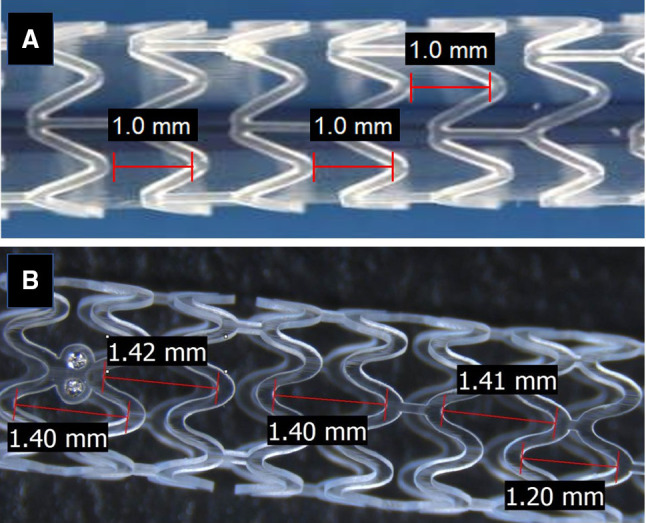
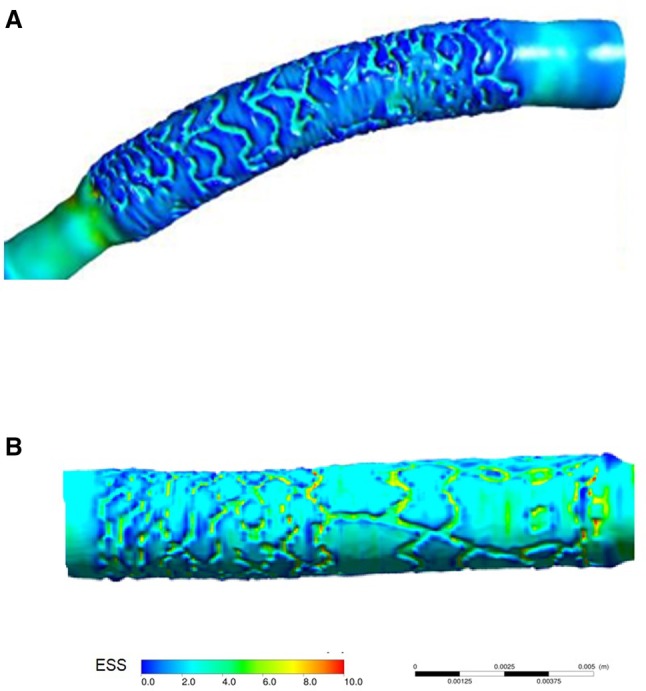
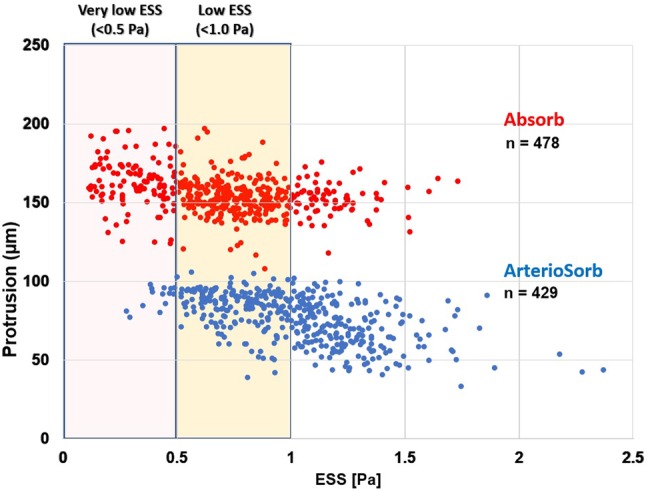
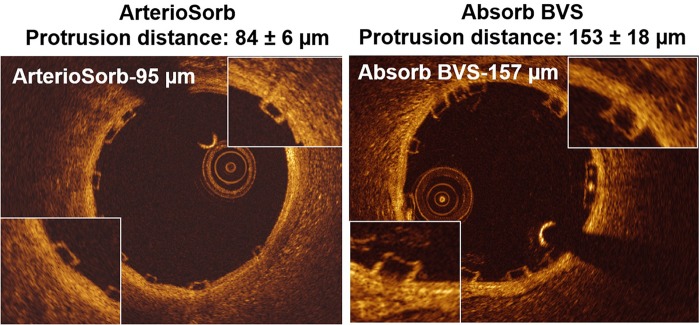
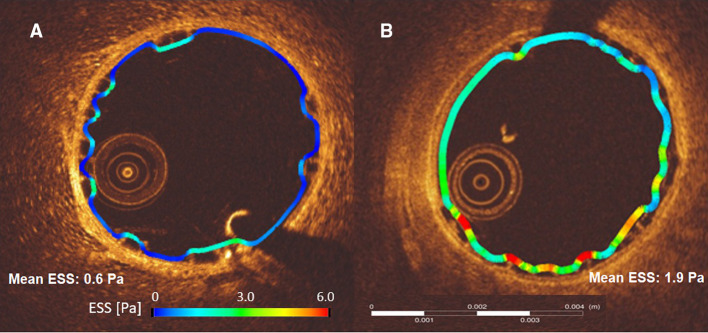
Optical coherence tomography based computational flow dynamic (CFD) modeling provides detailed information about the local flow behavior in stented/scaffolded vessel segments. Our aim is to investigate the in-vivo effect of strut thickness and strut protrusion on endothelial wall shear stress (ESS) distribution in ArterioSorb Absorbable Drug-Eluting Scaffold (ArterioSorb) and Absorb everolimus-eluting Bioresorbable Vascular Scaffold (Absorb) devices that struts with similar morphology (quadratic structure) but different thickness. In three animals, six coronary arteries were treated with ArterioSorb. At different six animals, six coronary arteries were treated with Absorb. Following three-dimensional(3D) reconstruction of the coronary arteries, Newtonian steady flow simulation was performed and the ESS were estimated. Mixed effects models were used to compare ESS distribution in the two devices. There were 4591 struts in the analyzed 477 cross-sections in Absorb (strut thickness = 157 µm) and 3105 struts in 429 cross-sections in ArterioSorb (strut thickness = 95 µm) for the protrusion analysis. In cross-section level analysis, there was significant difference between the scaffolds in the protrusion distances. The protrusion was higher in Absorb (97% of the strut thickness) than in ArterioSorb (88% of the strut thickness). ESS was significantly higher in ArterioSorb (1.52 ± 0.34 Pa) than in Absorb (0.73 ± 2.19 Pa) (p = 0.001). Low- and very-low ESS data were seen more often in Absorb than in ArterioSorb. ArterioSorb is associated with a more favorable ESS distribution compared to the Absorb. These differences should be attributed to different strut thickness/strut protrusion that has significant effect on shear stress distribution.
基于光学相干断层扫描的计算流体动力学(CFD)建模提供了有关带支架/带骨架血管段局部血流行为的详细信息。我们的目的是研究在具有相似形态(二次结构)但厚度不同的支柱的动脉可吸收药物洗脱支架(ArterioSorb)和依维莫司洗脱生物可吸收血管支架(Absorb)装置中,支柱厚度和支柱突出对内皮壁面剪应力(ESS)分布的体内影响。在三只动物中,用ArterioSorb治疗了六条冠状动脉。在另外六只不同的动物中,用Absorb治疗了六条冠状动脉。在对冠状动脉进行三维(3D)重建后,进行了牛顿稳态血流模拟并估计了ESS。使用混合效应模型比较两种装置中的ESS分布。在用于突出分析的Absorb的477个横截面中的4591个支柱(支柱厚度 = 157 µm)和ArterioSorb的429个横截面中的3105个支柱(支柱厚度 = 95 µm)。在横截面水平分析中,两种支架在突出距离上存在显著差异。Absorb中的突出(支柱厚度的97%)高于ArterioSorb(支柱厚度的88%)。ArterioSorb中的ESS(1.52±0.34 Pa)显著高于Absorb(0.73±2.19 Pa)(p = 0.001)。与ArterioSorb相比,Absorb中低ESS和极低ESS数据出现的频率更高。与Absorb相比,ArterioSorb与更有利的ESS分布相关。这些差异应归因于对剪应力分布有显著影响的不同支柱厚度/支柱突出。