
基于 HbA1c 轨迹的患者聚类:迈向 2 型糖尿病个体化医学的一步。
Patient clusters based on HbA1c trajectories: A step toward individualized medicine in type 2 diabetes.
机构信息
Clalit Research Institute, Tel Aviv, Israel.
Israeli National Council of Diabetes, Jerusalem, Israel.
出版信息
PLoS One. 2018 Nov 14;13(11):e0207096. doi: 10.1371/journal.pone.0207096. eCollection 2018.
AIMS
To identify clinically meaningful clusters of patients with similar glycated hemoglobin (HbA1c) trajectories among patients with type 2 diabetes.
METHODS
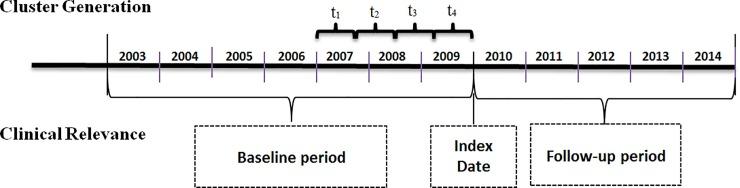
A retrospective cohort study using unsupervised machine learning clustering methodologies to determine clusters of patients with similar longitudinal HbA1c trajectories. Stability of these clusters was assessed and supervised random forest analysis verified the clusters' reproducibility. Clinical relevance of the clusters was assessed through multivariable analysis, comparing differences in risk for a composite outcome (macrovascular and microvascular outcomes, hypoglycemic events, and all-cause mortality) at HbA1c thresholds for each cluster.
RESULTS
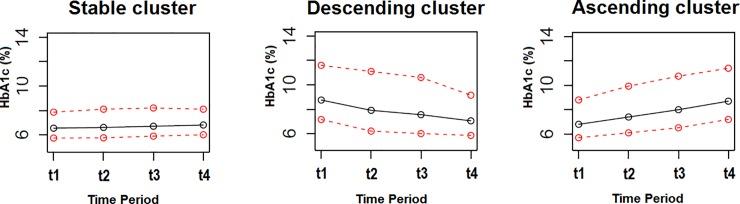
Among 60,423 patients, three clusters of HbA1c trajectories were generated: stable (n = 45,679), descending (n = 6,084), and ascending (n = 8,660) trends, which were reproduced with 99.8% accuracy using a random forest model. In the clinical relevance assessment, HbA1c levels demonstrated a J-shape association with the risk for outcomes. HbA1c level thresholds for minimizing outcomes' risk differed by cluster: 6.0-6.4% for the stable cluster, <8.0% for the descending cluster, and <9.0 for the ascending cluster.
CONCLUSIONS
By applying unsupervised machine learning to longitudinal HbA1c trajectories, we have identified clusters of patients who have distinct risk for diabetes-related complications. These clusters can be the basis for developing individualized models to personalize glycemic targets.
目的
在 2 型糖尿病患者中,确定具有相似糖化血红蛋白(HbA1c)轨迹的具有临床意义的患者聚类。
方法
采用无监督机器学习聚类方法的回顾性队列研究,以确定具有相似纵向 HbA1c 轨迹的患者聚类。评估这些聚类的稳定性,并通过监督随机森林分析验证聚类的可重复性。通过多变量分析评估聚类的临床相关性,比较每个聚类的 HbA1c 阈值下复合结局(大血管和微血管结局、低血糖事件和全因死亡率)风险的差异。
结果
在 60423 名患者中,生成了 3 个 HbA1c 轨迹聚类:稳定(n=45679)、下降(n=6084)和上升(n=8660)趋势,使用随机森林模型可准确复制 99.8%。在临床相关性评估中,HbA1c 水平与结局风险呈 J 形关联。最小化结局风险的 HbA1c 水平阈值因聚类而异:稳定聚类为 6.0-6.4%,下降聚类<8.0%,上升聚类<9.0%。
结论
通过将无监督机器学习应用于纵向 HbA1c 轨迹,我们确定了具有不同糖尿病相关并发症风险的患者聚类。这些聚类可以作为开发个性化血糖目标个体化模型的基础。

 Zotero 插件