Division of Hematology-Oncology, Department of Internal Medicine, Seoul National University Bundang Hospital, Seongnam, Korea.
Department of Pathology, Seoul National University Bundang Hospital, Seoul National University College of Medicine, Seongnam, Korea.
Cancer Res Treat. 2019 Jul;51(3):1086-1097. doi: 10.4143/crt.2018.537. Epub 2018 Nov 5.
Programmed death-1 (PD-1)/PD-1 ligand (PD-L1) axis blockades have revolutionized the treatment of advanced non-small cell lung cancer (NSCLC). We assessed the effect of platinum-based chemotherapy on tumor PD-L1 expression and its clinical implications.
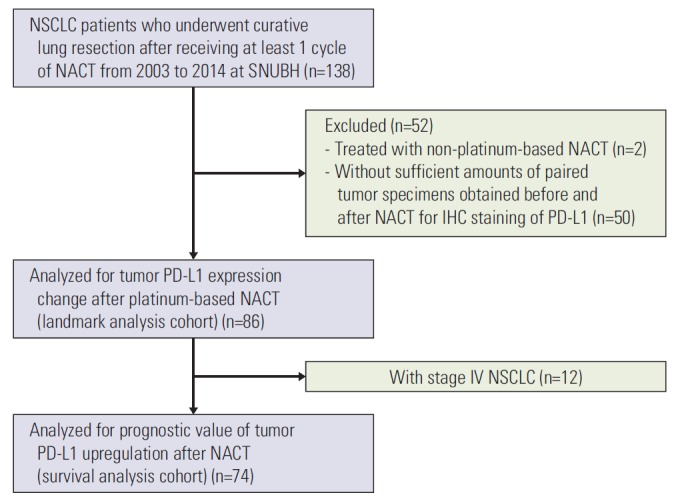
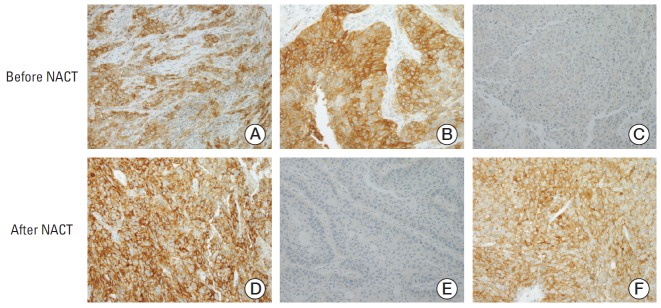
We used immunohistochemistry to retrospectively evaluate the percentage of tumor cells with membranous PD-L1 staining (tumor proportion score) in paired tumor specimens obtained before and after platinum-based neoadjuvant chemotherapy (NACT) in 86 patients with NSCLC. We analyzed the correlation between the change in PD-L1 tumor proportion score and clinicopathologic characteristics, response to NACT, and survival.
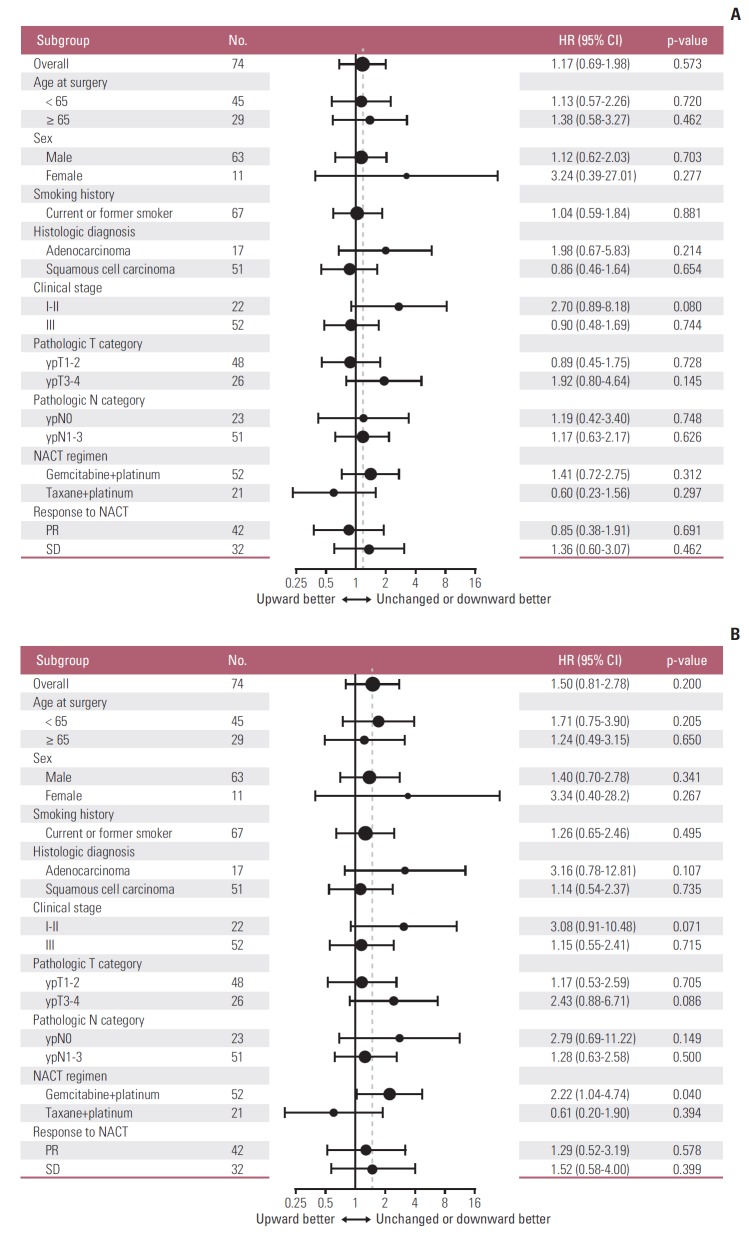
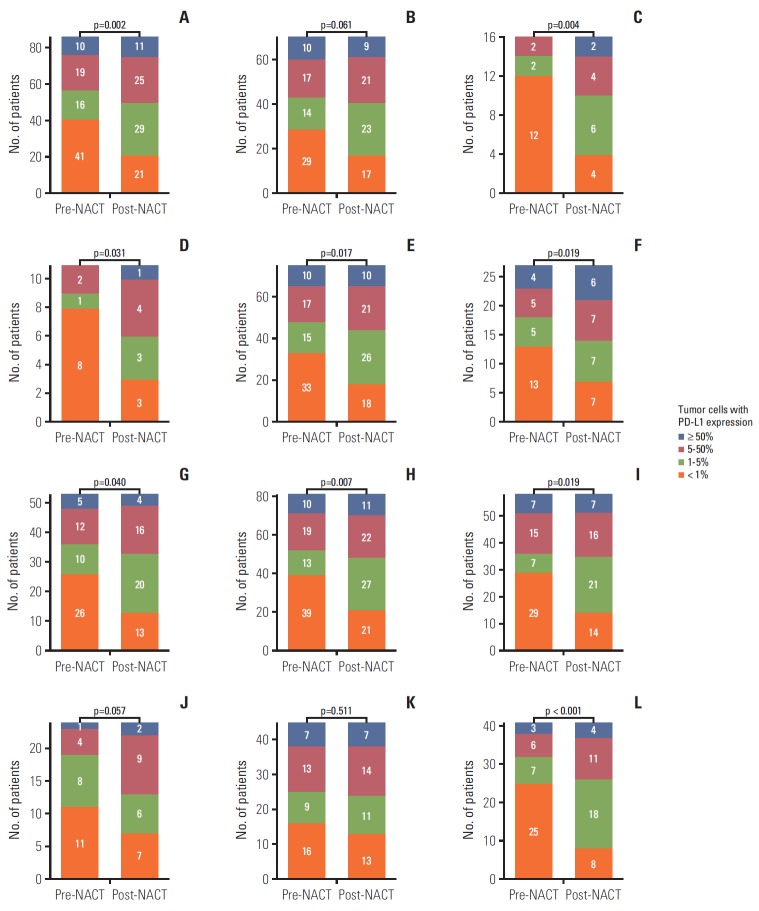
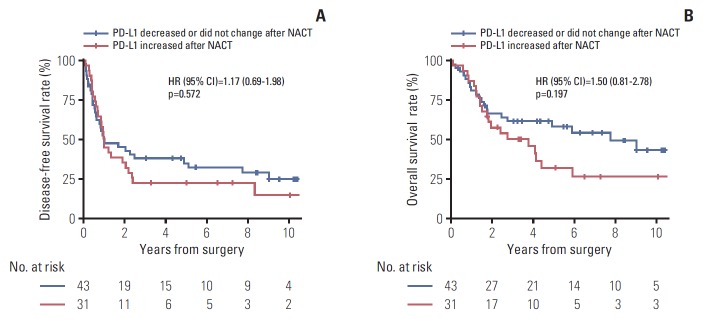
The PD-L1 tumor proportion score increased in a significant proportion of patients with NSCLC after platinum-based NACT (Wilcoxon signed-rank test, p=0.002). That pattern was consistent across clinically defined subgroups except for patients with partial response to NACT. Tumors from 26 patients (30.2%) were PD-L1‒negative before NACT but PD-L1-positive after NACT, whereas the reverse pattern occurred in six patients (7%) (McNemar's test, p < 0.001). Increase in PD-L1 tumor proportion score was significantly associated with lack of response to NACT (Fisher exact test, p=0.015). There was a tendency, albeit not statistically significant, for patients with an increase in PD-L1 tumor proportion score to have shorter survival.
Tumor PD-L1 expression increased after platinum-based NACT in a significant proportion of patients with NSCLC. Increase in tumor PD-L1 expression may predict poor clinical outcome.
程序性死亡受体-1(PD-1)/PD-1 配体(PD-L1)轴阻断疗法彻底改变了晚期非小细胞肺癌(NSCLC)的治疗格局。本研究评估了铂类化疗对肿瘤 PD-L1 表达的影响及其临床意义。
我们使用免疫组织化学法,回顾性评估了 86 例接受铂类新辅助化疗(NACT)的 NSCLC 患者配对肿瘤标本中肿瘤细胞 PD-L1 膜染色百分比(肿瘤比例评分)的变化。我们分析了 PD-L1 肿瘤比例评分变化与临床病理特征、NACT 反应和生存之间的相关性。
在接受铂类 NACT 的 NSCLC 患者中,PD-L1 肿瘤比例评分显著增加(Wilcoxon 符号秩检验,p=0.002)。该模式在各临床定义亚组中一致,除了对 NACT 部分缓解的患者。26 例患者(30.2%)的肿瘤在 NACT 前为 PD-L1 阴性,而在 NACT 后为 PD-L1 阳性,而在 6 例患者(7%)中则出现相反的模式(McNemar 检验,p<0.001)。PD-L1 肿瘤比例评分增加与 NACT 无反应显著相关(Fisher 确切检验,p=0.015)。尽管没有统计学意义,但 PD-L1 肿瘤比例评分增加的患者生存时间有缩短的趋势。
在接受铂类 NACT 的 NSCLC 患者中,肿瘤 PD-L1 表达显著增加。肿瘤 PD-L1 表达增加可能预示着不良的临床结局。