Departments of Pathology.
Thoracic Surgery, National Cancer Center/National Clinical Research Center for Cancer/Cancer Hospital, Chinese Academy of Medical Sciences and Peking Union Medical College, Beijing, China.
J Immunother. 2019 Jul/Aug;42(6):215-220. doi: 10.1097/CJI.0000000000000275.
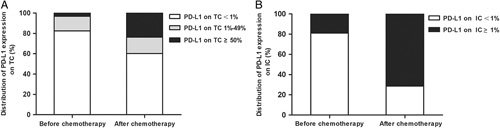
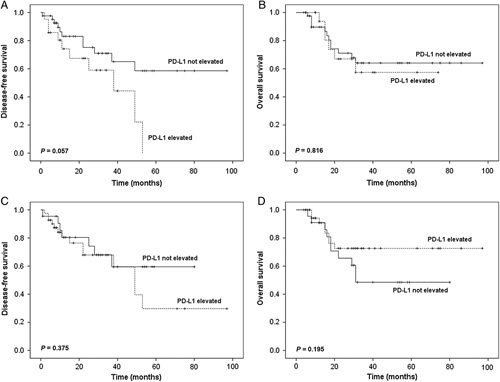
The effect of chemotherapy on programmed cell death-ligand 1 (PD-L1) expression has been previously studied in lung cancer, while the results remain controversial. The aim of this study was to investigate the variation of PD-L1 expression after neoadjuvant chemotherapy and explore the association between chemotherapy response, prognosis and the variation of PD-L1 expression in lung cancer patients. A total of 63 lung cancer patients who received platinum-based neoadjuvant chemotherapy and subsequently underwent surgical resection were selected. PD-L1 expression on tumor cells (TC) and tumor-infiltrating immune cells (IC) was assessed by immunohistochemistry using 22C3 monoclonal antibody in these 63 matched lung cancer specimens before and after neoadjuvant chemotherapy. The positivity of PD-L1 on TC changed from 17.5% to 39.7% after neoadjuvant chemotherapy and the positivity of PD-L1 on IC changed from 19.0% to 71.4% after neoadjuvant chemotherapy. The elevation of PD-L1 expression on TC after neoadjuvant chemotherapy was more frequently observed in patients achieving stable disease or progressive disease than in patients achieving partial response (P=0.026). Patients with elevated PD-L1 expression on TC after neoadjuvant chemotherapy showed a trend to have a shorter progression-free survival than patients without elevated PD-L1 expression on TC, although the difference was not statistically significant in multivariate analysis (hazard ratio=2.38, 95% confidence interval=0.99-5.73, P=0.053). PD-L1 expression can be elevated by chemotherapy in lung cancer. Furthermore, elevation of PD-L1 expression on TC after neoadjuvant chemotherapy was associated with reduced chemotherapy response and inferior progression-free survival in patients with lung cancer.
化疗对程序性死亡配体 1(PD-L1)表达的影响已在肺癌中进行了研究,但其结果仍存在争议。本研究旨在探讨新辅助化疗后 PD-L1 表达的变化,并探讨化疗反应、预后与肺癌患者 PD-L1 表达变化之间的关系。本研究共纳入 63 例接受铂类新辅助化疗后行手术切除的肺癌患者。采用 22C3 单克隆抗体通过免疫组织化学法检测 63 例配对肺癌标本化疗前后肿瘤细胞(TC)和肿瘤浸润免疫细胞(IC)上的 PD-L1 表达。新辅助化疗后 TC 上 PD-L1 的阳性率从 17.5%变为 39.7%,IC 上 PD-L1 的阳性率从 19.0%变为 71.4%。新辅助化疗后 TC 上 PD-L1 表达升高更常见于疾病稳定或进展的患者,而不是部分缓解的患者(P=0.026)。新辅助化疗后 TC 上 PD-L1 表达升高的患者无进展生存期较 TC 上 PD-L1 表达未升高的患者有缩短趋势,但在多变量分析中差异无统计学意义(危险比=2.38,95%置信区间=0.99-5.73,P=0.053)。化疗可使肺癌中 PD-L1 表达升高。此外,新辅助化疗后 TC 上 PD-L1 表达升高与肺癌患者化疗反应降低和无进展生存期缩短相关。