Ennis Naomi, Sijercic Iris, Monson Candice M
Department of Psychology, Ryerson University, Toronto, ON, Canada.
J Med Internet Res. 2018 Nov 14;20(11):e280. doi: 10.2196/jmir.9795.
Over 75% of individuals are exposed to a traumatic event, and a substantial minority goes on to experience mental health problems that can be chronic and pernicious in their lifetime. Early interventions show promise for preventing trauma following psychopathology; however, a face-to-face intervention can be costly, and there are many barriers to accessing this format of care.
The aim of this study was to systematically review studies of internet-delivered early interventions for trauma-exposed individuals.
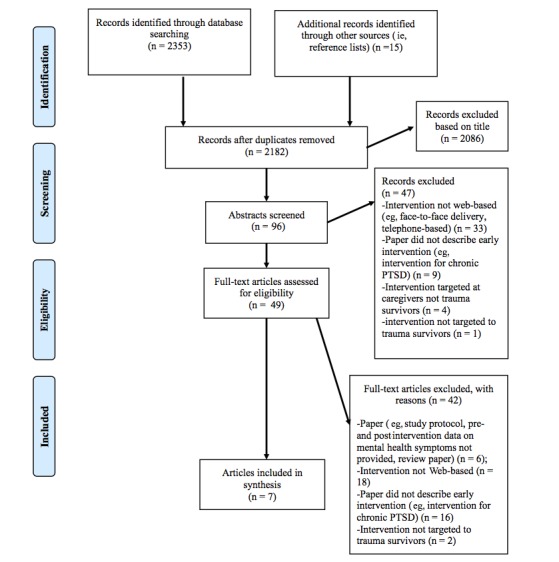
A literature search was conducted in PsycINFO and PubMed for papers published between 1991 and 2017. Papers were included if the following criteria were met: (1) an internet-based intervention was described and applied to individuals exposed to a traumatic event; (2) the authors stated that the intervention was intended to be applied early following trauma exposure or as a preventive intervention; and (3) data on mental health symptoms at pre-and postintervention were described (regardless of whether these were primary outcomes). Methodological quality of included studies was assessed using the Downs and Black checklist.
The interventions in the 7 studies identified were categorized as selected (ie, delivered to an entire sample after trauma regardless of psychopathology symptoms) or indicated (ie, delivered to those endorsing some level of posttraumatic distress). Selected interventions did not produce significant symptom improvement compared with treatment-as-usual or no intervention control groups. However, indicated interventions yielded significant improvements over other active control conditions on mental health outcomes.
Consistent with the notion that many experience natural recovery following trauma, results imply that indicated early internet-delivered interventions hold the most promise in future prevention efforts. More studies that use rigorous methods and clearly defined outcomes are needed to evaluate the efficacy of early internet-delivered interventions. Moreover, basic research on risk and resilience factors following trauma exposure is necessary to inform indicated internet-delivered interventions.
超过75%的人经历过创伤性事件,其中相当一部分人会出现心理健康问题,这些问题在他们的一生中可能会持续存在并造成危害。早期干预显示出预防精神病理学创伤的前景;然而,面对面干预成本高昂,而且获得这种护理形式存在许多障碍。
本研究的目的是系统评价针对创伤暴露个体的互联网早期干预研究。
在PsycINFO和PubMed中检索1991年至2017年发表的论文。符合以下标准的论文纳入研究:(1)描述了基于互联网的干预措施并应用于创伤暴露个体;(2)作者表示该干预措施旨在在创伤暴露后早期应用或作为预防性干预措施;(3)描述了干预前后心理健康症状的数据(无论这些是否为主要结局)。使用唐斯和布莱克检查表评估纳入研究的方法学质量。
所确定的7项研究中的干预措施分为选择性干预(即创伤后对整个样本进行干预,无论其精神病理学症状如何)或指导性干预(即对那些认可一定程度创伤后痛苦的人进行干预)。与常规治疗或无干预对照组相比,选择性干预并未显著改善症状。然而,指导性干预在心理健康结局方面比其他积极对照组有显著改善。
与许多人在创伤后自然恢复的观点一致,结果表明,有针对性的早期互联网干预在未来的预防工作中最有前景。需要更多使用严格方法和明确界定结局的研究来评估早期互联网干预的疗效。此外,有必要对创伤暴露后的风险和恢复力因素进行基础研究,以为有针对性的互联网干预提供依据。