QIMR Berghofer Medical Research Institute, Brisbane, Australia.
Department of Epidemiology, Richard M. Fairbanks School of Public Health, Melvin and Bren Simon Cancer Center, Indiana University, Indianapolis, IN, 63110, USA.
Nat Commun. 2018 Nov 14;9(1):4774. doi: 10.1038/s41467-018-06649-5.
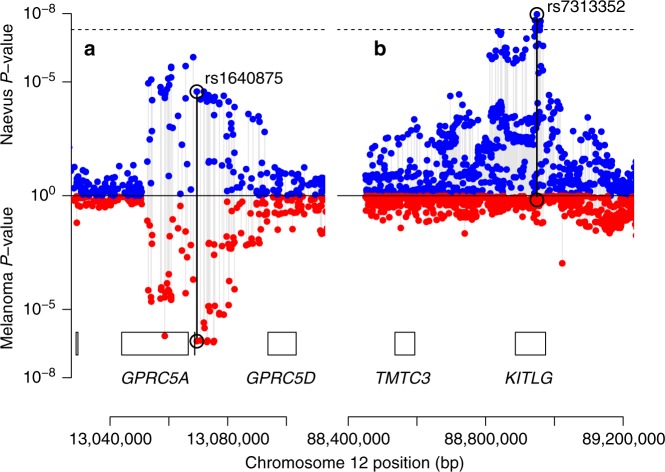
The total number of acquired melanocytic nevi on the skin is strongly correlated with melanoma risk. Here we report a meta-analysis of 11 nevus GWAS from Australia, Netherlands, UK, and USA comprising 52,506 individuals. We confirm known loci including MTAP, PLA2G6, and IRF4, and detect novel SNPs in KITLG and a region of 9q32. In a bivariate analysis combining the nevus results with a recent melanoma GWAS meta-analysis (12,874 cases, 23,203 controls), SNPs near GPRC5A, CYP1B1, PPARGC1B, HDAC4, FAM208B, DOCK8, and SYNE2 reached global significance, and other loci, including MIR146A and OBFC1, reached a suggestive level. Overall, we conclude that most nevus genes affect melanoma risk (KITLG an exception), while many melanoma risk loci do not alter nevus count. For example, variants in TERC and OBFC1 affect both traits, but other telomere length maintenance genes seem to affect melanoma risk only. Our findings implicate multiple pathways in nevogenesis.
皮肤获得性黑素细胞痣的总数与黑色素瘤风险密切相关。在这里,我们报告了来自澳大利亚、荷兰、英国和美国的 11 项痣 GWAS 的荟萃分析,共包括 52506 个人。我们证实了已知的位点,包括 MTAP、PLA2G6 和 IRF4,并在 KITLG 和 9q32 区域检测到新的 SNPs。在结合最近的黑色素瘤 GWAS 荟萃分析(12874 例病例,23203 例对照)的二元分析中,接近 GPRC5A、CYP1B1、PPARGC1B、HDAC4、FAM208B、DOCK8 和 SYNE2 的 SNPs 达到了全球显著性,其他位点,包括 MIR146A 和 OBFC1,达到了提示性水平。总的来说,我们得出的结论是,大多数痣基因会影响黑色素瘤风险(KITLG 是个例外),而许多黑色素瘤风险位点不会改变痣的数量。例如,TERC 和 OBFC1 中的变体同时影响这两种特征,但其他端粒长度维持基因似乎只影响黑色素瘤风险。我们的研究结果表明,多种途径参与了痣的发生。