Martens Géraldine, Deflandre Dorian, Schwartz Cédric, Dardenne Nadia, Bury Thierry
Coma Science Group, GIGA-Research & Neurology Department, University and University Hospital of Liège, Liège, Belgium.
Department of Sport and Rehabilitation Sciences, University of Liège, Liège, Belgium.
J Hum Kinet. 2018 Oct 15;64:57-69. doi: 10.1515/hukin-2017-0184. eCollection 2018 Sep.
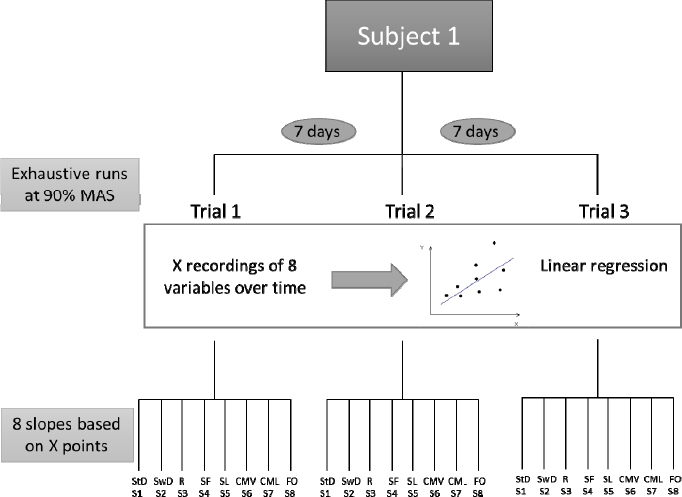
Running biomechanics and its evolution that occurs over intensive trials are widely studied, but few studies have focused on the reproducibility of stride evolution in these runs. The purpose of this investigation was to assess the reproducibility of changes in eight biomechanical variables during exhaustive runs, using three-dimensional analysis. Ten male athletes (age: 23 ± 4 years; maximal oxygen uptake: 57.5 ± 4.4 ml0·min·kg; maximal aerobic speed: 19.3 ± 0.8 km·h) performed a maximal treadmill test. Between 3 to 10 days later, they started a series of three time-to-exhaustion trials at 90% of the individual maximal aerobic speed, seven days apart. During these trials eight biomechanical variables were recorded over a 20-s period every 4 min until exhaustion. The evolution of a variable over a trial was represented as the slope of the linear regression of these variables over time. Reproducibility was assessed with intraclass correlation coefficients and variability was quantified as standard error of measurement. Changes in five variables (swing duration, stride frequency, step length, centre of gravity vertical and lateral amplitude) showed moderate to good reproducibility (0.48 ≤ ICC ≤ 0.72), while changes in stance duration, reactivity and foot orientation showed poor reproducibility (-0.71 ≤ ICC ≤ 0.04). Fatigue-induced changes in stride biomechanics do not follow a reproducible course across the board; however, several variables do show satisfactory stability: swing duration, stride frequency, step length and centre of gravity shift.
跑步生物力学及其在高强度试验过程中的演变已得到广泛研究,但很少有研究关注这些跑步过程中步幅演变的可重复性。本研究的目的是使用三维分析评估力竭性跑步过程中八个生物力学变量变化的可重复性。十名男性运动员(年龄:23±4岁;最大摄氧量:57.5±4.4 ml·min·kg;最大有氧速度:19.3±0.8 km·h)进行了一次最大跑步机测试。在3至10天后,他们开始进行一系列三次力竭时间试验,速度为个人最大有氧速度的90%,每次试验间隔七天。在这些试验中,每4分钟记录20秒内的八个生物力学变量,直至力竭。一次试验中一个变量的演变表示为这些变量随时间的线性回归斜率。使用组内相关系数评估可重复性,并将变异性量化为测量标准误差。五个变量(摆动持续时间、步频、步长、重心垂直和横向幅度)的变化显示出中等至良好的可重复性(0.48≤组内相关系数≤0.72),而站立持续时间、反应性和足部方向的变化显示出较差的可重复性(-0.71≤组内相关系数≤0.04)。疲劳引起的步幅生物力学变化并非完全遵循可重复的过程;然而,几个变量确实显示出令人满意的稳定性:摆动持续时间、步频、步长和重心位移。