Department of Breast Oncology, Sun Yat-sen University Cancer Center, State Key Laboratory of Oncology in South China, Collaborative Innovation Center for Cancer Medicine, Guangzhou, China.
Organ Transplant Center, The First Affiliated Hospital of Sun Yat-sen University, Guangzhou, China.
Cancer Med. 2018 Dec;7(12):6040-6050. doi: 10.1002/cam4.1873. Epub 2018 Nov 14.
Vascular invasion, rather than tumor size, was applied into the 7th edition of the AJCC TNM staging system to predict survival of solitary hepatocellular carcinoma (HCC) patients. However, does this mean tumor size is of little value in prognostic prediction? The current study was designed to explore the prognostic ability of tumor sizes in solitary HCC.
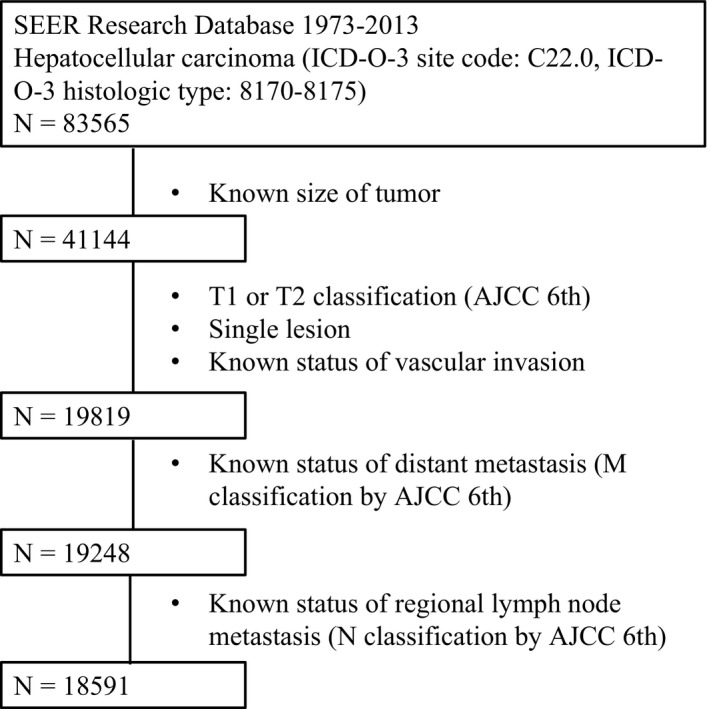
A total of 18 591 patients with solitary HCC categorized as T1 and T2 were retrieved from the Surveillance Epidemiology and End Results (SEER) database. The Cox proportional hazards regression model was adopted to evaluate the impact of tumor sizes on overall survival (OS) and disease-specific survival (DSS) in general and in subgroups stratified by vascular invasion and surgery type.
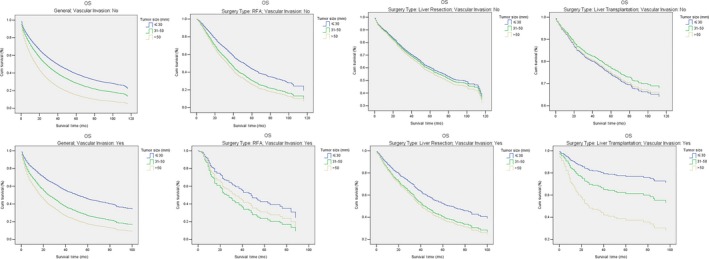
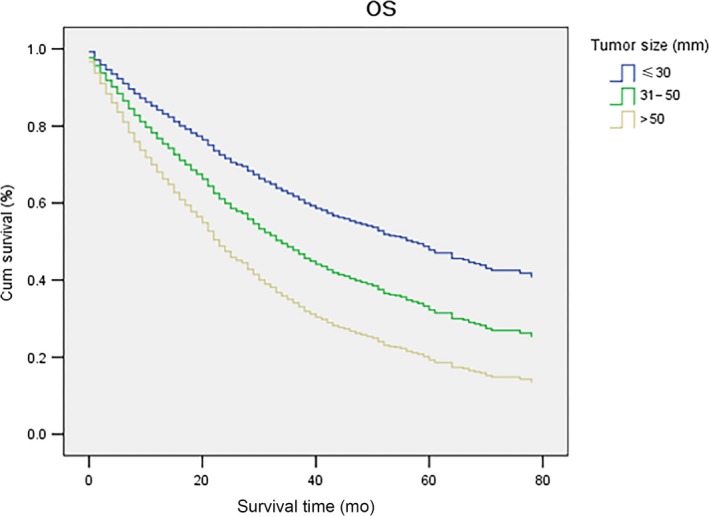
Large tumor sizes (>39 mm) were associated with unfavorable clinicopathologic characteristics. Compared with tumors ≤30 mm, tumors between 31-50 mm and tumors >50 mm showed significantly worse OS and DSS in general using multivariate analysis (all P < 0.001). In subgroup analyses, for patients without vascular invasion, tumor size was a notable prognostic indicator for OS in the radiofrequency ablation group (P < 0.001), rather than in the liver resection or transplantation group. Nevertheless, for patients with vascular invasion, tumor sizes exhibited a notable impact on OS in the liver resection and transplantation group.
The AJCC TNM staging system for solitary HCC would be more comprehensive if tumor sizes were integrated into the T2 classification. Additionally, for T1 patients, tumor sizes play no role in the choice between resection and transplantation.
血管侵犯而非肿瘤大小已被纳入第 7 版 AJCC TNM 分期系统,用于预测单发肝细胞癌(HCC)患者的生存情况。然而,这是否意味着肿瘤大小在预后预测中意义不大?本研究旨在探讨肿瘤大小在单发 HCC 中的预后能力。
从 SEER 数据库中检索了 18591 例 T1 和 T2 期单发 HCC 患者。采用 Cox 比例风险回归模型评估肿瘤大小对总体生存(OS)和疾病特异性生存(DSS)的影响,包括一般情况以及血管侵犯和手术类型分层后的亚组情况。
大肿瘤尺寸(>39mm)与不利的临床病理特征相关。与肿瘤≤30mm 相比,肿瘤尺寸在 31-50mm 和>50mm 之间的患者,经多变量分析显示 OS 和 DSS 均显著更差(均 P<0.001)。亚组分析显示,对于无血管侵犯的患者,肿瘤大小是射频消融组 OS 的显著预后指标(P<0.001),而不是肝切除术或肝移植组。然而,对于有血管侵犯的患者,肿瘤大小对肝切除术和肝移植组的 OS 有显著影响。
如果将肿瘤大小纳入 T2 分类,AJCC 单独 HCC 分期系统将更加全面。此外,对于 T1 期患者,肿瘤大小在选择肝切除或肝移植时没有作用。