Center for Theragnosis, Korea Institute of Science and Technology, 5 Hwarangro-14-gil, Seongbuk-gu, Seoul, 02792, Republic of Korea.
Division of Bio-Medical Science & Technology, KIST School, Korea University of Science and Technology, 5 Hwarangro-14-gil, Seongbuk-gu, Seoul, 02792, Republic of Korea.
Sci Rep. 2018 Nov 15;8(1):16892. doi: 10.1038/s41598-018-34858-x.
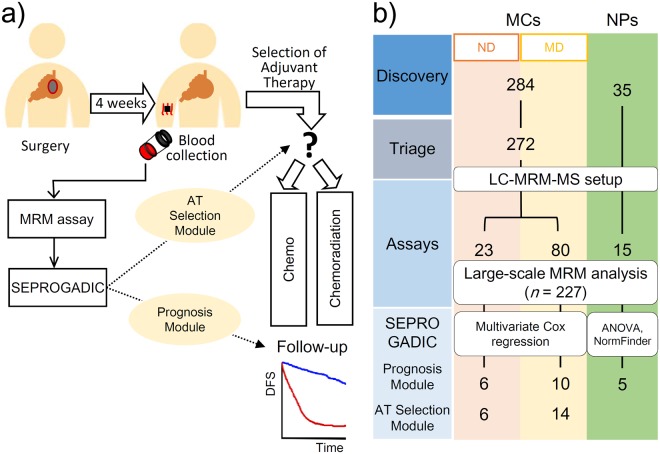
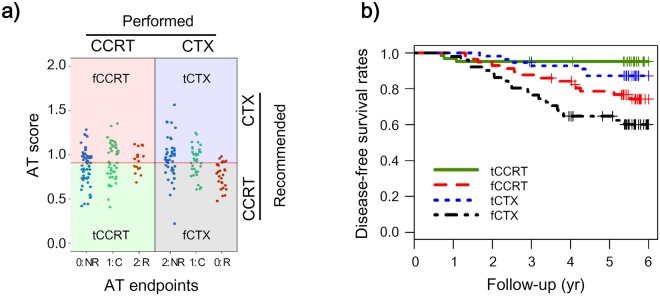
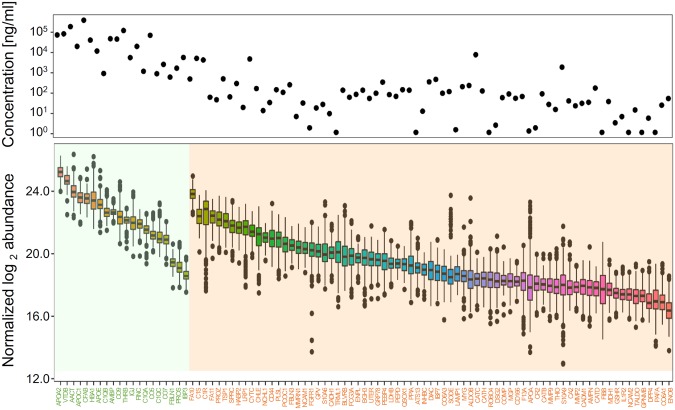
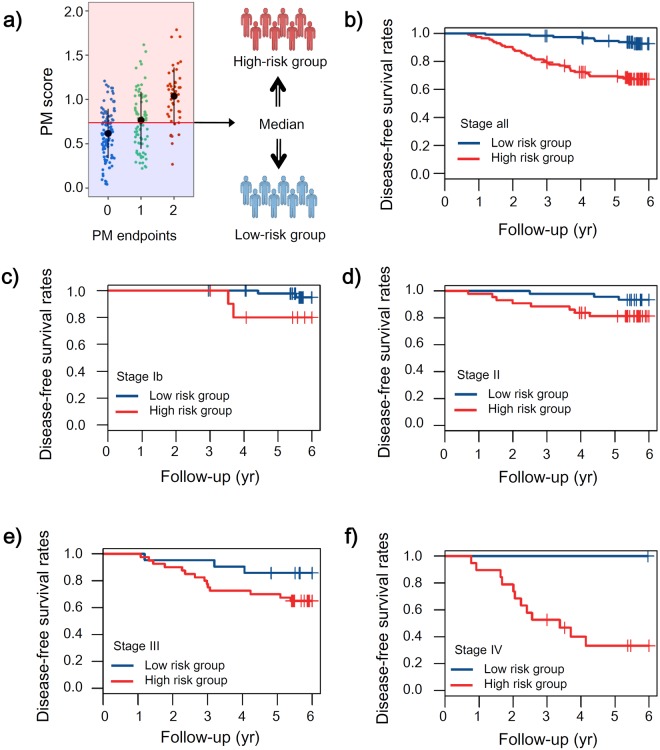
Gastric cancer (GC) patients usually receive surgical treatment. Postoperative therapeutic options such as anticancer adjuvant therapies (AT) based on prognostic prediction models would provide patient-specific treatment to decrease postsurgical morbidity and mortality rates. Relevant prognostic factors in resected GC patient's serum may improve therapeutic measures in a non-invasive manner. In order to develop a GC prognostic model, we designed a retrospective study. In this study, serum samples were collected from 227 patients at a 4-week recovery period after D2 lymph node dissection, and 103 cancer-related serum proteins were analyzed by multiple reaction monitoring mass spectrometry. Using the quantitative values of the serum proteins, we developed SEPROGADIC (SErum PROtein-based GAstric cancer preDICtor) prognostic model consisting of 6 to 14 serum proteins depending on detailed purposes of the model, prognosis prediction and proper AT selection. SEPROGADIC could clearly classify patients with good or bad prognosis at each TNM stage (1b, 2, 3 and 4) and identify a patient subgroup who would benefit from CCRT (combined chemoradiation therapy) rather than CTX (chemotherapy), or vice versa. Our study demonstrated that serum proteins could serve as prognostic factors along with clinical stage information in patients with resected gastric cancer, thus allowing patient-tailored postsurgical treatment.
胃癌(GC)患者通常接受手术治疗。基于预后预测模型的抗癌辅助治疗(AT)等术后治疗选择将为患者提供特定的治疗方案,以降低术后发病率和死亡率。在接受 D2 淋巴结清扫术的 GC 患者的血清中,相关的预后因素可以非侵入性地改善治疗措施。为了开发 GC 预后模型,我们设计了一项回顾性研究。在这项研究中,在接受 D2 淋巴结清扫术 4 周恢复期时,从 227 名患者中收集血清样本,并通过多重反应监测质谱法分析了 103 种癌症相关的血清蛋白。我们使用血清蛋白的定量值,根据模型的详细目的、预后预测和适当的 AT 选择,开发了由 6 到 14 种血清蛋白组成的 SEPROGADIC(基于血清蛋白的胃癌预测模型)预后模型。SEPROGADIC 可以根据 TNM 分期(1b、2、3 和 4)清楚地对预后良好或不良的患者进行分类,并确定适合 CCRT(联合放化疗)治疗而不是 CTX(化疗)或反之的患者亚组。我们的研究表明,血清蛋白可以作为接受胃癌根治术患者的预后因素,与临床分期信息一起,为患者提供个体化的术后治疗。