Kim Kwanhyeong, Lee Juyeon, Moon Hyunji, Lee Sang-Ah, Kim Deokhwan, Yang Susumin, Lee Dae-Hee, Lee Gwangrog, Park Daeho
School of Life Sciences and Aging Research Institute, Gwangju Institute of Science and Technology, Gwangju 61005, Korea.
Research Center for Cellular Homeostasis, Ewha Womans University, Seoul 03760, Korea.
Cells. 2018 Nov 15;7(11):211. doi: 10.3390/cells7110211.
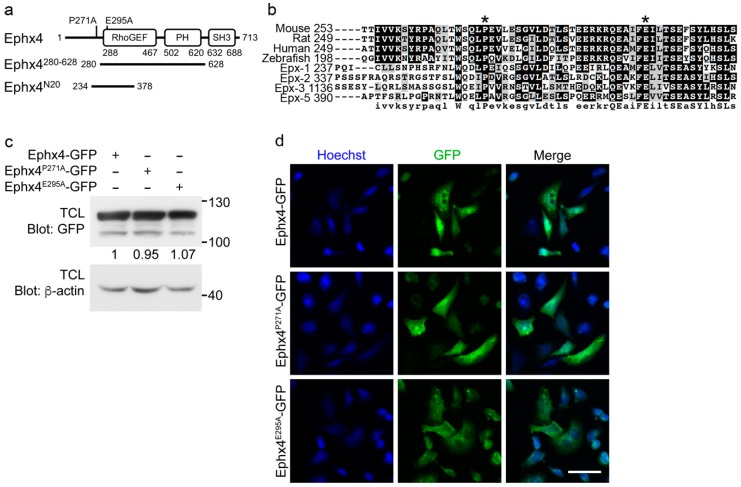
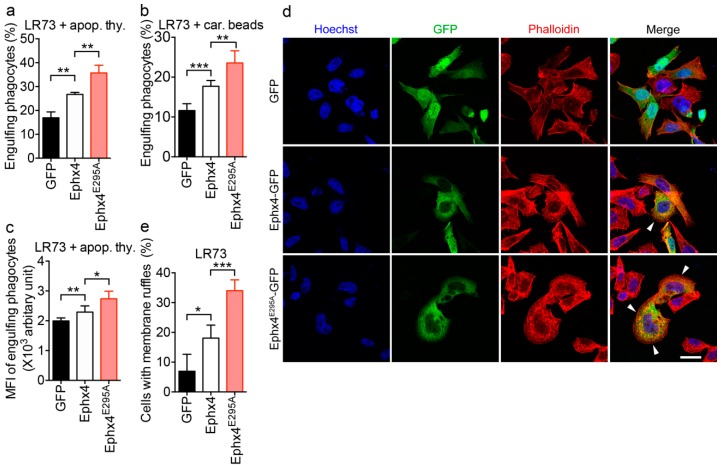
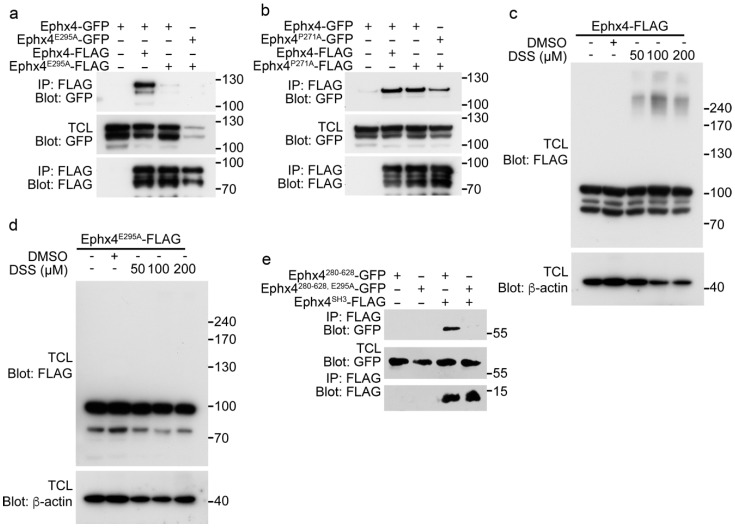
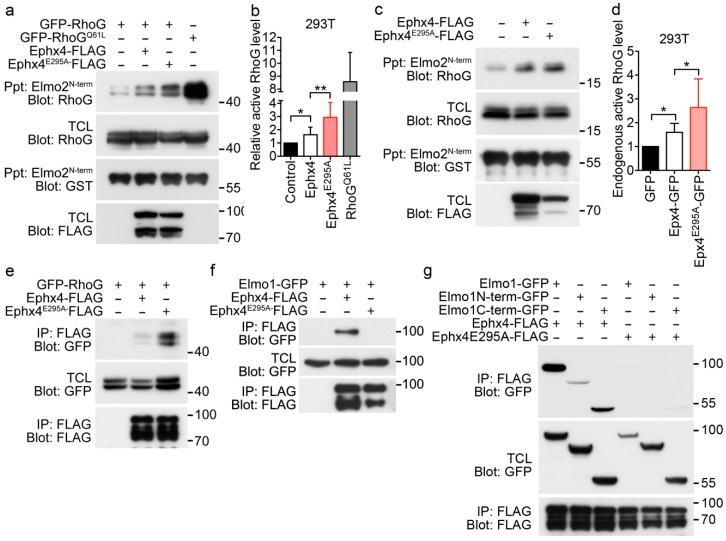
Ephexin4 is a guanine nucleotide-exchange factor (GEF) for RhoG and is involved in various RhoG-related cellular processes such as phagocytosis of apoptotic cells and migration of cancer cells. Ephexin4 forms an oligomer via an intermolecular interaction, and its GEF activity is increased in the presence of Elmo, an Ephexin4-interacting protein. However, it is uncertain if and how Ephexin4 is autoinhibited. Here, using an Ephexin4 mutant that abrogated the intermolecular interaction, we report that this interaction impeded binding of RhoG to Ephexin4 and thus inhibited RhoG activation. Mutation of the glutamate residue at position 295, which is a highly conserved residue located in the region of Ephexin4 required for the intermolecular interaction, to alanine (Ephexin4) disrupted the intermolecular interaction and increased binding of RhoG, resulting in augmented RhoG activation. In addition, phagocytosis of apoptotic cells and formation of membrane ruffles were increased more by expression of Ephexin4 than by expression of wild-type Ephexin4. Taken together, our data suggest that Ephexin4 is autoinhibited through its intermolecular interaction, which impedes binding of RhoG.
Ephexin4是RhoG的鸟嘌呤核苷酸交换因子(GEF),参与多种与RhoG相关的细胞过程,如凋亡细胞的吞噬作用和癌细胞的迁移。Ephexin4通过分子间相互作用形成寡聚体,并且在与Ephexin4相互作用的蛋白Elmo存在时其GEF活性增强。然而,Ephexin4是否以及如何被自身抑制尚不确定。在此,我们使用一种消除了分子间相互作用的Ephexin4突变体,报告这种相互作用阻碍了RhoG与Ephexin4的结合,从而抑制了RhoG的激活。位于Ephexin4分子间相互作用所需区域的高度保守的第295位谷氨酸残基突变为丙氨酸(Ephexin4)破坏了分子间相互作用并增加了RhoG的结合,导致RhoG激活增强。此外,与野生型Ephexin4的表达相比,Ephexin4的表达对凋亡细胞的吞噬作用和膜皱褶的形成有更大的促进作用。综上所述,我们的数据表明Ephexin4通过其分子间相互作用被自身抑制,这种相互作用阻碍了RhoG的结合。