Department of Pathology, University of Washington, Seattle, Washington.
Department of Biostatistics, University of Washington, Seattle, Washington.
Mol Cancer Res. 2019 Feb;17(2):488-498. doi: 10.1158/1541-7786.MCR-18-0520. Epub 2018 Nov 16.
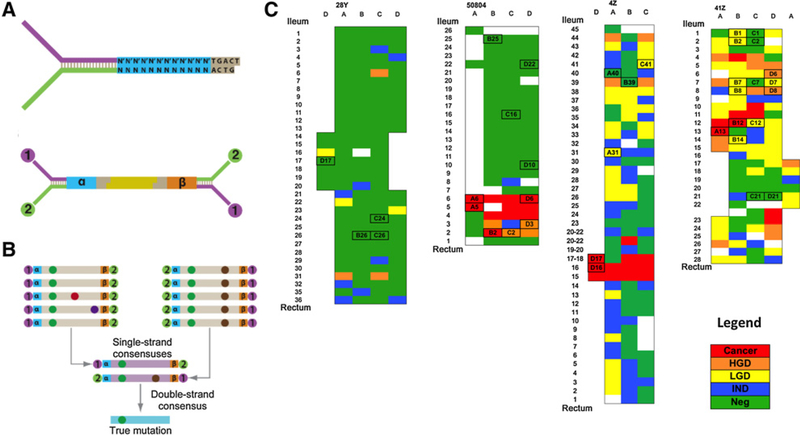
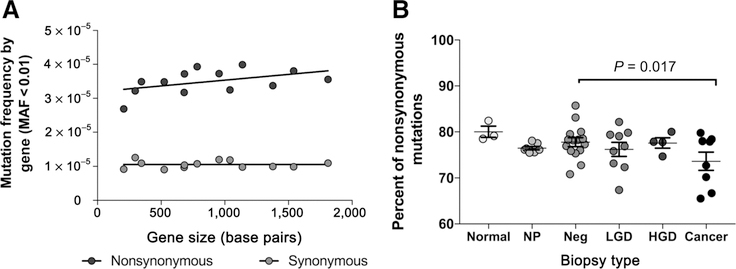
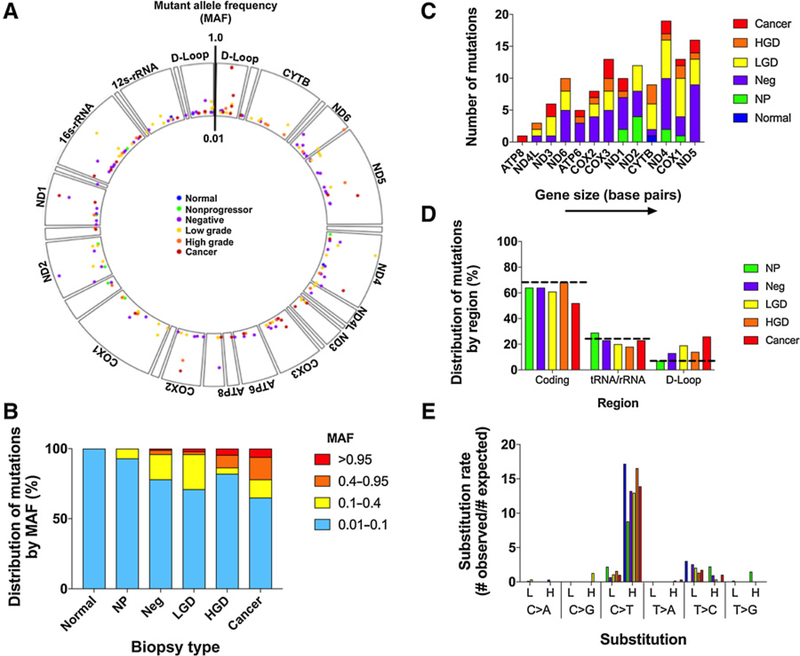
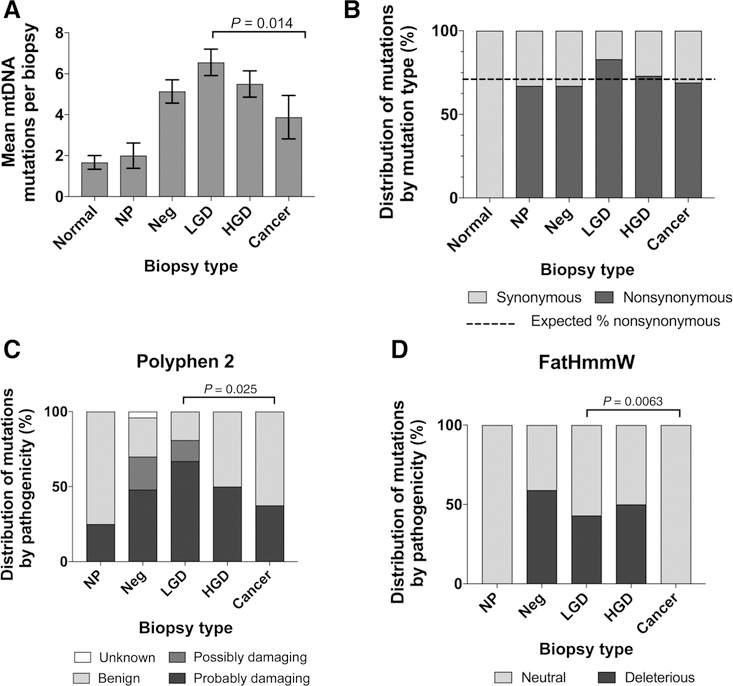
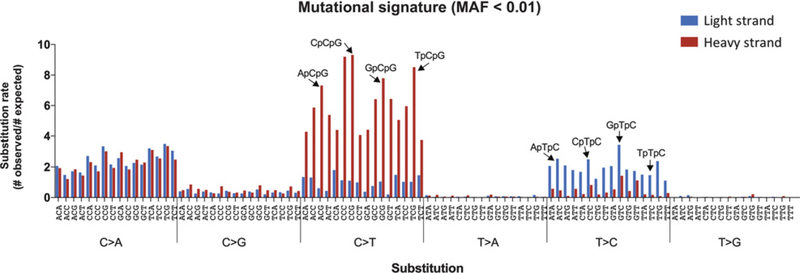
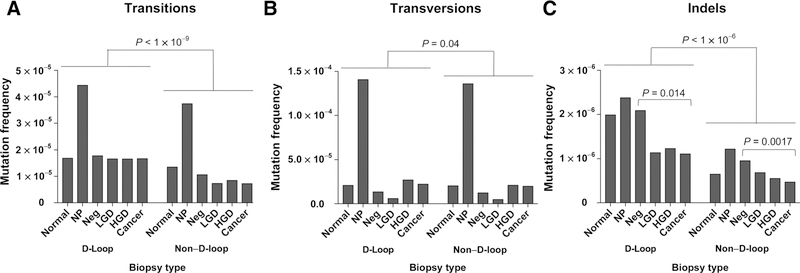
The role of mitochondrial DNA (mtDNA) mutations in cancer remains controversial. Ulcerative colitis is an inflammatory bowel disease that increases the risk of colorectal cancer and involves mitochondrial dysfunction, making it an ideal model to study the role of mtDNA in tumorigenesis. Our goal was to comprehensively characterize mtDNA mutations in ulcerative colitis tumorigenesis using Duplex Sequencing, an ultra-accurate next-generation sequencing method. We analyzed 46 colon biopsies from non-ulcerative colitis control patients and ulcerative colitis patients with and without cancer, including biopsies at all stages of dysplastic progression. mtDNA was sequenced at a median depth of 1,364x. Mutations were classified by mutant allele frequency: clonal > 0.95, subclonal 0.01-0.95, and very low frequency (VLF) < 0.01. We identified 208 clonal and subclonal mutations and 56,764 VLF mutations. Mutations were randomly distributed across the mitochondrial genome. Clonal and subclonal mutations increased in number and pathogenicity in early dysplasia, but decreased in number and pathogenicity in cancer. Most clonal, subclonal, and VLF mutations were C>T transitions in the heavy strand of mtDNA, which likely arise from DNA replication errors. A subset of VLF mutations were C>A transversions, which are probably due to oxidative damage. VLF transitions and indels were less abundant in the non-D-loop region and decreased with progression. Our results indicate that mtDNA mutations are frequent in ulcerative colitis preneoplasia but negatively selected in cancers. IMPLICATIONS: While mtDNA mutations might contribute to early ulcerative colitis tumorigenesis, they appear to be selected against in cancer, suggesting that functional mitochondria might be required for malignant transformation in ulcerative colitis.
线粒体 DNA(mtDNA)突变在癌症中的作用仍存在争议。溃疡性结肠炎是一种炎症性肠病,会增加结直肠癌的风险,并涉及线粒体功能障碍,使其成为研究 mtDNA 在肿瘤发生中的作用的理想模型。我们的目标是使用 Duplex Sequencing(一种超精确的下一代测序方法)全面描述溃疡性结肠炎肿瘤发生中的 mtDNA 突变。我们分析了 46 例非溃疡性结肠炎对照患者和溃疡性结肠炎伴或不伴癌症患者的结肠活检样本,包括处于所有异型增生进展阶段的活检样本。mtDNA 的测序中位数深度为 1364x。突变按突变等位基因频率分类:克隆>0.95,亚克隆 0.01-0.95,非常低频(VLF)<0.01。我们鉴定了 208 个克隆和亚克隆突变和 56764 个 VLF 突变。突变随机分布在整个线粒体基因组中。在早期异型增生中,克隆和亚克隆突变的数量和致病性增加,但在癌症中减少。大多数克隆、亚克隆和 VLF 突变是 mtDNA 重链上的 C>T 转换,可能源于 DNA 复制错误。一部分 VLF 突变是 C>A 颠换,可能是由于氧化损伤所致。VLF 转换和插入缺失在非 D-环区较少,且随着进展而减少。我们的结果表明,mtDNA 突变在溃疡性结肠炎前期病变中频繁发生,但在癌症中被负选择。意义:虽然 mtDNA 突变可能有助于早期溃疡性结肠炎的肿瘤发生,但它们在癌症中似乎被选择排除,这表明在溃疡性结肠炎中,功能线粒体可能是恶性转化所必需的。