Piubeli Francine Amaral, Dos Santos Ligia Gibbi, Fernández Emilia Naranjo, DA Silva Flávio Henrique, Durrant Lucia Regina, Grossman Matthew James
Department of Microbiology and Parasitology, Faculty of Pharmacy, University of Seville, Seville, Spain.
Department of Food Science - FEA, University of Campinas (UNICAMP), Campinas, São Paulo, Brazil.
Pol J Microbiol. 2018;67(3):365-375. doi: 10.21307/pjm-2018-046.
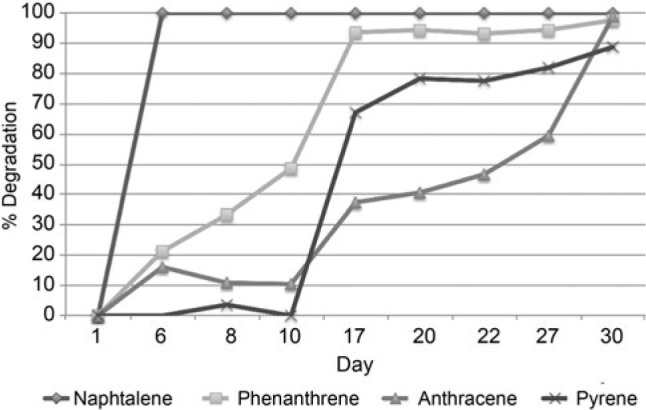
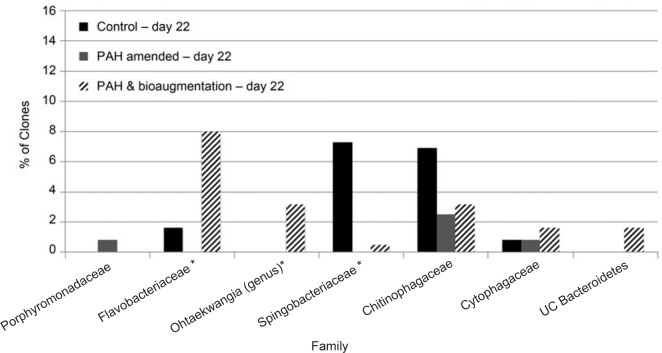
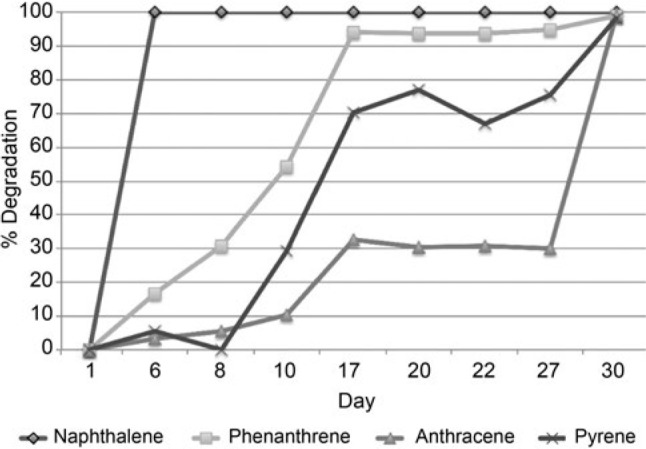
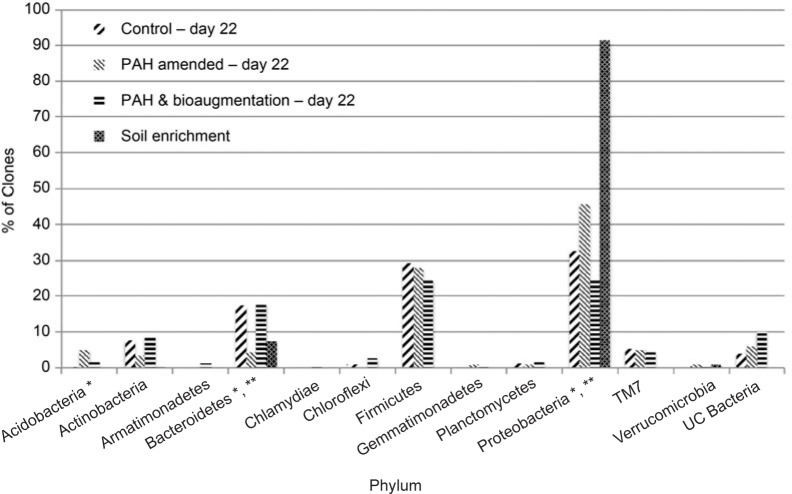
Polycyclic aromatic hydrocarbon (PAHs) are common soil contaminants of concern due to their toxicity toward plants, animals and microorganisms. The use of indigenous or added microbes (bioaugmentation) is commonly used for bioremediation of PAHs. In this work, the biodegradation rates and changes in the bacterial community structure were evaluated. The enrichment culture was useful for unambiguously identifying members of the soil bacterial community associated with PAH degradation and yielded a low diversity community. No significant difference in the rate of PAH degradation was observed between the microcosm receiving only PAHs or PAHs and bioaugmentation. Moreover, identical matches to the bioaugmentation inoculum were only observed at the initial stages of PAH degradation on day 8. After 22 days of incubation, the substantial degradation of all PAHs had occurred in both microcosms and the PAH contaminated soil had statistically significant increases in Alphaproteobacteria. There were also increases in Betaproteobacteria. In contrast, the PAH contaminated and bioaugmented soil was not enriched in PAH degrading Proteobacteria genera and, instead, an increase from 1.6% to 8% of the population occurred in the phylum Bacteroidetes class Flavobacteria, with Flavobacterium being the only identified genus. In addition, the newly discovered genus Ohtaekwangia increased from 0% to 3.2% of the total clones. These results indicate that the same soil microbial community can give rise to different PAH degrading consortia that are equally effective in PAH degradation efficiency. Moreover, these results suggest that the lack of efficacy of bioaugmentation in soils can be attributed to a lack of persistence of the introduced microbes, yet nonetheless may alter the microbial community that arises in response to PAH contamination in unexpected ways.
多环芳烃(PAHs)是常见的土壤污染物,因其对植物、动物和微生物具有毒性而备受关注。利用本土或添加的微生物(生物强化)常用于多环芳烃的生物修复。在本研究中,评估了生物降解速率和细菌群落结构的变化。富集培养有助于明确鉴定与多环芳烃降解相关的土壤细菌群落成员,并产生了一个低多样性群落。在仅接受多环芳烃或多环芳烃与生物强化的微观世界之间,未观察到多环芳烃降解速率的显著差异。此外,仅在第8天多环芳烃降解的初始阶段观察到与生物强化接种物的完全匹配。培养22天后,两个微观世界中的所有多环芳烃都发生了大量降解,且多环芳烃污染土壤中的α-变形菌门有统计学上的显著增加。β-变形菌门也有所增加。相比之下,多环芳烃污染并经过生物强化的土壤中,降解多环芳烃的变形菌属并未富集,相反,拟杆菌门黄杆菌纲的种群从1.6%增加到了8%,其中黄杆菌属是唯一鉴定出的属。此外,新发现的大光杆菌属从总克隆数的0%增加到了3.2%。这些结果表明,相同的土壤微生物群落可以产生不同的多环芳烃降解菌群,它们在多环芳烃降解效率方面同样有效。此外这些结果表明,生物强化在土壤中缺乏效果可能归因于引入微生物的持久性不足,但尽管如此,仍可能以意想不到的方式改变因多环芳烃污染而产生的微生物群落。