Department of Cognitive Psychology, Universidad de La Laguna, Tenerife, Spain.
Instituto Universitario de Neurociencia (IUNE), Universidad de La Laguna, Tenerife, Spain.
Sci Rep. 2018 Nov 19;8(1):17039. doi: 10.1038/s41598-018-35259-w.
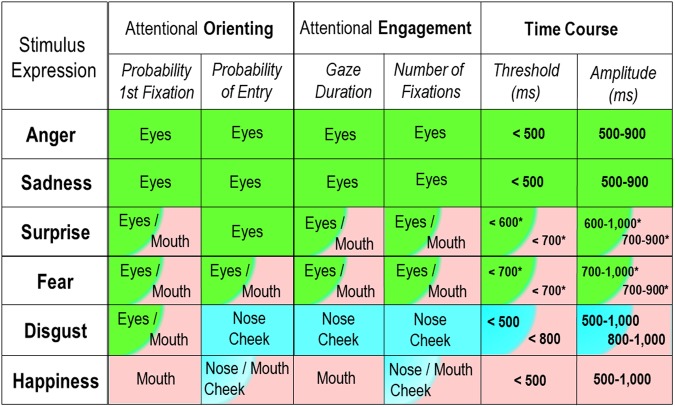
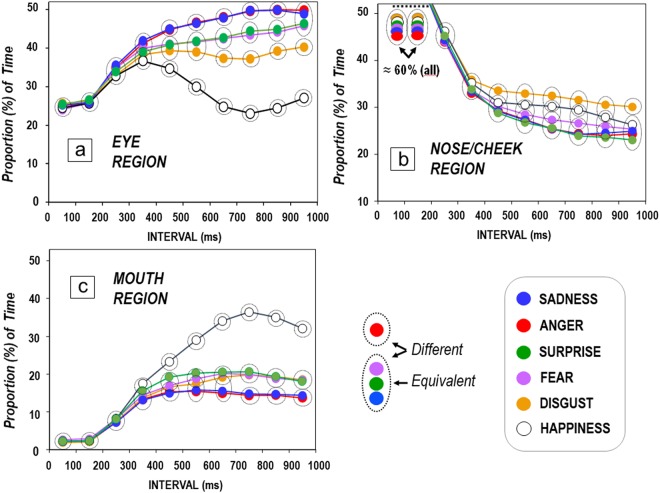
Prior research using static facial stimuli (photographs) has identified diagnostic face regions (i.e., functional for recognition) of emotional expressions. In the current study, we aimed to determine attentional orienting, engagement, and time course of fixation on diagnostic regions. To this end, we assessed the eye movements of observers inspecting dynamic expressions that changed from a neutral to an emotional face. A new stimulus set (KDEF-dyn) was developed, which comprises 240 video-clips of 40 human models portraying six basic emotions (happy, sad, angry, fearful, disgusted, and surprised). For validation purposes, 72 observers categorized the expressions while gaze behavior was measured (probability of first fixation, entry time, gaze duration, and number of fixations). Specific visual scanpath profiles characterized each emotional expression: The eye region was looked at earlier and longer for angry and sad faces; the mouth region, for happy faces; and the nose/cheek region, for disgusted faces; the eye and the mouth regions attracted attention in a more balanced manner for surprise and fear. These profiles reflected enhanced selective attention to expression-specific diagnostic face regions. The KDEF-dyn stimuli and the validation data will be available to the scientific community as a useful tool for research on emotional facial expression processing.
先前使用静态面部刺激(照片)的研究已经确定了情绪表达的诊断性面部区域(即识别功能)。在当前的研究中,我们旨在确定对诊断区域的注意定向、参与和注视时间进程。为此,我们评估了观察者检查从中性到情绪面部变化的动态表情时的眼球运动。开发了一个新的刺激集(KDEF-dyn),它包含 240 个视频剪辑,由 40 个人类模型表现出六种基本情绪(快乐、悲伤、愤怒、恐惧、厌恶和惊讶)。为了验证目的,72 名观察者对表情进行了分类,同时测量了注视行为(首次注视的概率、进入时间、注视持续时间和注视次数)。特定的视觉扫描路径特征描述了每种情绪表达:愤怒和悲伤的面孔先看眼睛区域,且时间更长;快乐的面孔先看嘴巴区域;厌恶的面孔先看鼻子/脸颊区域;惊讶和恐惧的面孔眼睛和嘴巴区域以更平衡的方式吸引注意力。这些特征反映了对表情特异性诊断性面部区域的选择性注意力增强。KDEF-dyn 刺激和验证数据将作为研究情绪面部表情处理的有用工具提供给科学界。