Department of Applied Physiology and Kinesiology, University of Florida, Gainesville, FL, USA.
Department of Applied Physiology and Kinesiology, University of Florida, Gainesville, FL, USA; Department of Physical Education, University of Estadual of Londrina, Londrina, Brazil.
Arch Biochem Biophys. 2019 Feb 15;662:49-60. doi: 10.1016/j.abb.2018.11.005. Epub 2018 Nov 16.
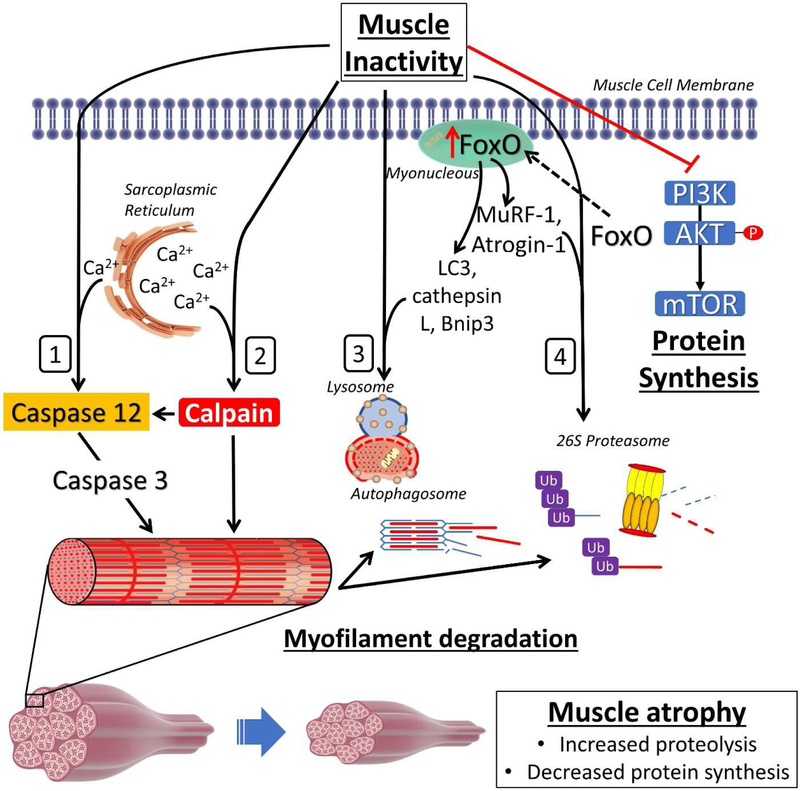
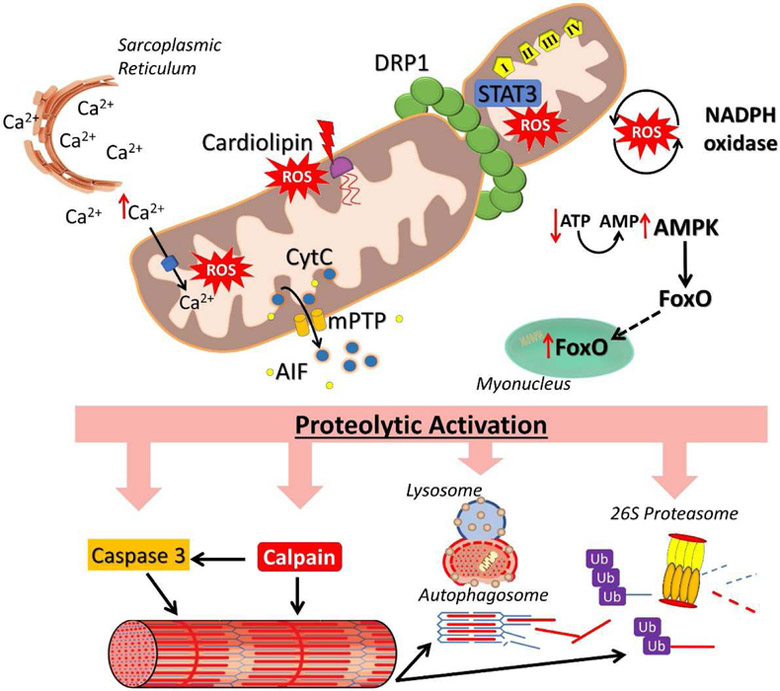
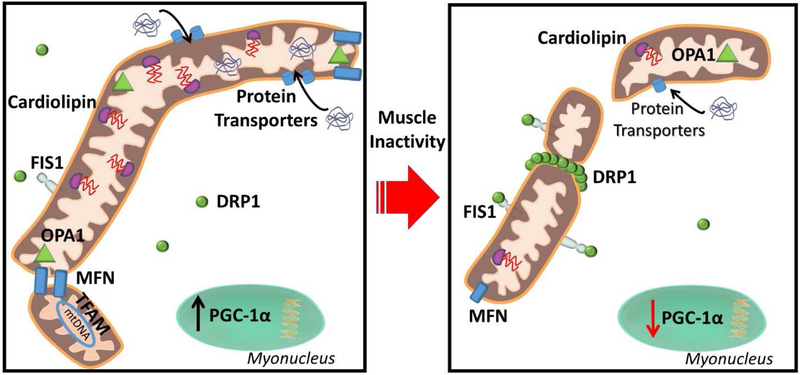
Prolonged skeletal muscle inactivity (e.g. limb immobilization, bed rest, mechanical ventilation, spinal cord injury, etc.) results in muscle atrophy that manifests into a decreased quality of life and in select patient populations, a higher risk of morbidity and mortality. Thus, understanding the processes that contribute to muscle atrophy during prolonged periods of muscle disuse is an important area of research. In this regard, mitochondrial dysfunction has been directly linked to the muscle wasting that occurs during extended periods of skeletal muscle inactivity. While the concept that mitochondrial dysfunction contributes to disuse muscle atrophy has been contemplated for nearly 50 years, the mechanisms connecting mitochondrial signaling events to skeletal muscle atrophy remained largely unexplained until recently. Indeed, emerging evidence reveals that mitochondrial dysfunction and the associated mitochondrial signaling events are a requirement for several forms of inactivity-induced skeletal muscle atrophy. Specifically, inactivity-induced alterations in skeletal muscle mitochondria phenotype and increased ROS emission, impaired Ca handling, and release of mitochondria-specific proteolytic activators are established occurrences that promote fiber atrophy during prolonged periods of muscle inactivity. This review highlights the evidence that directly connects mitochondrial dysfunction and aberrant mitochondrial signaling with skeletal muscle atrophy and discusses the mechanisms linking these interconnected phenomena.
长时间的骨骼肌不活动(例如肢体固定、卧床休息、机械通气、脊髓损伤等)会导致肌肉萎缩,表现为生活质量下降,在某些特定患者群体中,发病率和死亡率更高。因此,了解导致肌肉在长时间废用期间萎缩的过程是一个重要的研究领域。在这方面,线粒体功能障碍与长时间骨骼肌不活动期间发生的肌肉消耗直接相关。虽然线粒体功能障碍导致废用性肌肉萎缩的概念已经被考虑了近 50 年,但将线粒体信号事件与骨骼肌萎缩联系起来的机制在很大程度上仍未得到解释,直到最近。事实上,新出现的证据表明,线粒体功能障碍和相关的线粒体信号事件是几种失用性骨骼肌萎缩的必要条件。具体来说,失用性诱导的骨骼肌线粒体表型改变和活性氧(ROS)释放增加、钙处理受损以及线粒体特异性蛋白水解激活物的释放,这些都是在长时间肌肉废用期间促进纤维萎缩的常见事件。本综述强调了将线粒体功能障碍和异常线粒体信号与骨骼肌萎缩直接联系起来的证据,并讨论了将这些相互关联的现象联系起来的机制。