Center for Reproductive Medicine, Department of Obstetrics and Gynecology, Peking University Third Hospital, 49 N Garden Rd, Haidian District, Beijing, 100191, China.
Research Center of Clinical Epidemiology, Peking University Third Hospital, Beijing, China.
Reprod Biol Endocrinol. 2018 Nov 19;16(1):119. doi: 10.1186/s12958-018-0438-7.
There is limited literature investigating the effects of body mass index (BMI) and androgen level on in vitro fertilization (IVF) outcomes with a gonadotropin-releasing hormone (GnRH)-antagonist protocol in polycystic ovary syndrome (PCOS). Androgen-related variation in the effect of body mass index (BMI) on IVF outcomes remains unknown.
In this retrospective study, 583 infertile women with PCOS who underwent IVF using the conventional GnRH-antagonist protocol were included. Patients were divided into four groups according to BMI and androgen level: overweight- hyperandrogenism(HA) group, n = 96, overweight-non-HA group, n = 117, non-overweight-HA group, n = 152, and non-overweight-non-HA group, n = 218.
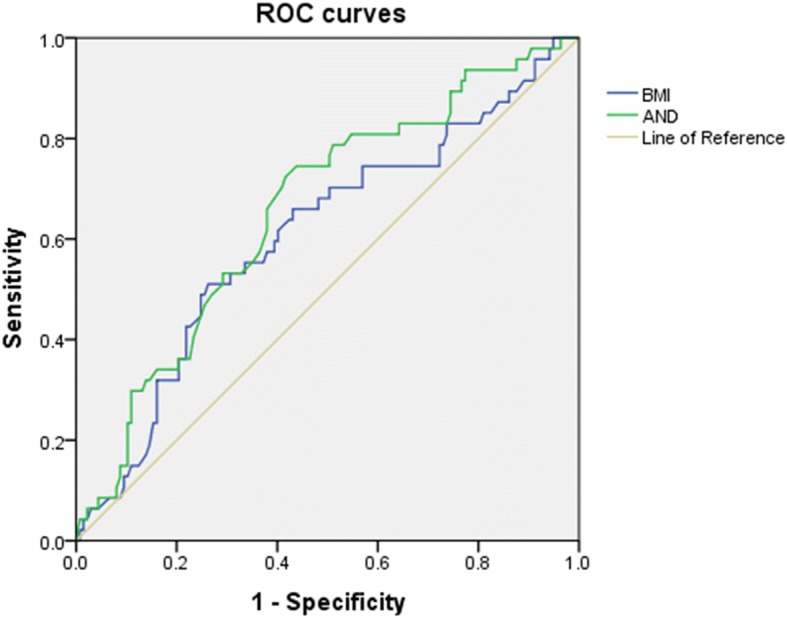
A significantly higher number of oocytes were retrieved, and the total Gn consumption as well Gn consumption per day was significantly lower, in the non-overweight groups than in the overweight groups. The number of available embryos was significantly higher in the HA groups than in the non-HA groups. Clinical pregnancy rate was of no significant difference among four groups. Live-birth rates in the overweight groups were significantly lower than those in non-overweight-non-HA group (23.9, 28.4% vs. 42.5%, P<0.05). The miscarriage rate in overweight-HA group was significantly higher than that in non-overweight-non-HA group (45.2% vs. 14.5%, P<0.05). Multivariate logistic regression analysis revealed that BMI and basal androstenedione (AND) both acted as significantly influent factors on miscarriage rate. The area under the curve (AUC) in receiver operating characteristic (ROC) analysis for BMI and basal AND on miscarriage rate were 0.607 (P = 0.029) and 0.657 (P = 0.001), respectively, and the cut-off values of BMI and basal AND were 25.335 kg/m and 10.95 nmol/L, respectively.
In IVF cycles with GnRH-antagonist protocol, economic benefits were seen in non-overweight patients with PCOS, with less Gn cost and more retrieved oocytes. BMI and basal AND were both significantly influential factors with moderate predictive ability on the miscarriage rate. The predictive value of basal AND on miscarriage was slightly stronger than BMI.
在使用促性腺激素释放激素(GnRH)拮抗剂方案的多囊卵巢综合征(PCOS)患者中,关于体质量指数(BMI)和雄激素水平对体外受精(IVF)结局的影响的文献有限。雄激素相关的 BMI 对 IVF 结局的影响尚不清楚。
本回顾性研究纳入了 583 名接受常规 GnRH 拮抗剂方案 IVF 的 PCOS 不孕妇女。根据 BMI 和雄激素水平将患者分为 4 组:超重-高雄激素血症(HA)组,n=96;超重-非 HA 组,n=117;非超重-HA 组,n=152;非超重-非 HA 组,n=218。
非超重组的获卵数明显多于超重组,Gn 总用量和每日 Gn 用量明显低于超重组。HA 组的可利用胚胎数明显多于非 HA 组。四组间临床妊娠率无显著差异。超重组的活产率明显低于非超重-非 HA 组(23.9%、28.4%比 42.5%,P<0.05)。超重-HA 组的流产率明显高于非超重-非 HA 组(45.2%比 14.5%,P<0.05)。多因素 logistic 回归分析显示,BMI 和基础雄烯二酮(AND)均为流产率的显著影响因素。ROC 分析中 BMI 和基础 AND 对流产率的 AUC 分别为 0.607(P=0.029)和 0.657(P=0.001),BMI 和基础 AND 的截断值分别为 25.335kg/m2 和 10.95nmol/L。
在 GnRH 拮抗剂方案的 IVF 周期中,非超重 PCOS 患者具有经济优势,Gn 成本较低,获卵数较多。BMI 和基础 AND 均为流产率的显著影响因素,具有中等预测能力。基础 AND 对流产的预测价值略强于 BMI。