Wang Keyan, Bu Zhiqin, Ge Xiaofei, Wang Fang, Zhang Menghui, Guo Yihong
Henan Institute of Medical and Pharmaceutical Sciences, Zhengzhou University, Zhengzhou, 450052, China.
Center for Reproductive Medicine, Henan Key Laboratory of Reproduction and Genetics, The First Affiliated Hospital of Zhengzhou University, Zhengzhou, 450052, China.
BMC Pregnancy Childbirth. 2025 Feb 28;25(1):222. doi: 10.1186/s12884-025-07342-4.
The potential effects of hyperandrogenism (HA) on pregnancy outcomes among polycystic ovary syndrome (PCOS) patients are still unknown. The aim of this study was to explore the impact of HA on miscarriage rate after in vitro fertilization/intracytoplasmic sperm injection (IVF/ICSI) treatment in PCOS patients.
Women diagnosed with PCOS who underwent the first autologous IVF/ICSI cycles using gonadotropin-releasing hormone agonist (GnRH-a) protocols for ovarian stimulation during the period from January 2016 to December 2022 were included. Women were divided into the HA and non-HA group according to Hyperandrogenemia (serum testosterone level > 0.48 ng/mL), and/or the presence of hirsutism. Pregnancy outcomes were compared before and after propensity-score matching (PSM). Multiple logistic regression models were performed to demonstrate the independent impact of HA on pregnancy outcomes.
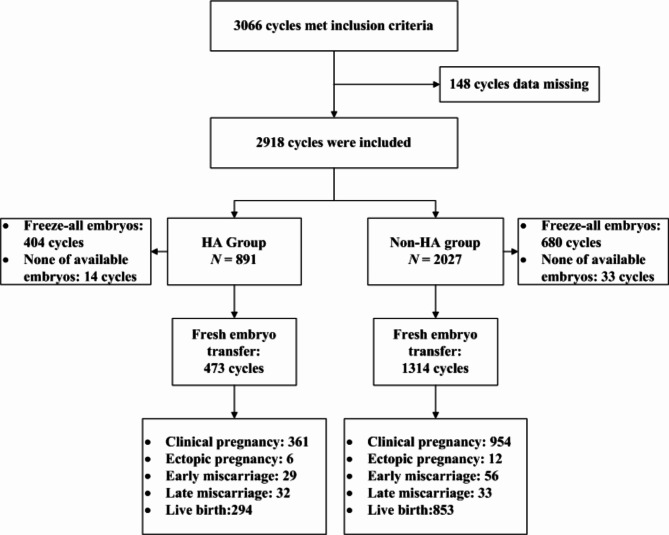
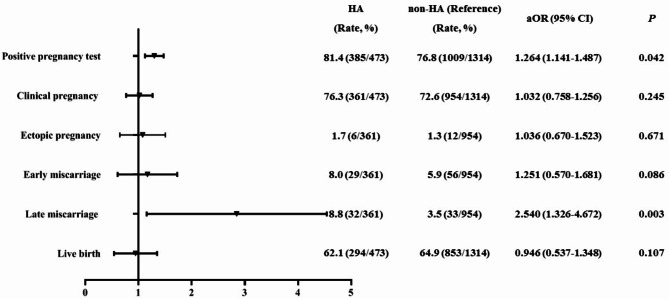
A total of 3066 patients were included. PCOS women with HA experienced a notably higher rates of late spontaneous miscarriage (LSM) as compared to those without HA before and after PSM (8.8% versus 3.5%, P < 0.001; 8.9% versus 3.9%, P = 0.001, respectively), but comparable rates of clinical pregnancy, early spontaneous miscarriage, and live birth. After adjusting for possible confounding factors, the logistic regression confirmed that HA was independently associated with the increased risk of LSM (adjusted OR: 2.540, 95% confidence interval: 1.326-4.672, P = 0.003). For the specific reasons for LSM, cervical insufficiency accounted for a larger proportion in women with HA than their counterparts without HA (15/32 versus 7/33, P = 0.029).
Androgen excess is postulated to play a role in late miscarriage via increased likelihood of cervical insufficiency.
N/A.
高雄激素血症(HA)对多囊卵巢综合征(PCOS)患者妊娠结局的潜在影响尚不清楚。本研究旨在探讨HA对PCOS患者体外受精/卵胞浆内单精子注射(IVF/ICSI)治疗后流产率的影响。
纳入2016年1月至2022年12月期间诊断为PCOS并使用促性腺激素释放激素激动剂(GnRH-a)方案进行卵巢刺激的首次自体IVF/ICSI周期的女性。根据高雄激素血症(血清睾酮水平>0.48 ng/mL)和/或多毛症的存在,将女性分为HA组和非HA组。在倾向得分匹配(PSM)前后比较妊娠结局。进行多因素逻辑回归模型以证明HA对妊娠结局的独立影响。
共纳入3066例患者。PSM前后,患有HA的PCOS女性晚期自然流产(LSM)率明显高于未患HA的女性(分别为8.8%对3.5%,P<0.001;8.9%对3.9%,P=0.001),但临床妊娠、早期自然流产和活产率相当。在调整可能的混杂因素后,逻辑回归证实HA与LSM风险增加独立相关(调整后的OR:2.540,95%置信区间:1.326-4.672,P=0.003)。对于LSM的具体原因,宫颈机能不全在患有HA的女性中所占比例高于未患HA的女性(15/32对7/33,P=0.029)。
推测雄激素过多通过增加宫颈机能不全的可能性在晚期流产中起作用。
无。