Inoue Yoshihiro, Fujii Kensuke, Ishii Masatsugu, Kagota Syuji, Hamamoto Hiroki, Osumi Wataru, Tsuchimoto Yusuke, Masubuchi Shinsuke, Yamamoto Masashi, Asai Akira, Komeda Koji, Fukunishi Shinya, Hirokawa Fumitoshi, Higuchi Kazuhide, Uchiyama Kazuhisa
Osaka Medical College Hospital, Takatsuki, Osaka, Japan.
Contemp Oncol (Pozn). 2018;22(3):184-190. doi: 10.5114/wo.2018.78940. Epub 2018 Sep 30.
Despite recent technical progress and advances in the perioperative management of liver surgery, postoperative surgical site infection (SSI) is still one of the most common complications that extends hospital stays and increases medical expenses following hepatic surgery.
From 2001 to 2017 a total of 1180 patients who underwent hepatic resection for liver tumours were retrospectively analysed with respect to the predictive factor of superficial incisional SSI, using a propensity score matching by procedure (subcuticular or mattress suture).
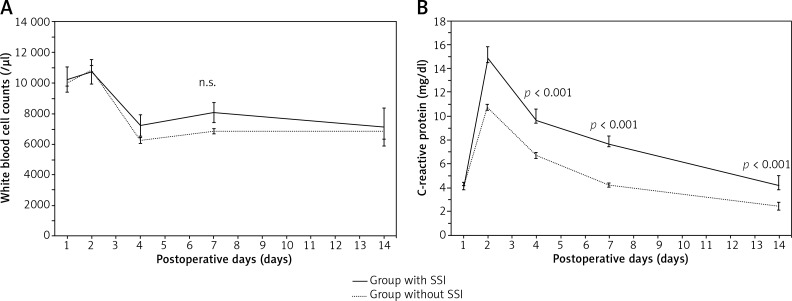
The incidence of superficial and deep incisional SSIs was found to be 7.1% (84/1180). By propensity score matching (PSM), 121 of the 577 subcuticular suture group patients could be matched with 121 of the 603 mattress suture group patients. Multivariate analysis demonstrated wound closure technique as the only independent risk factor that correlated significantly with the occurrence of superficial incisional SSIs ( = 0.038). C-reactive protein (CRP) levels on postoperative day 4 were significantly higher in patients with incisional SSIs than in those without ( < 0.001).
Wound closure technique with subcuticular continuous spiral suture using absorbable suture should be considered to minimise the incidence of incisional SSIs. Moreover, wounds should be carefully checked when CRP levels are high on postoperative day 4.
尽管近期肝脏手术的技术取得了进展,围手术期管理也有所改善,但术后手术部位感染(SSI)仍是肝脏手术后延长住院时间和增加医疗费用的最常见并发症之一。
回顾性分析2001年至2017年期间1180例行肝肿瘤肝切除术患者的表浅切口SSI预测因素,采用手术方式(皮下或褥式缝合)的倾向评分匹配法。
表浅和深部切口SSI的发生率为7.1%(84/1180)。通过倾向评分匹配(PSM),577例皮下缝合组患者中的121例可与603例褥式缝合组患者中的121例匹配。多因素分析表明,伤口闭合技术是与表浅切口SSI发生显著相关的唯一独立危险因素(P = 0.038)。切口SSI患者术后第4天的C反应蛋白(CRP)水平显著高于无切口SSI的患者(P < 0.001)。
应考虑采用可吸收缝线进行皮下连续螺旋缝合的伤口闭合技术,以尽量减少切口SSI的发生率。此外,术后第4天CRP水平升高时,应仔细检查伤口。