Vollrath D, Davis R W, Connelly C, Hieter P
Department of Biochemistry, Stanford University School of Medicine, CA 94305.
Proc Natl Acad Sci U S A. 1988 Aug;85(16):6027-31. doi: 10.1073/pnas.85.16.6027.
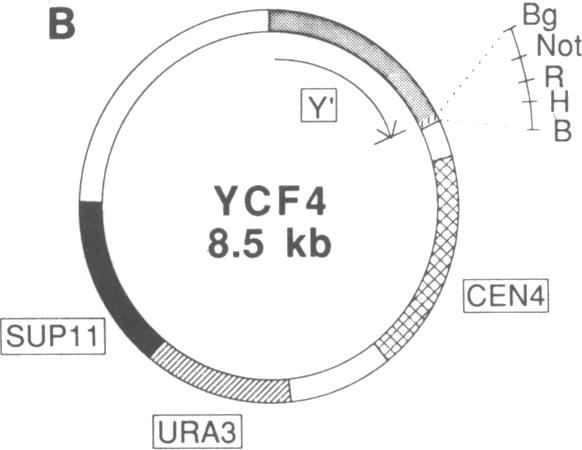
A technique is described for physically positioning any cloned DNA on a native or artificial Saccharomyces cerevisiae chromosome. The technique involves splitting a chromosome at a specific site by transformation with short linear molecules containing the cloned DNA at one end and telomeric sequences at the other. Recombination between the end of the linear molecules and homologous chromosomal sequences gives rise to chromosome fragments comprising all sequences distal or proximal to the mapping site depending on the orientation of the cloned DNA. The recombinant products are recovered by screening for stabilization of a suppressor tRNA on the linear molecules using a colony color assay. The cloned DNA is positioned relative to the chromosome ends by sizing the chromosomal fragments using alternating contour-clamped homogeneous electric field gel electrophoresis. Application of this technique to organisms other than S. cerevisiae and to the analysis of exogenous DNA cloned in yeast is discussed.
本文描述了一种将任何克隆DNA物理定位到天然或人工酿酒酵母染色体上的技术。该技术包括通过用短线性分子转化来在特定位点切割染色体,这些短线性分子一端含有克隆DNA,另一端含有端粒序列。线性分子末端与同源染色体序列之间的重组产生染色体片段,根据克隆DNA的方向,这些片段包含定位位点远端或近端的所有序列。通过使用菌落颜色测定法筛选线性分子上抑制性tRNA的稳定性来回收重组产物。通过使用交变轮廓钳位均匀电场凝胶电泳对染色体片段进行大小测定,将克隆DNA相对于染色体末端进行定位。本文还讨论了该技术在酿酒酵母以外的生物中的应用以及对酵母中克隆的外源DNA的分析。