Siji Annes, Karthik K N, Pardeshi Varsha Chhotusing, Hari P S, Vasudevan Anil
Division of Molecular Medicine, St. John's Research Institute, Bangalore, India.
Department of Pediatric Nephrology, St. John's Medical College Hospital, Bangalore, India.
BMC Med Genet. 2018 Nov 20;19(1):200. doi: 10.1186/s12881-018-0714-6.
Steroid resistant nephrotic syndrome (SRNS) is a genetically heterogeneous disease with significant phenotypic variability. More than 53 podocyte-expressed genes are implicated in SRNS which complicates the routine use of genetic screening in the clinic. Next generation sequencing technology (NGS) allows rapid screening of multiple genes in large number of patients in a cost-effective manner.
We developed a targeted panel of 17 genes to determine relative frequency of mutations in south Indian ethnicity and feasibility of using the assay in a clinical setting. Twenty-five children with SRNS and 3 healthy individuals were screened.
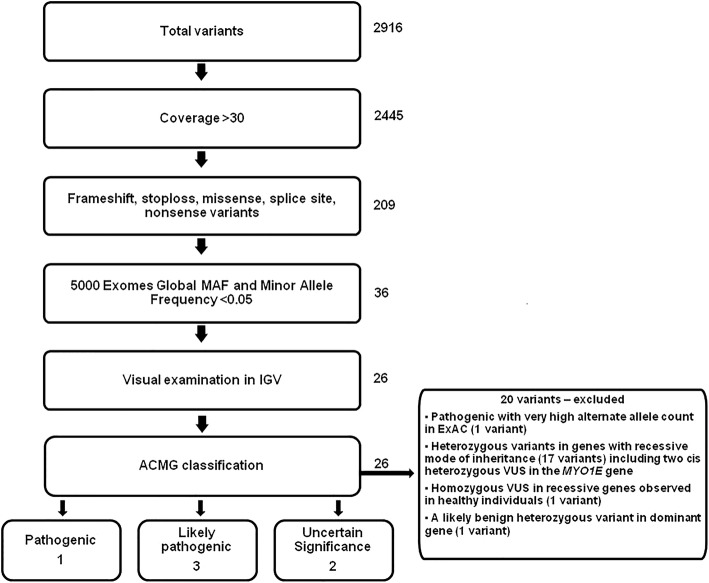
In this study, novel variants including 1 pathogenic variant (2 patients) and 3 likely pathogenic variants (3 patients) were identified. In addition, 2 novel variants of unknown significance (VUS) in 2 patients (8% of total patients) were also identified.
The results show that genetic screening in SRNS using NGS is feasible in a clinical setting. However the panel needs to be screened in a larger cohort of children with SRNS in order to assess the utility of the customised targeted panel in Indian children with SRNS. Determining the prevalence of variants in Indian population and improvising the bioinformatics-based filtering strategy for a more accurate differentiation of pathogenic variants from those that are benign among the VUS will help in improving medical and genetic counselling in SRNS.
类固醇抵抗型肾病综合征(SRNS)是一种具有显著表型变异性的基因异质性疾病。超过53个足细胞表达基因与SRNS相关,这使得临床常规基因筛查变得复杂。新一代测序技术(NGS)能够以经济高效的方式对大量患者的多个基因进行快速筛查。
我们开发了一个包含17个基因的靶向检测板,以确定印度南部人群中突变的相对频率以及该检测方法在临床环境中的可行性。对25名SRNS患儿和3名健康个体进行了筛查。
在本研究中,鉴定出了新的变异,包括1个致病变异(2例患者)和3个可能致病的变异(3例患者)。此外,还在2例患者中鉴定出2个意义未明的新变异(VUS)(占患者总数的8%)。
结果表明,在临床环境中使用NGS对SRNS进行基因筛查是可行的。然而,需要在更大的SRNS患儿队列中对该检测板进行筛查,以评估定制靶向检测板对印度SRNS患儿的实用性。确定印度人群中变异的患病率,并改进基于生物信息学的过滤策略,以便更准确地区分VUS中的致病变异和良性变异,将有助于改善SRNS的医学和遗传咨询。