Murakami Takashi, Akazawa Yoichi, Yatagai Noboru, Hiromoto Takafumi, Sasahara Noriko, Saito Tsuyoshi, Sakamoto Naoto, Nagahara Akihito, Yao Takashi
Department of Gastroenterology, Juntendo University School of Medicine, 2-1-1 Hongo, Bunkyo-ku, Tokyo, 113-8421, Japan.
Department of Human Pathology, Juntendo University School of Medicine, Tokyo, Japan.
Diagn Pathol. 2018 Nov 20;13(1):88. doi: 10.1186/s13000-018-0771-3.
Colorectal sessile serrated adenoma/polyps (SSA/Ps) are considered early precursor lesions in the serrated neoplasia pathway. Recent studies have shown associations of SSA/Ps with lost MLH1 expression, a CpG island methylator phenotype, and BRAF mutations. However, the molecular biological features of SSA/Ps with early neoplastic progression have not yet been fully elucidated, owing to the rarity of cases of SSA/P with advanced histology such as cytologic dysplasia or invasive carcinoma. In this study, we aimed to elucidate the molecular biological features of SSA/Ps with dysplasia/carcinoma, representing relatively early stages of the serrated neoplasia pathway.
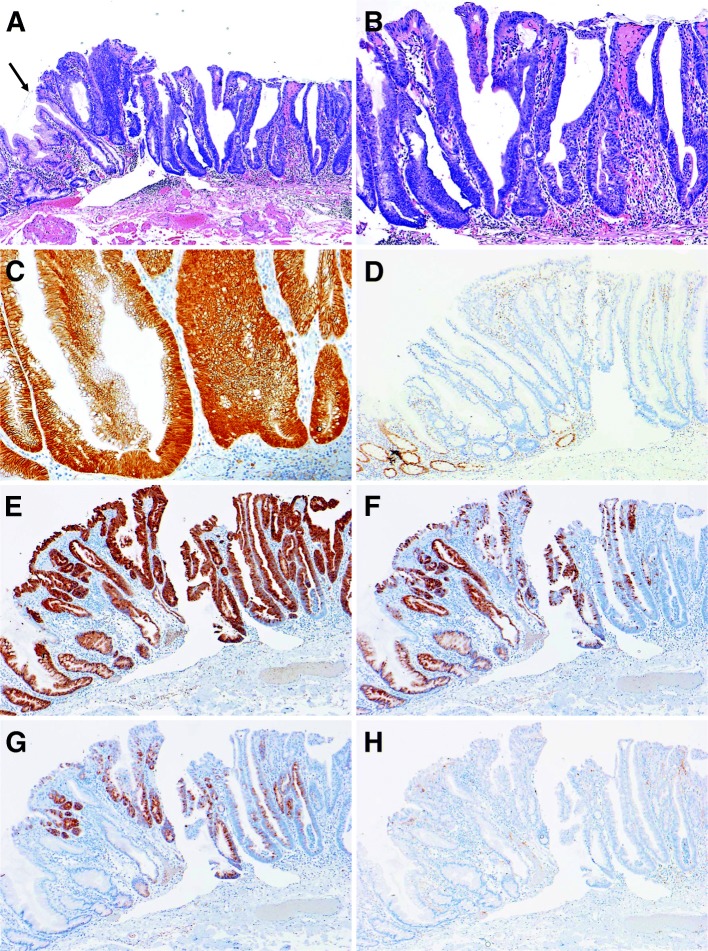
We performed immunostaining for β-catenin, MLH1, and mucins (e.g., MUC2, MUC5AC, MUC6, and CD10); targeted next-generation sequencing; and microsatellite instability (MSI) testing in 8 SSA/P lesions comprised of 4 SSA/Ps with high-grade dysplasia and 4 SSA/Ps with submucosal carcinoma.
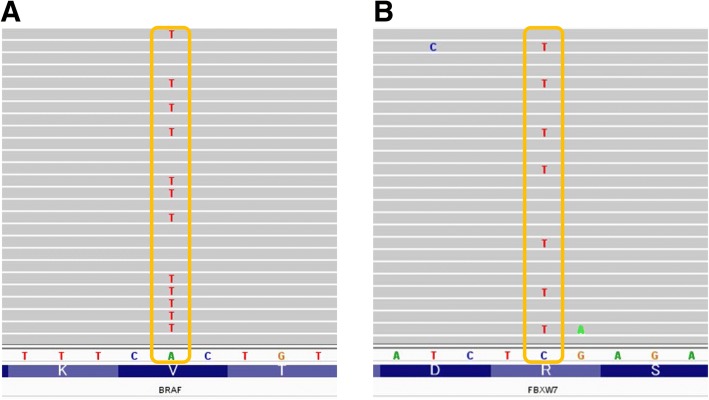
Lost MLH1 expression was found in 5 cases. All lesions studied were positive for nuclear β-catenin expression. Regarding phenotypic mucin expression, all lesions were positive for MUC2, but negative for CD10. MUC5AC and MUC6 positivity was observed in 7 cases. Genetically, the most frequently mutated gene was BRAF (7 cases), and other mutations were detected in FBXW7 (3 cases); TP53 (2 cases), and KIT, PTEN, SMAD4, and SMARCB1 (1 case each). Furthermore, 4 of 8 lesions were MSI-high and the remaining 4 lesions were microsatellite-stable (MSS). Interestingly, all 4 MSI-high lesions displayed MLH1 loss, 3 of which harbored a FBXW7 mutation, but not a TP53 mutation. However, 2 MSS lesions harbored a TP53 mutation, although none harbored a FBXW7 mutation.
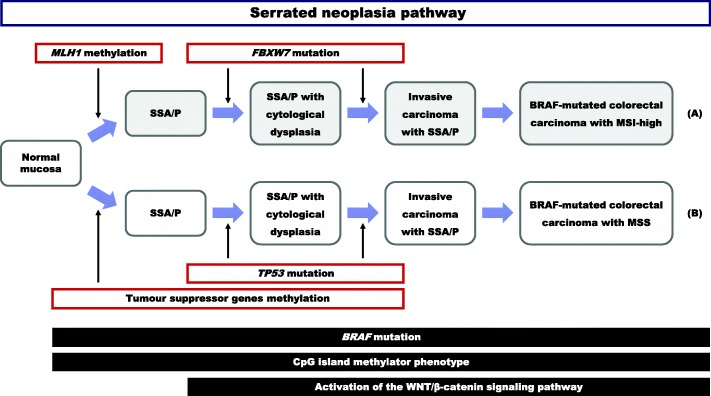
SSA/Ps with dysplasia/carcinoma frequently harbored BRAF mutations. Activation of the WNT/β-catenin signaling pathway may facilitate the development of dysplasia in SSA/Ps and progression to carcinoma. Furthermore, our results suggested that these lesions might be associated with both MSI-high and MSS colorectal cancer, which might be distinguished by distinct molecular biological features such as lost MLH1 expression, FBXW7 mutations, and TP53 mutations.
结直肠无蒂锯齿状腺瘤/息肉(SSA/Ps)被认为是锯齿状肿瘤发生途径中的早期前体病变。最近的研究表明,SSA/Ps与MLH1表达缺失、CpG岛甲基化表型以及BRAF突变有关。然而,由于具有高级别组织学特征(如细胞学异型增生或浸润性癌)的SSA/P病例罕见,具有早期肿瘤进展的SSA/Ps的分子生物学特征尚未完全阐明。在本研究中,我们旨在阐明具有异型增生/癌的SSA/Ps的分子生物学特征,其代表锯齿状肿瘤发生途径的相对早期阶段。
我们对8个SSA/P病变进行了β-连环蛋白、MLH1和粘蛋白(如MUC2、MUC5AC、MUC6和CD10)的免疫染色;靶向二代测序;以及微卫星不稳定性(MSI)检测,其中包括4个高级别异型增生的SSA/Ps和4个黏膜下癌的SSA/Ps。
5例发现MLH1表达缺失。所有研究病变的核β-连环蛋白表达均为阳性。关于表型粘蛋白表达,所有病变的MUC2均为阳性,但CD10为阴性。7例观察到MUC5AC和MUC6阳性。在基因方面,最常发生突变的基因是BRAF(7例),其他突变在FBXW7(3例)、TP53(2例)以及KIT、PTEN、SMAD4和SMARCB1(各1例)中检测到。此外,8个病变中有4个为MSI高,其余4个病变为微卫星稳定(MSS)。有趣的是,所有4个MSI高的病变均显示MLH1缺失,其中3个含有FBXW7突变,但无TP53突变。然而,2个MSS病变含有TP53突变,尽管均无FBXW7突变。
具有异型增生/癌的SSA/Ps经常含有BRAF突变。WNT/β-连环蛋白信号通路的激活可能促进SSA/Ps中异型增生的发展并进展为癌。此外,我们的结果表明,这些病变可能与MSI高和MSS结直肠癌均相关,这可能通过不同的分子生物学特征如MLH1表达缺失、FBXW7突变和TP53突变来区分。