Laboratory of Persistent Viral Diseases, Rocky Mountain Laboratories, National Institute of Allergy and Infectious Diseases (NIAID), National Institutes of Health (NIH), Hamilton, Montana, USA.
Department of Pathology, University of California, San Diego, La Jolla, California, USA.
mBio. 2018 Nov 20;9(6):e02095-18. doi: 10.1128/mBio.02095-18.
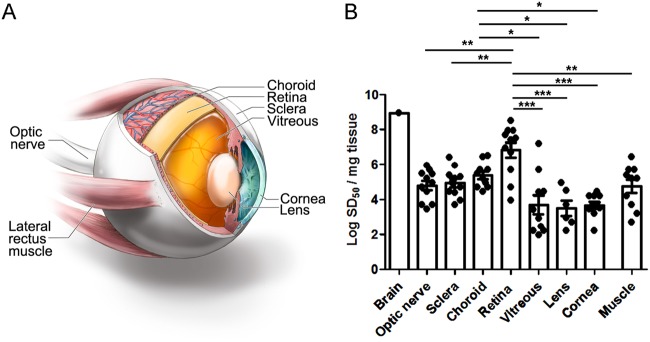
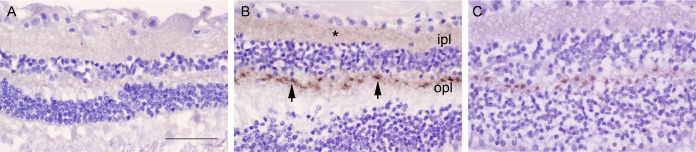
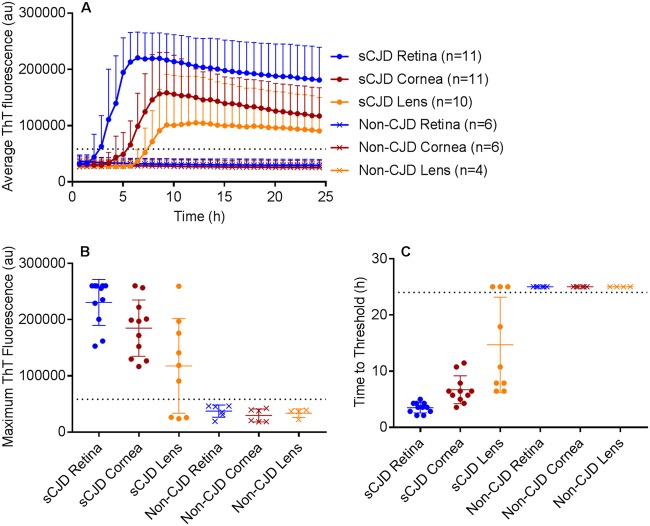
Sporadic Creutzfeldt-Jakob disease (sCJD) is the most common prion disease in humans and has been iatrogenically transmitted through corneal graft transplantation. Approximately 40% of sCJD patients develop visual or oculomotor symptoms and may seek ophthalmological consultation. Here we used the highly sensitive real-time quaking-induced conversion (RT-QuIC) assay to measure postmortem prion seeding activities in cornea, lens, ocular fluid, retina, choroid, sclera, optic nerve, and extraocular muscle in the largest series of sCJD patient eyes studied by any assay to date. We detected prion seeding activity in 100% of sCJD eyes, representing three common sCJD subtypes, with levels varying by up to 4 log-fold among individuals. The retina consistently showed the highest seed levels, which in some cases were only slightly lower than brain. Within the retina, prion deposits were detected by immunohistochemistry (IHC) in the retinal outer plexiform layer in most sCJD cases, and in some eyes the inner plexiform layer, consistent with synaptic prion deposition. Prions were not detected by IHC in any other eye region. With RT-QuIC, prion seed levels generally declined in eye tissues with increased distance from the brain, and yet all corneas had prion seeds detectable. Prion seeds were also present in the optic nerve, extraocular muscle, choroid, lens, vitreous, and sclera. Collectively, these results reveal that sCJD patients accumulate prion seeds throughout the eye, indicating the potential diagnostic utility as well as a possible biohazard. Cases of iatrogenic prion disease have been reported from corneal transplants, yet the distribution and levels of prions throughout the eye remain unknown. This study probes the occurrence, level, and distribution of prions in the eyes of patients with sporadic Creutzfeldt-Jakob disease (sCJD). We tested the largest series of prion-infected eyes reported to date using an ultrasensitive technique to establish the prion seed levels in eight regions of the eye. All 11 cases had detectable prion seeds in the eye, and in some cases, the seed levels in the retina approached those in brain. In most cases, prion deposits could also be seen by immunohistochemical staining of retinal tissue; other ocular tissues were negative. Our results have implications for estimating the risk for iatrogenic transmission of sCJD as well as for the development of antemortem diagnostic tests for prion diseases.
散发性克雅氏病(sCJD)是人类中最常见的朊病毒病,已通过角膜移植发生医源性传播。大约 40%的 sCJD 患者出现视觉或眼球运动症状,并可能寻求眼科咨询。在这里,我们使用高度敏感的实时震颤诱导转化(RT-QuIC)测定法,测量迄今为止通过任何测定法研究的最大系列 sCJD 患者眼中死后朊病毒接种活性的角膜、晶状体、眼液、视网膜、脉络膜、巩膜、视神经和眼外肌。我们在 100%的 sCJD 眼中检测到朊病毒接种活性,代表三种常见的 sCJD 亚型,个体之间的水平差异高达 4 个对数倍。视网膜始终显示出最高的种子水平,在某些情况下,仅略低于大脑。在视网膜内,免疫组织化学(IHC)在大多数 sCJD 病例的视网膜外丛状层中检测到朊病毒沉积物,在一些眼中的内丛状层中也检测到,这与突触朊病毒沉积一致。在任何其他眼部区域均未通过 IHC 检测到朊病毒。使用 RT-QuIC,随着距大脑距离的增加,眼部组织中的朊病毒种子水平通常会下降,但所有角膜都可检测到朊病毒种子。在视神经、眼外肌、脉络膜、晶状体、玻璃体和巩膜中也存在朊病毒。总的来说,这些结果表明 sCJD 患者在整个眼中积累了朊病毒种子,这表明其具有潜在的诊断效用以及可能的生物危害。已报道从角膜移植中发生医源性朊病毒病的病例,但眼部中朊病毒的分布和水平仍未知。本研究探讨了散发性克雅氏病(sCJD)患者眼中朊病毒的发生、水平和分布。我们使用超灵敏技术测试了迄今为止报告的最大系列朊病毒感染眼,以确定眼部八个区域的朊病毒种子水平。所有 11 例患者的眼部均检测到可检测的朊病毒种子,在某些情况下,视网膜中的种子水平接近大脑中的水平。在大多数情况下,还可以通过视网膜组织的免疫组织化学染色观察到朊病毒沉积物;其他眼部组织呈阴性。我们的结果对估计医源性传播 sCJD 的风险以及开发朊病毒病的生前诊断测试具有重要意义。