Faculty of Biology, Medicine and Health, University of Manchester, Oxford Road, Manchester M13 9PT UK.
Faculty of Biology, Medicine and Health, University of Manchester, Oxford Road, Manchester M13 9PT UK
Plant Physiol. 2019 Feb;179(2):391-401. doi: 10.1104/pp.18.01119. Epub 2018 Nov 20.
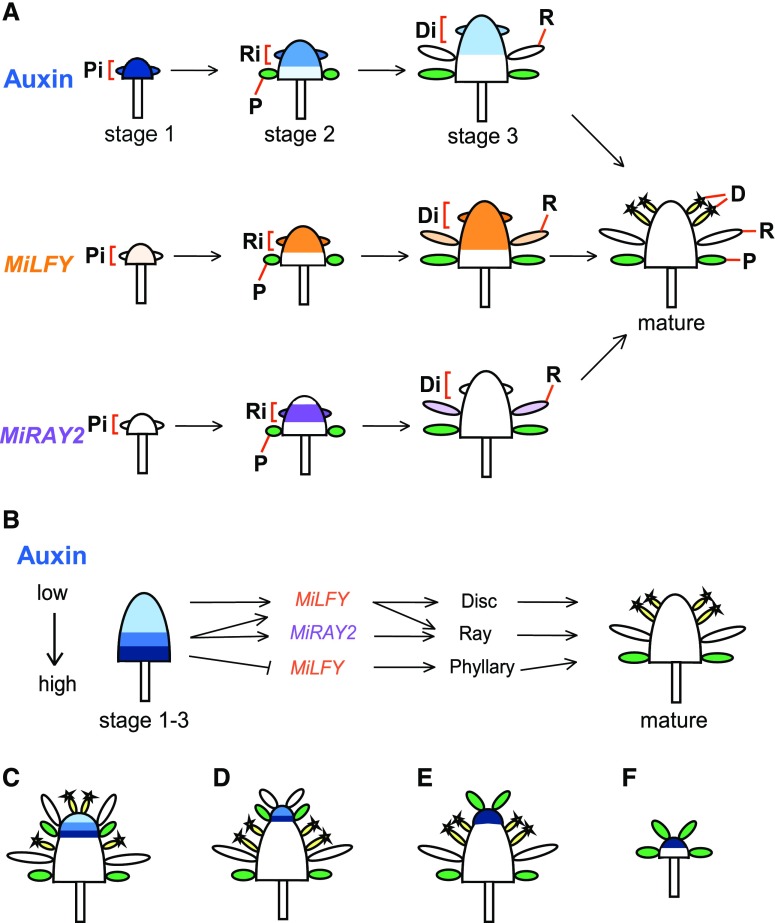
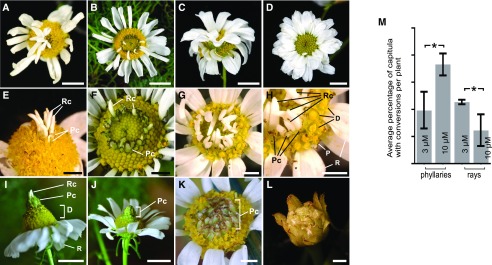
Nature often creates complex structures by rearranging pre-existing units. One such example is the flower head (capitulum) in daisies, where a group of flowers (florets) and phyllaries (modified bracts) are arranged to superficially mimic a single flower. The capitulum is a key taxonomical innovation that defines the daisy family (Asteraceae), the largest flowering plant group. However, patterning mechanisms underlying its structure remain elusive. Here, we show that auxin, a plant hormone, provides a developmental patterning cue for the capitulum. During capitulum development, a temporal auxin gradient occurs, regulating the successive and centripetal formation of distinct florets and phyllaries. Disruption of the endogenous auxin gradient led to homeotic conversions of florets and phyllaries in the capitulum. Furthermore, auxin regulates floral meristem identity genes, such as and , which determine floret and phyllary identity. This study reveals the mechanism of capitulum patterning and highlights how common developmental tools, such as hormone gradients, have independently evolved in plants and animals.
自然界常常通过重新排列预先存在的单元来创造复杂的结构。例如,在雏菊中,头状花序(capitulum)是一个由一组花(小花)和总苞片(变态的苞片)排列而成的结构,表面上模仿一朵单独的花。头状花序是一个关键的分类学创新,定义了雏菊科(菊科),这是最大的开花植物群。然而,其结构背后的模式形成机制仍然难以捉摸。在这里,我们表明植物激素生长素为头状花序提供了一个发育模式形成线索。在头状花序发育过程中,会出现一个时间上的生长素梯度,调节不同小花和总苞片的连续和向心形成。内源性生长素梯度的破坏导致头状花序中小花和总苞片的同态转化。此外,生长素调节花分生组织身份基因,如花分生组织基因 和 ,它们决定小花和总苞片的身份。本研究揭示了头状花序的模式形成机制,并强调了激素梯度等常见发育工具如何在植物和动物中独立进化。