University of New South Wales (UNSW), Sydney, NSW, Australia.
Arizona State University (ASU), Tempe, AZ, USA.
Emerg Microbes Infect. 2018 Nov 21;7(1):184. doi: 10.1038/s41426-018-0185-z.
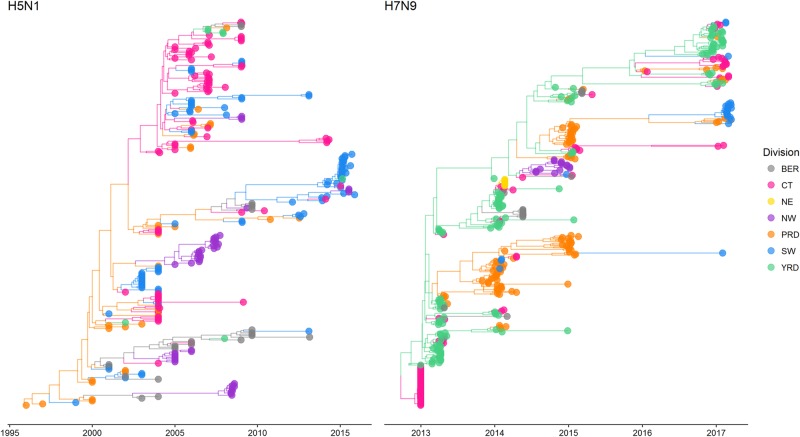
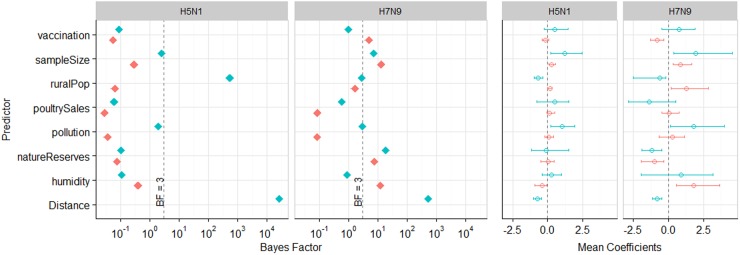
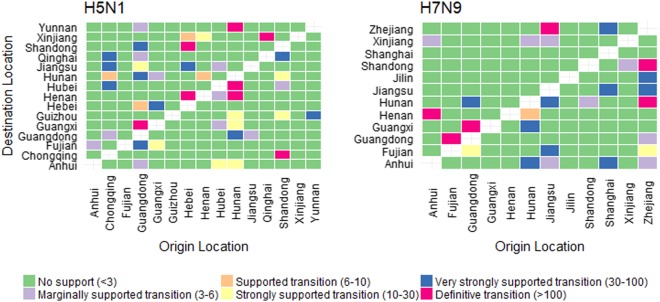
Avian influenza H5N1 subtype has caused a global public health concern due to its high pathogenicity in poultry and high case fatality rates in humans. The recently emerged H7N9 is a growing pandemic risk due to its sustained high rates of human infections, and recently acquired high pathogenicity in poultry. Here, we used Bayesian phylogeography on 265 H5N1 and 371 H7N9 haemagglutinin sequences isolated from humans, animals and the environment, to identify and compare migration patterns and factors predictive of H5N1 and H7N9 diffusion rates in China. H7N9 diffusion dynamics and predictor contributions differ from H5N1. Key determinants of spatial diffusion included: proximity between locations (for H5N1 and H7N9), and lower rural population densities (H5N1 only). For H7N9, additional predictors included low avian influenza vaccination rates, low percentage of nature reserves and high humidity levels. For both H5N1 and H7N9, we found viral migration rates from Guangdong to Guangxi and Guangdong to Hunan were highly supported transmission routes (Bayes Factor > 30). We show fundamental differences in wide-scale transmission dynamics between H5N1 and H7N9. Importantly, this indicates that avian influenza initiatives designed to control H5N1 may not be sufficient for controlling the H7N9 epidemic. We suggest control and prevention activities to specifically target poultry transportation networks between Central, Pan-Pearl River Delta and South-West regions.
由于 H5N1 亚型禽流感在禽类中具有高致病性,在人类中病死率高,因此引起了全球公共卫生关注。最近出现的 H7N9 由于其在人类中的持续高感染率以及最近获得的禽类高致病性,成为一种日益严重的大流行风险。在这里,我们使用贝叶斯系统地理学方法对 265 株 H5N1 和 371 株 H7N9 血凝素序列进行分析,这些序列分别来自人类、动物和环境,以鉴定和比较 H5N1 和 H7N9 在我国的传播模式和预测扩散率的因素。H7N9 的扩散动态和预测因素与 H5N1 不同。空间扩散的关键决定因素包括:地理位置之间的接近程度(H5N1 和 H7N9 都适用),以及农村人口密度较低(仅适用于 H5N1)。对于 H7N9,另外的预测因素包括低禽流感疫苗接种率、低自然保护区比例和高湿度水平。对于 H5N1 和 H7N9,我们发现病毒从广东到广西和广东到湖南的迁移率是高度支持的传播途径(贝叶斯因子>30)。我们发现 H5N1 和 H7N9 之间在大范围传播动态方面存在根本差异。重要的是,这表明旨在控制 H5N1 的禽流感计划可能不足以控制 H7N9 疫情。我们建议针对中部、泛珠江三角洲和西南地区之间的家禽运输网络开展控制和预防活动。