Institute of Pathology, University Hospital of Cologne, Cologne, Germany.
Else Kröner Forschungskolleg Clonal Evolution in Cancer, University Hospital Cologne, Cologne, Germany.
Mod Pathol. 2019 May;32(5):627-638. doi: 10.1038/s41379-018-0182-8. Epub 2018 Nov 20.
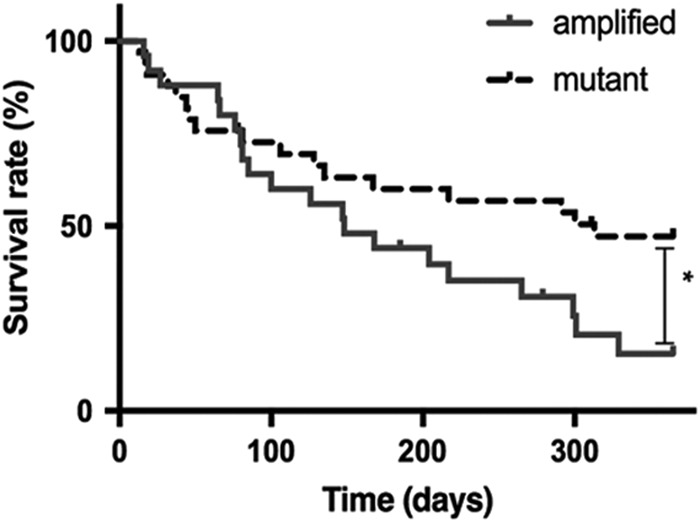
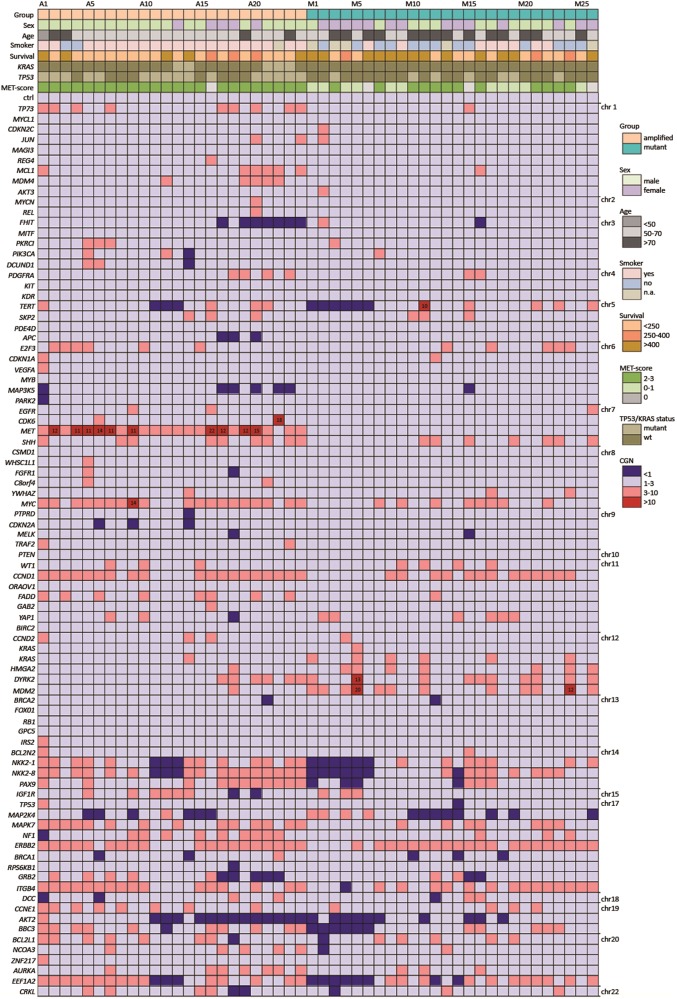
Although non-small-cell lung cancer is a leading cause of cancer-related deaths, the molecular characterization and classification of its genetic alterations has drastically changed treatment options and overall survival within the last few decades. In particular, tyrosine kinase inhibitors targeting specific molecular alterations, among other MET, have greatly improved the prognosis of non-small-cell lung cancer patients. Here, we compare the genomic background of a subset of non-small-cell lung cancer cases harboring either a MET high-level amplification (n = 24) or a MET exon 14 skipping mutation (n = 26), using next-generatison sequencing, fluorescence in situ hybridization, immunohistochemistry, and Nanostring nCounter technology. We demonstrate that the MET-amplified cohort shows a higher genetic instability, compared with the mutant cohort (p < 0.001). Furthermore, MET mutations occur at high allele frequency and in the presence of co-occurring TP53 mutations (n = 7), as well as MDM2 (n = 7), CDK4 (n = 6), and HMGA2 (n = 5) co-amplifications. No other potential driver mutation has been detected. Conversely, in the MET-amplified group, we identify co-occurring pathogenic NRAS and KRAS mutations (n = 5) and a significantly higher number of TP53 mutations, compared with the MET-mutant cohort (p = 0.048). Of note, MET amplifications occur more frequently as subclonal events. Interestingly, despite the significantly (p = 0.00103) older age at diagnosis of stage IIIb/IV of MET-mutant patients (median 77 years), compared with MET high-level amplified patients (median 69 years), MET-mutant patients with advanced-stage tumors showed a significantly better prognosis at 12 months (p = 0.04). In conclusion, the two groups of MET genetic alterations differ, both clinically and genetically: our data strongly suggest that MET exon 14 skipping mutations represent an early driver mutation. In opposition, MET amplifications occur usually in the background of other strong genetic events and therefore MET amplifications should be interpreted in the context of each tumor's genetic background, rather than as an isolated driver event, especially when considering MET-specific treatment options.
尽管非小细胞肺癌是癌症相关死亡的主要原因,但在过去几十年中,其遗传改变的分子特征和分类极大地改变了治疗选择和整体生存率。特别是针对特定分子改变的酪氨酸激酶抑制剂,包括 MET,极大地改善了非小细胞肺癌患者的预后。在这里,我们使用下一代测序、荧光原位杂交、免疫组织化学和 Nanostring nCounter 技术比较了一组具有高水平 MET 扩增(n=24)或 MET 外显子 14 跳跃突变(n=26)的非小细胞肺癌病例的基因组背景。我们证明,与突变组相比,MET 扩增组显示出更高的遗传不稳定性(p<0.001)。此外,MET 突变以高等位基因频率发生,并伴有共发生的 TP53 突变(n=7),以及 MDM2(n=7)、CDK4(n=6)和 HMGA2(n=5)的共扩增。未检测到其他潜在的驱动突变。相反,在 MET 扩增组中,我们发现与 MET 突变组相比,存在共发生的致病性 NRAS 和 KRAS 突变(n=5)和更高数量的 TP53 突变(p=0.048)。值得注意的是,MET 扩增更频繁地作为亚克隆事件发生。有趣的是,尽管 MET 突变患者(中位年龄 77 岁)的 IIIb/IV 期诊断年龄明显(p=0.00103)大于 MET 高表达扩增患者(中位年龄 69 岁),但晚期肿瘤的 MET 突变患者在 12 个月时的预后明显更好(p=0.04)。总之,这两组 MET 遗传改变在临床和遗传上都存在差异:我们的数据强烈表明,MET 外显子 14 跳跃突变代表早期驱动突变。相反,MET 扩增通常发生在其他强烈遗传事件的背景下,因此 MET 扩增应根据每个肿瘤的遗传背景进行解释,而不是作为孤立的驱动事件,尤其是在考虑 MET 特异性治疗选择时。