Mei Yu-Ying, Wu Dong Chuan, Zhou Ning
Translational Medicine Research Center, China Medical University Hospital, Taichung, Taiwan.
Graduate Institute of Biomedical Sciences, China Medical University, Taichung, Taiwan.
Front Psychiatry. 2018 Nov 6;9:544. doi: 10.3389/fpsyt.2018.00544. eCollection 2018.
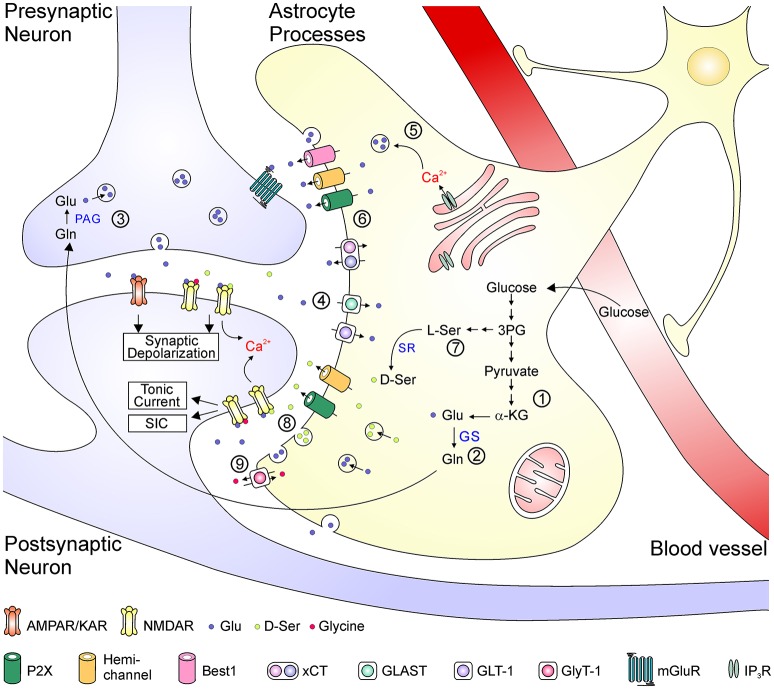
According to the glutamate hypothesis of schizophrenia, the abnormality of glutamate transmission induced by hypofunction of NMDA receptors (NMDARs) is causally associated with the positive and negative symptoms of schizophrenia. However, the underlying mechanisms responsible for the changes in glutamate transmission in schizophrenia are not fully understood. Astrocytes, the major regulatory glia in the brain, modulate not only glutamate metabolism but also glutamate transmission. Here we review the recent progress in understanding the role of astrocytes in schizophrenia. We focus on the astrocytic mechanisms of (i) glutamate synthesis via the glutamate-glutamine cycle, (ii) glutamate clearance by excitatory amino acid transporters (EAATs), (iii) D-serine release to activate NMDARs, and (iv) glutamatergic target engagement biomarkers. Abnormality in these processes is highly correlated with schizophrenia phenotypes. These findings will shed light upon further investigation of pathogenesis as well as improvement of biomarkers and therapies for schizophrenia.
根据精神分裂症的谷氨酸假说,NMDA受体(NMDARs)功能减退引起的谷氨酸传递异常与精神分裂症的阳性和阴性症状存在因果关系。然而,精神分裂症中谷氨酸传递变化的潜在机制尚未完全明确。星形胶质细胞是大脑中主要的调节性神经胶质细胞,不仅调节谷氨酸代谢,还调节谷氨酸传递。在此,我们综述了在理解星形胶质细胞在精神分裂症中作用方面的最新进展。我们重点关注以下星形胶质细胞机制:(i)通过谷氨酸-谷氨酰胺循环合成谷氨酸,(ii)通过兴奋性氨基酸转运体(EAATs)清除谷氨酸,(iii)释放D-丝氨酸以激活NMDARs,以及(iv)谷氨酸能靶点参与生物标志物。这些过程中的异常与精神分裂症表型高度相关。这些发现将为进一步研究精神分裂症的发病机制以及改善其生物标志物和治疗方法提供线索。