Giannopulu Irini, Terada Kazunori, Watanabe Tomio
Interdisciplinary Centre for the Artificial Mind (iCAM), Faculty of Society & Design, Bond University, Gold Coast, QLD, Australia.
Department of Electrical, Electronic and Computer Engineering, Gifu University, Gifu, Japan.
Front Psychol. 2018 Oct 16;9:1852. doi: 10.3389/fpsyg.2018.01852. eCollection 2018.
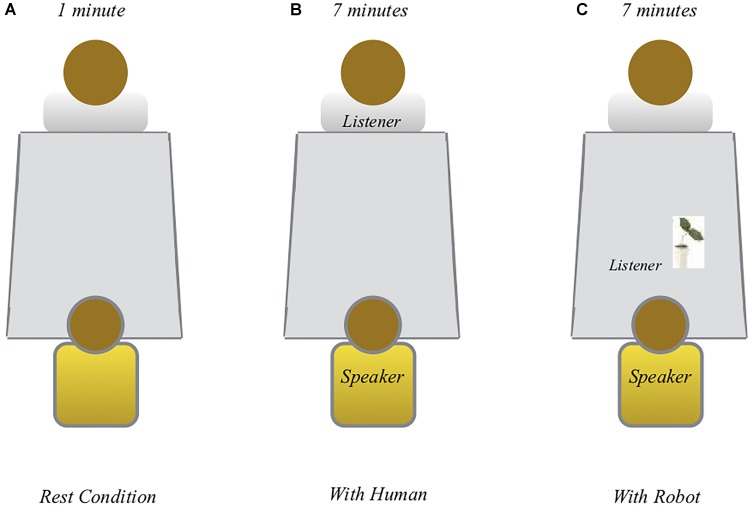
Simulating emotional experience, emotional empathy is the fundamental ingredient of interpersonal communication. In the speaker-listener scenario, the speaker is always a child, the listener is a human or a toy robot. Two groups of neurotypical children aged 6 years on average composed the population: one Japanese ( = 20) and one French ( = 20). Revealing potential similarities in communicative exchanges in both groups when in contact with a human or a toy robot, the results might signify that emotional empathy requires the implication of an automatic identification. In this sense, emotional empathy might be considered a broad idiosyncrasy, a kind of synchronisation, offering the mind a peculiar form of communication. Our findings seem to be consistent with the assumption that children's brains would be constructed to simulate the feelings of others in order to ensure interpersonal synchronisation.
模拟情感体验的情感共鸣是人际交流的基本要素。在说话者-倾听者场景中,说话者总是一个孩子,倾听者是一个人或一个玩具机器人。两组平均年龄为6岁的神经典型儿童构成了样本:一组是20名日本儿童,另一组是20名法国儿童。当与人类或玩具机器人接触时,两组在交流互动中显示出潜在的相似性,结果可能表明情感共鸣需要自动识别的参与。从这个意义上说,情感共鸣可能被视为一种广泛的特质,一种同步性,为心灵提供一种特殊的交流形式。我们的研究结果似乎与这样的假设一致,即儿童的大脑会被构建来模拟他人的感受,以确保人际同步。