Xu Zheng, Te Shu Harn, He Yiliang, Gin Karina Yew-Hoong
School of Environmental Science and Engineering, Shanghai Jiao Tong University, Shanghai, China.
NUS Environmental Research Institute (NERI), National University of Singapore, Singapore, Singapore.
Front Microbiol. 2018 Nov 6;9:2531. doi: 10.3389/fmicb.2018.02531. eCollection 2018.
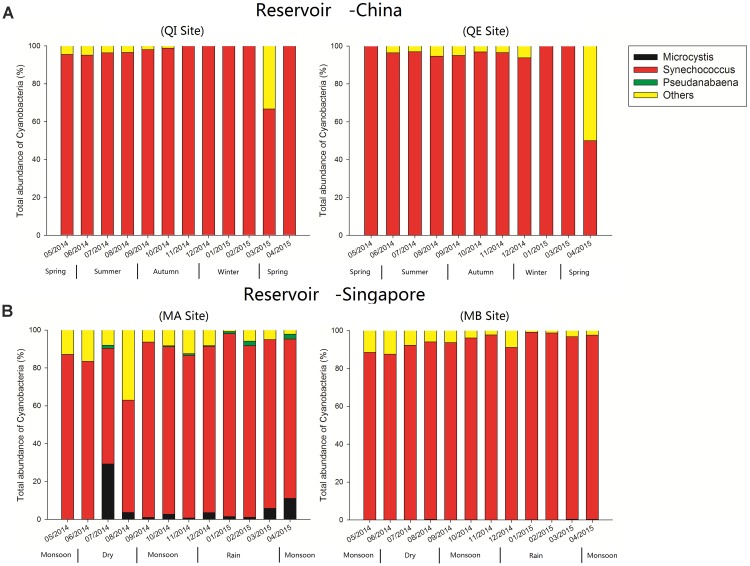
In this study, Illumina MiSeq sequencing technique was employed to explore the characteristics and dynamics of cyanobacteria-heterotrophic bacteria between two estuarine reservoirs in sub-tropical (reservoir A in Shanghai) and tropical (reservoir B in Singapore) regions. The results indicated that significant differences in bacterial community composition were found between two estuarine reservoirs, which influenced by varied environmental variables. The environmental heterogeneity in reservoir A was much higher, which indicated that the composition of bacterial community in reservoir A was more complex. In contrast, reservoir B provided a suitable and temperate water environment conditions for bacterial growth, which resulted in higher community diversity and less co-exclusion correlations. The molecular ecological network indicated that the presence of dominant bacterial community in each of the reservoir were significant different. These differences mainly reflected the responses of bacterial community to the variations of environmental variables. Although was the dominant cyanobacterial species in both reservoirs, it exhibited co-occurrence patterns with different heterotrophic bacteria between reservoirs. In addition, the cyanobacteria-heterotrophic bacteria interaction exhibited highly dynamic variations, which was affected by nutrition and survive space. Also, the co-occurrence of and found in reservoir B implied that the non-N-fixing accompanied with N-fixing occurrence in freshwater lakes, so as to better meet the demand for nitrogen source.
在本研究中,采用Illumina MiSeq测序技术探究亚热带地区(上海的水库A)和热带地区(新加坡的水库B)两个河口水库中蓝细菌-异养细菌的特征和动态变化。结果表明,两个河口水库之间的细菌群落组成存在显著差异,这受到多种环境变量的影响。水库A的环境异质性更高,这表明水库A中细菌群落的组成更为复杂。相比之下,水库B为细菌生长提供了适宜且温和的水环境条件,导致更高的群落多样性和更少的共排斥相关性。分子生态网络表明,每个水库中优势细菌群落的存在存在显著差异。这些差异主要反映了细菌群落对环境变量变化的响应。尽管 是两个水库中占主导地位的蓝细菌物种,但它在不同水库中与不同的异养细菌呈现出共生模式。此外,蓝细菌-异养细菌的相互作用表现出高度动态的变化,这受到营养和生存空间的影响。此外,在水库B中发现的 和 的共生意味着非固氮 伴随着固氮 在淡水湖泊中的出现,从而更好地满足对氮源的需求。