Kato Takashi, Hagiyama Man, Ito Akihiko
Department of Cell Biology, Johns Hopkins University School of Medicine, Baltimore, MD, United States.
Department of Pathology, Kindai University School of Medicine, Osakasayama, Japan.
Front Cell Dev Biol. 2018 Nov 6;6:153. doi: 10.3389/fcell.2018.00153. eCollection 2018.
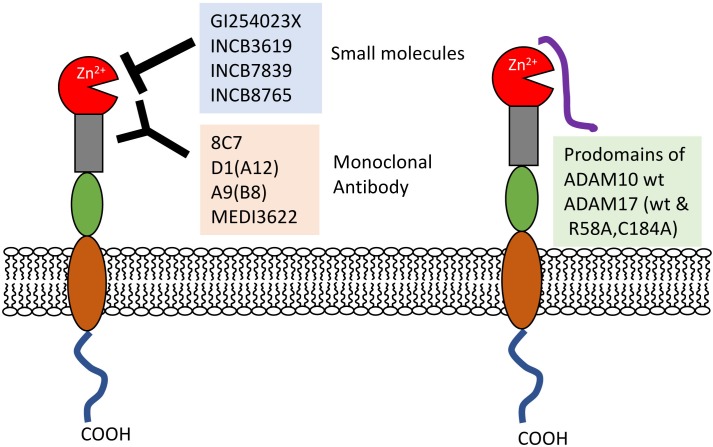
A disintegrin and metalloproteinases (ADAMs) are a Zn-dependent transmembrane and secreted metalloprotease superfamily, so-called "molecular scissors," and they consist of an N-terminal signal sequence, a prodomain, zinc-binding metalloprotease domain, disintegrin domain, cysteine-rich domain, transmembrane domain and cytoplasmic tail. ADAMs perform proteolytic processing of the ectodomains of diverse transmembrane molecules into bioactive mediators. This review summarizes on their most well-known members, ADAM10 and 17, focusing on the kidneys. ADAM10 is expressed in renal tubular cells and affects the expression of specific brush border genes, and its activation is involved in some renal diseases. ADAM17 is weakly expressed in normal kidneys, but its expression is markedly induced in the tubules, capillaries, glomeruli, and mesangium, and it is involved in interstitial fibrosis and tubular atrophy. So far, the various substrates have been identified in the kidneys. Shedding fragments become released ligands, such as Notch and EGFR ligands, and act as the chemoattractant factors including CXCL16. Their ectodomain shedding is closely correlated with pathological factors, which include inflammation, interstitial fibrosis, and renal injury. Also, the substrates of both ADAMs contain the molecules that play important roles at the plasma membrane, such as meaprin, E-cadherin, Klotho, and CADM1. By being released into urine, the shedding products could be useful for biomarkers of renal diseases, but ADAM10 and 17 are also notable as biomarkers. Furthermore, ADAM10 and/or 17 inhibitions based on various strategies such as small molecules, antibodies, and their recombinant prodomains are valuable, because they potentially protect renal tissues and promote renal regeneration. Although temporal and spatial regulations of inhibitors are problems to be solved, their inhibitors could be useful for renal diseases.
解整合素金属蛋白酶(ADAMs)是一个依赖锌的跨膜和分泌型金属蛋白酶超家族,即所谓的“分子剪刀”,它们由一个N端信号序列、一个前结构域、锌结合金属蛋白酶结构域、解整合素结构域、富含半胱氨酸结构域、跨膜结构域和细胞质尾组成。ADAMs将多种跨膜分子的胞外域进行蛋白水解加工成生物活性介质。本综述总结了它们最著名的成员ADAM10和ADAM17,重点是肾脏。ADAM10在肾小管细胞中表达,影响特定刷状缘基因的表达,其激活与一些肾脏疾病有关。ADAM17在正常肾脏中弱表达,但其表达在肾小管、毛细血管、肾小球和系膜中明显诱导,并且它参与间质纤维化和肾小管萎缩。到目前为止,已经在肾脏中鉴定出各种底物。脱落片段成为释放的配体,如Notch和表皮生长因子受体(EGFR)配体,并作为趋化因子发挥作用,包括CXC趋化因子配体16(CXCL16)。它们的胞外域脱落与病理因素密切相关,这些病理因素包括炎症、间质纤维化和肾损伤。此外,两种ADAMs的底物都包含在质膜上起重要作用的分子,如膜联蛋白、E-钙黏蛋白、klotho和细胞黏附分子1(CADM1)。通过释放到尿液中而产生的脱落产物可能对肾脏疾病的生物标志物有用,但ADAM10和ADAM17作为生物标志物也值得关注。此外,基于小分子、抗体及其重组前结构域等各种策略对ADAM10和/或ADAM17的抑制是有价值的,因为它们可能保护肾组织并促进肾脏再生。尽管抑制剂的时空调节是有待解决的问题,但它们的抑制剂可能对肾脏疾病有用。