Department of Clinical Application, Center for iPS Cell Research and Application (CiRA), Kyoto University, Kyoto, Japan.
Kaken Pharmaceutical Co., Ltd., Tokyo, Japan.
Stem Cells Transl Med. 2017 Mar;6(3):720-730. doi: 10.5966/sctm.2016-0104. Epub 2016 Oct 5.
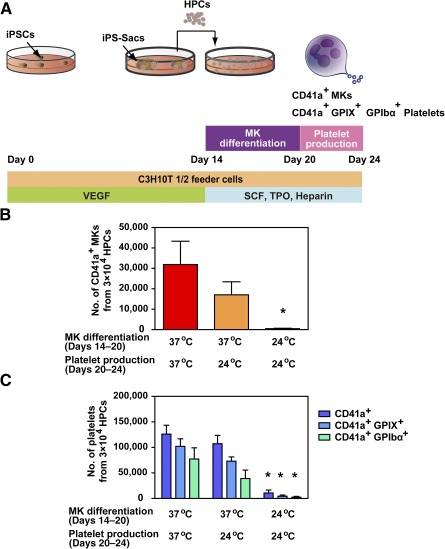
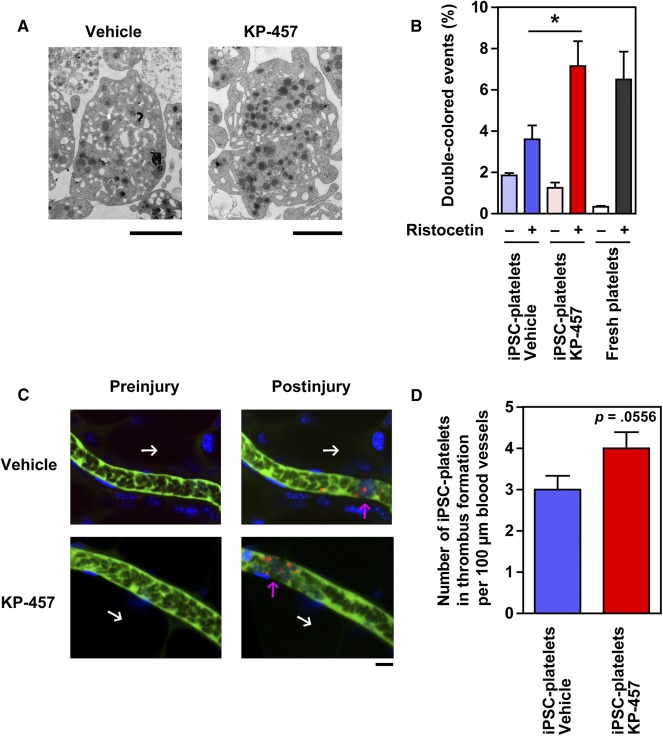
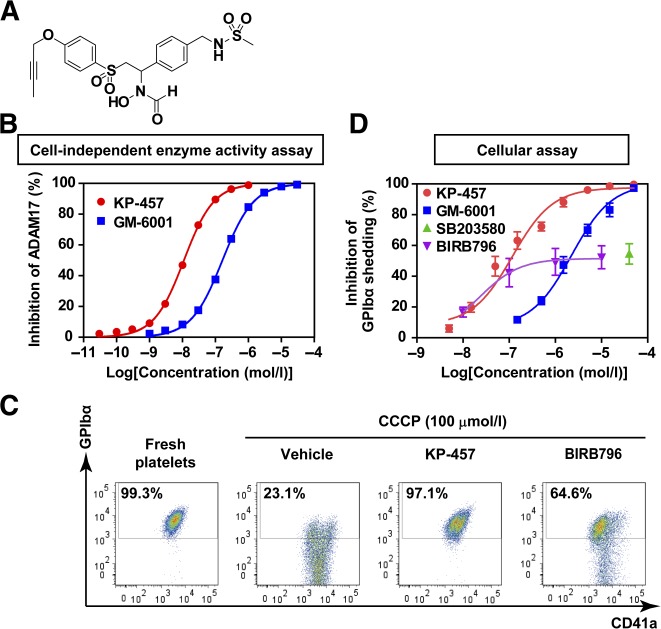
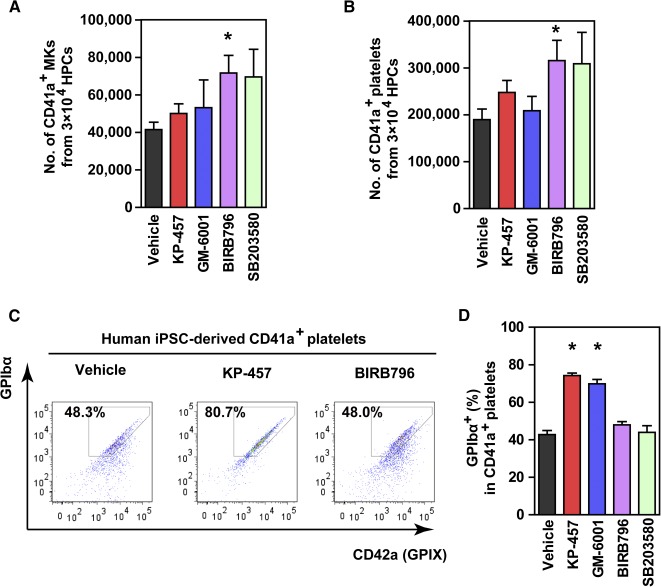
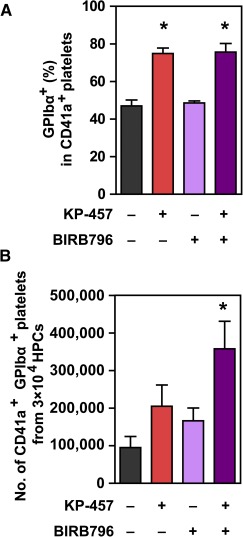
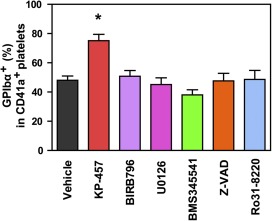
Donor-independent platelet concentrates for transfusion can be produced in vitro from induced pluripotent stem cells (iPSCs). However, culture at 37°C induces ectodomain shedding on platelets of glycoprotein Ibα (GPIbα), the von Willebrand factor receptor critical for adhesive function and platelet lifetime in vivo, through temperature-dependent activation of a disintegrin and metalloproteinase 17 (ADAM17). The shedding can be suppressed by using inhibitors of panmetalloproteinases and possibly of the upstream regulator p38 mitogen-activated protein kinase (p38 MAPK), but residues of these inhibitors in the final platelet products may be accompanied by harmful risks that prevent clinical application. Here, we optimized the culture conditions for generating human iPSC-derived GPIbα platelets, focusing on culture temperature and additives, by comparing a new and safe selective ADAM17 inhibitor, KP-457, with previous inhibitors. Because cultivation at 24°C (at which conventional platelet concentrates are stored) markedly diminished the yield of platelets with high expression of platelet receptors, 37°C was requisite for normal platelet production from iPSCs. KP-457 blocked GPIbα shedding from iPSC platelets at a lower half-maximal inhibitory concentration than panmetalloproteinase inhibitor GM-6001, whereas p38 MAPK inhibitors did not. iPSC platelets generated in the presence of KP-457 exhibited improved GPIbα-dependent aggregation not inferior to human fresh platelets. A thrombus formation model using immunodeficient mice after platelet transfusion revealed that iPSC platelets generated with KP-457 exerted better hemostatic function in vivo. Our findings suggest that KP-457, unlike GM-6001 or p38 MAPK inhibitors, effectively enhances the production of functional human iPSC-derived platelets at 37°C, which is an important step toward their clinical application. Stem Cells Translational Medicine 2017;6:720-730.
供体非依赖的血小板浓缩物可在体外从诱导多能干细胞(iPSCs)中产生。然而,在 37°C 下培养会通过温度依赖性激活金属蛋白酶 17(ADAM17)导致血小板糖蛋白 Ibα(GPIbα)的外结构域脱落,GPIbα 是体内血小板黏附功能和血小板寿命的重要的血管性血友病因子受体。通过使用泛金属蛋白酶抑制剂和上游调节物 p38 有丝分裂原激活蛋白激酶(p38 MAPK)抑制剂可以抑制脱落,但是最终血小板产物中的这些抑制剂的残留物可能伴随着阻止临床应用的有害风险。在这里,我们通过比较新型安全的选择性 ADAM17 抑制剂 KP-457 与以前的抑制剂,优化了生成人类 iPSC 衍生的 GPIbα 血小板的培养条件,重点是培养温度和添加剂。因为在 24°C(传统血小板浓缩物储存的温度)下培养会显著降低高表达血小板受体的血小板的产量,所以 37°C 是 iPSCs 产生正常血小板所必需的。与泛金属蛋白酶抑制剂 GM-6001 相比,KP-457 以较低的半最大抑制浓度阻断 iPSC 血小板的 GPIbα 脱落,而 p38 MAPK 抑制剂则不能。在 KP-457 的存在下生成的 iPSC 血小板表现出改善的 GPIbα 依赖性聚集,不次于人类新鲜血小板。在血小板输注后使用免疫缺陷小鼠的血栓形成模型表明,用 KP-457 生成的 iPSC 血小板在体内发挥更好的止血功能。我们的研究结果表明,与 GM-6001 或 p38 MAPK 抑制剂不同,KP-457 可有效地增强 37°C 下功能性人类 iPSC 衍生血小板的产生,这是其临床应用的重要一步。干细胞转化医学 2017;6:720-730。