Stem Cell Unit, Department of Anatomy, College of Medicine, King Saud University, Riyadh, 11461, Kingdom of Saudi Arabia.
Molecular Endocrinology Unit (KMEB), Department of Endocrinology, University Hospital of Odense and University of Southern Denmark, Odense, Denmark.
Stem Cell Res Ther. 2018 Nov 21;9(1):319. doi: 10.1186/s13287-018-1068-x.
Better understanding of the signaling pathways that regulate human bone marrow stromal stem cell (hBMSC) differentiation into bone-forming osteoblasts is crucial for their clinical use in regenerative medicine. Chemical biology approaches using small molecules targeting specific signaling pathways are increasingly employed to manipulate stem cell differentiation fate.
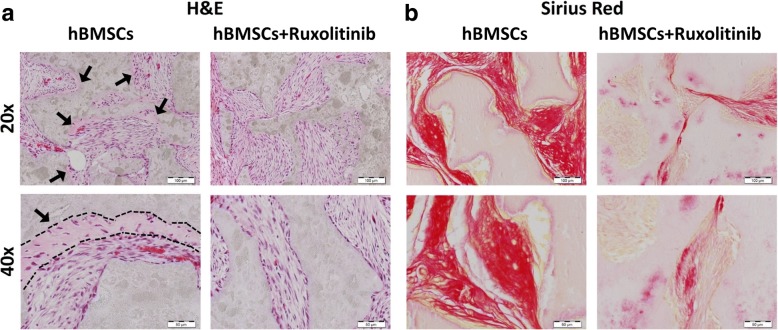
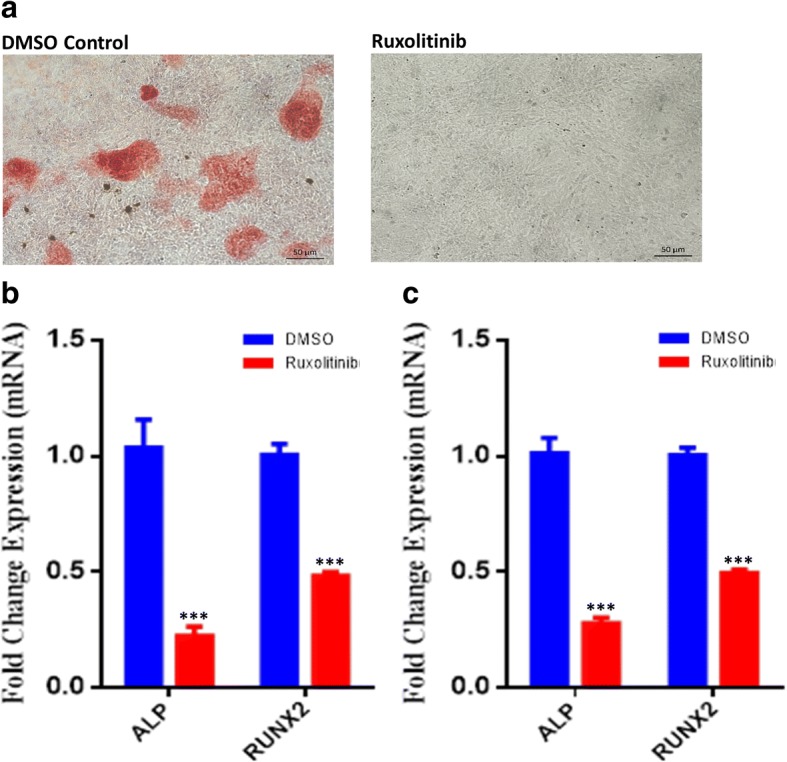
We employed alkaline phosphatase activity and staining assays to assess osteoblast differentiation and Alizarin R staining to assess mineralized matrix formation of cultured hBMSCs. Changes in gene expression were assessed using an Agilent microarray platform, and data normalization and bioinformatics were performed using GeneSpring software. For in vivo ectopic bone formation experiments, hMSCs were mixed with hydroxyapatite-tricalcium phosphate granules and implanted subcutaneously into the dorsal surface of 8-week-old female nude mice. Hematoxylin and eosin staining and Sirius Red staining were used to detect bone formation in vivo.
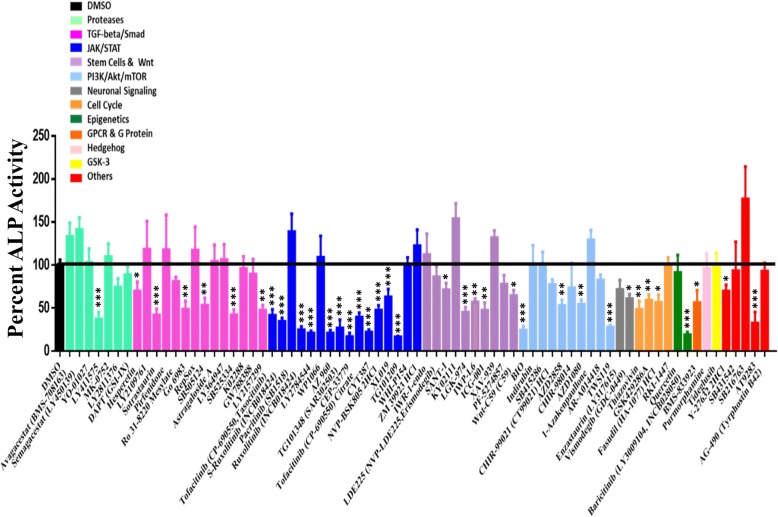
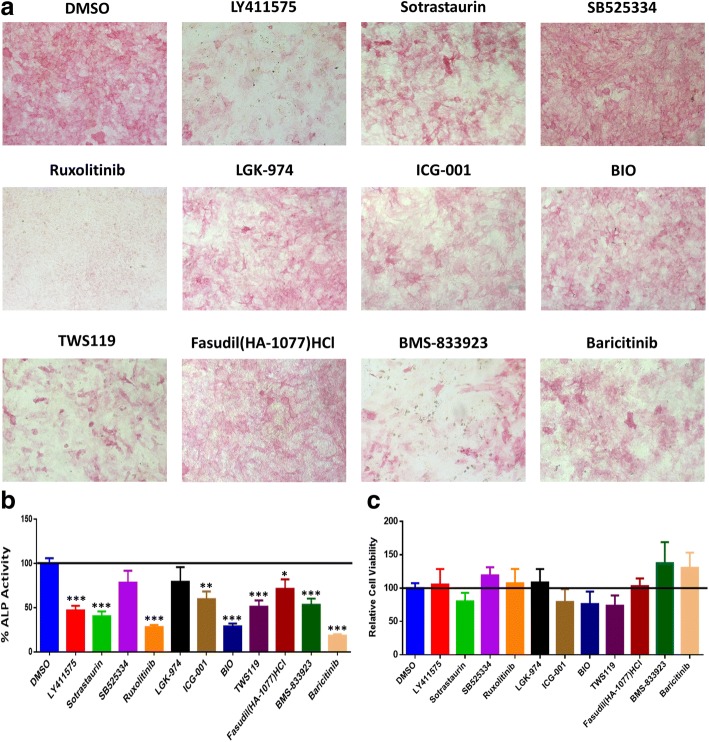
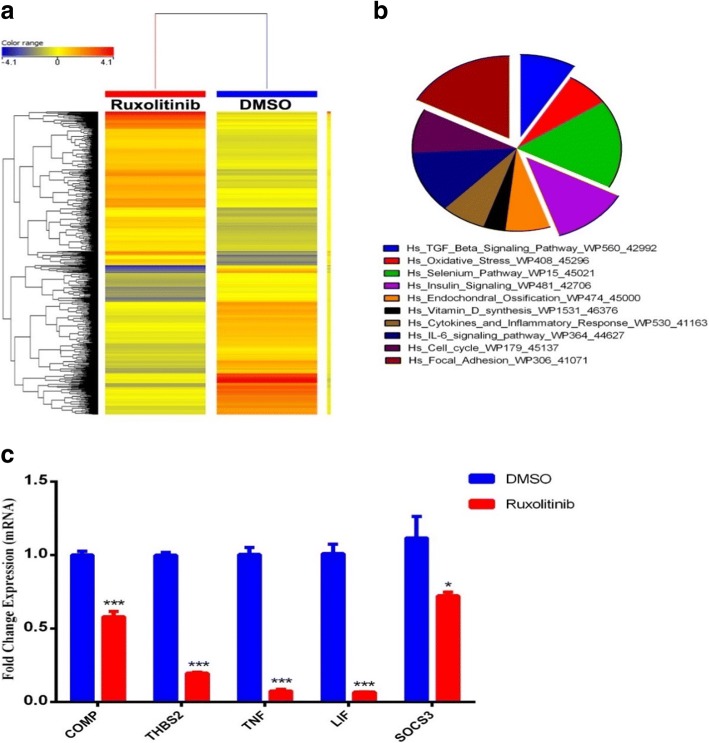
We identified several compounds which inhibited osteoblastic differentiation of hMSCs. In particular, we identified ruxolitinib (INCB018424) (3 μM), an inhibitor of JAK-STAT signaling that inhibited osteoblastic differentiation and matrix mineralization of hMSCs in vitro and reduced ectopic bone formation in vivo. Global gene expression profiling of ruxolitinib-treated cells identified 847 upregulated and 822 downregulated mRNA transcripts, compared to vehicle-treated control cells. Bioinformatic analysis revealed differential regulation of multiple genetic pathways, including TGFβ and insulin signaling, endochondral ossification, and focal adhesion.
We identified ruxolitinib as an important regulator of osteoblast differentiation of hMSCs. It is plausible that inhibition of osteoblast differentiation by ruxolitinib may represent a novel therapeutic strategy for the treatment of pathological conditions caused by accelerated osteoblast differentiation and mineralization.
更好地理解调控人骨髓基质干细胞(hBMSC)向成骨细胞分化的信号通路对于其在再生医学中的临床应用至关重要。利用靶向特定信号通路的小分子的化学生物学方法越来越多地被用于操纵干细胞分化命运。
我们采用碱性磷酸酶活性和染色测定法评估成骨细胞分化,并用茜素红染色评估培养的 hBMSCs 矿化基质的形成。使用 Agilent 微阵列平台评估基因表达变化,并使用 GeneSpring 软件进行数据标准化和生物信息学分析。对于体内异位骨形成实验,将 hMSC 与羟基磷灰石-三钙磷酸盐颗粒混合并皮下植入 8 周龄雌性裸鼠背部表面。采用苏木精和伊红染色以及天狼星红染色检测体内骨形成。
我们鉴定出几种抑制 hMSC 成骨分化的化合物。特别是,我们鉴定出 ruxolitinib(INCB018424)(3 μM),一种 JAK-STAT 信号抑制剂,它在体外抑制 hMSC 的成骨分化和基质矿化,并减少体内异位骨形成。与载体处理的对照细胞相比,ruxolitinib 处理的细胞的全基因组表达谱鉴定出 847 个上调和 822 个下调的 mRNA 转录本。生物信息学分析显示,多个遗传途径的差异调节,包括 TGFβ 和胰岛素信号、软骨内骨化和焦点黏附。
我们鉴定出 ruxolitinib 是 hMSC 成骨分化的重要调节剂。ruxolitinib 抑制成骨细胞分化可能代表一种治疗因成骨细胞分化和矿化加速而导致的病理状况的新治疗策略。