Zhang Lin, Li Er-Nan
Department of Spine Surgery, Beijing Shijitan Hospital, Capital Medical University, Beijing, China,
Ther Clin Risk Manag. 2018 Oct 31;14:2161-2169. doi: 10.2147/TCRM.S181477. eCollection 2018.
To identify risk factors for surgical site infection (SSI) in patients who had undergone lumbar spinal surgery.
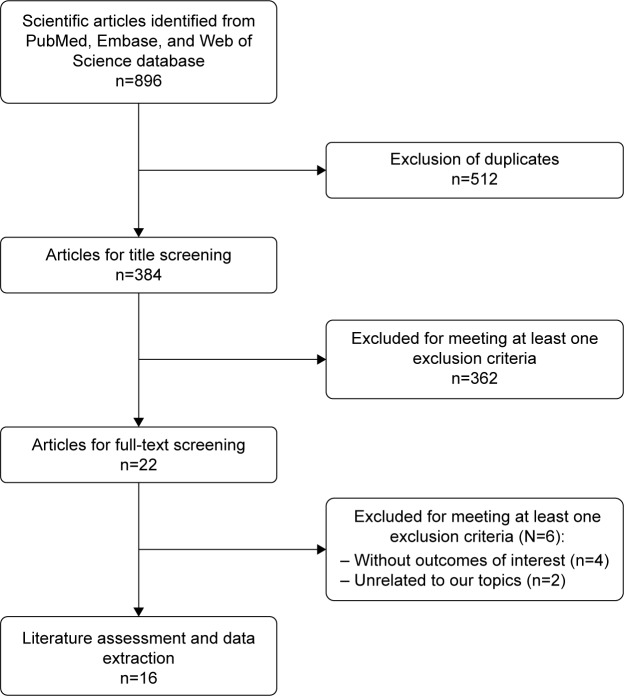
Studies published in PubMed, Web of Science, and Embase were systematically reviewed to determine risk factors for SSI following lumbar spinal surgery. Results are expressed as risk ratios (RRs) with 95% CIs and weighted mean difference (WMD) with 95% CI. A fixed-effect or random-effect model was used to pool the estimates according to heterogeneity among the studies included.
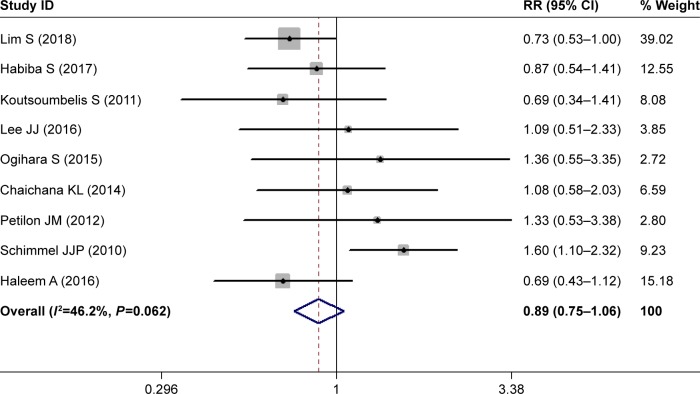
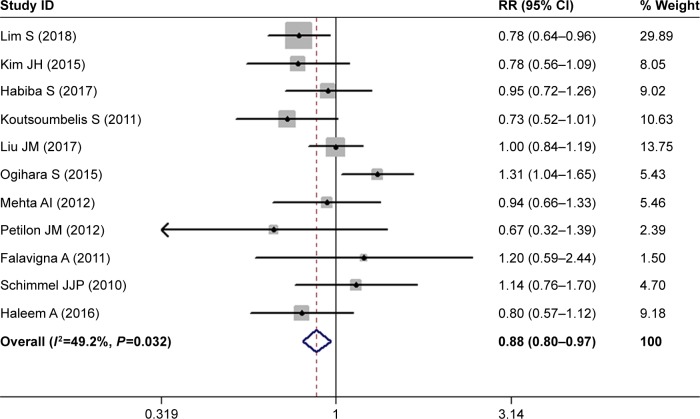
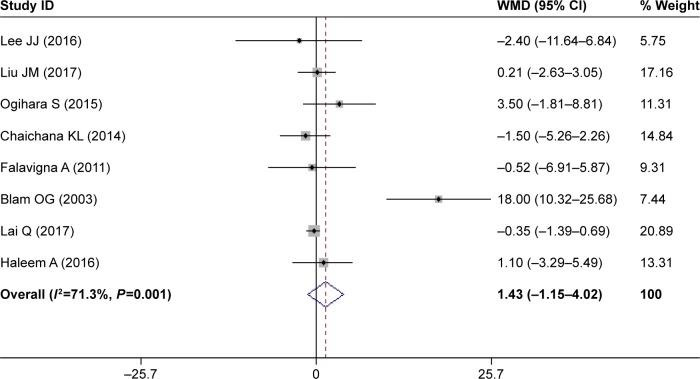
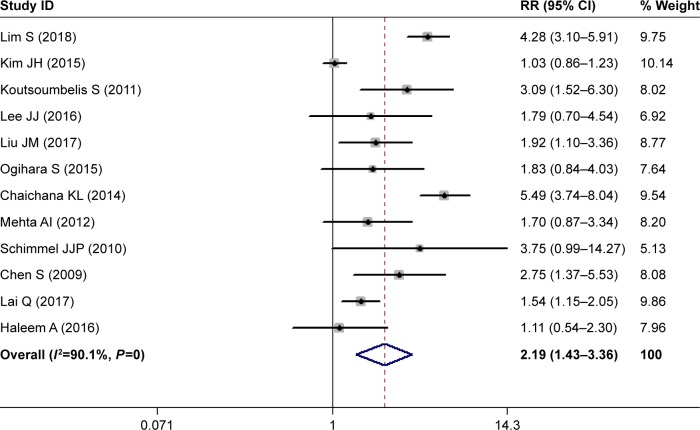
Sixteen studies involving 13,393 patients were included in this meta-analysis. Pooled estimates suggested that diabetes (RR 2.19, 95% CI 1.43-3.36; <0.001), obesity (RR 2.87, 95% CI 1.62-5.09; <0.001), BMI (WMD 1.32 kg/m, 95% CI 0.39-2.25; =0.006), prolonged operating time (WMD 24.96 minutes, 95% CI 14.77-35.15; <0.001), prolonged hospital stay (WMD 2.07 days, 95% CI 0.28-3.87; =0.024), hypertension (RR 1.28, 95% CI 1.08-1.52; =0.005), and previous surgery (RR 2.06, 95% CI 1.39-3.06; <0.001) were independent risk factors for SSI in patients who had undergone lumbar spine surgery. Current smoking (RR 0.89, 95% CI 0.75-1.06; =0.178), American Society of Anesthesiologists grade >2 (RR 2.63, 95% CI 0.84-8.27; =0.098), increased age (WMD 1.43 years, 95% CI -1.15 to 4.02; =0.278), COPD (RR 1.21, 95% CI 0.68-2.17; =0.521), cardiovascular disease (RR 1.63, 95% CI 0.40-6.70; =0.495), rheumatoid arthritis (RR 1.76, 95% CI 0.53-5.90; =0.359), and osteoporosis (RR 1.91, 95% CI 0.79-4.63; =0.152) were not risk factors for postoperative SSI.
Our results identified several important factors that increased the risk of postoperative SSI. Knowing these risk factors, surgeons could adequately analyze and evaluate risk factors in patients and then develop prevention measurements to reduce the rate of SSI.
确定接受腰椎手术患者手术部位感染(SSI)的危险因素。
系统回顾发表于PubMed、科学网和Embase的研究,以确定腰椎手术后SSI的危险因素。结果以95%置信区间的风险比(RRs)和95%置信区间的加权平均差(WMD)表示。根据纳入研究之间的异质性,使用固定效应或随机效应模型汇总估计值。
本荟萃分析纳入了16项涉及13393例患者的研究。汇总估计表明,糖尿病(RR 2.19,95%CI 1.43 - 3.36;<0.001)、肥胖(RR 2.87,95%CI 1.62 - 5.09;<0.001)、体重指数(WMD 1.32 kg/m,95%CI 0.39 - 2.25;=0.006)、手术时间延长(WMD 24.96分钟,95%CI 14.77 - 35.15;<0.001)、住院时间延长(WMD 2.07天,95%CI 0.28 - 3.87;=0.024)、高血压(RR 1.28,95%CI 1.08 - 1.52;=0.005)以及既往手术史(RR 2.06,95%CI 1.39 - 3.06;<