Yu Dong-Lin, Li Hong-Wei, Wang Yang, Li Cun-Qi, You Dong, Jiang Lei, Song Yi-Peng, Li Xing-Hua
Department of basic Theory of traditional Chinese Medicine, Binzhou Medical University, Yantai, People's Republic of China.
Department of Radiotherapy, The Affiliated Yantai Yuhuangding Hospital of Qingdao University, Yantai, People's Republic of China,
Onco Targets Ther. 2018 Oct 31;11:7643-7653. doi: 10.2147/OTT.S171963. eCollection 2018.
Acyl-CoA dehydrogenase long chain (ACADL) was revealed to have a correlation with malignant progression of cancer. However, whether ACADL plays a role in clinical therapy remains unclear. The clinicopathological role of ACADL in esophageal squamous cell carcinoma (ESCC) will be discussed in this study.
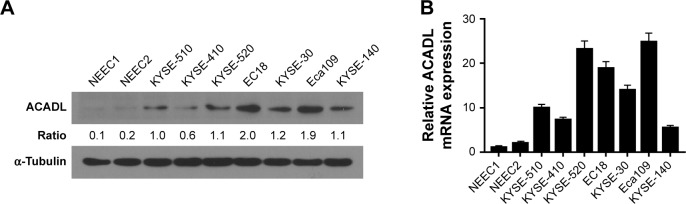
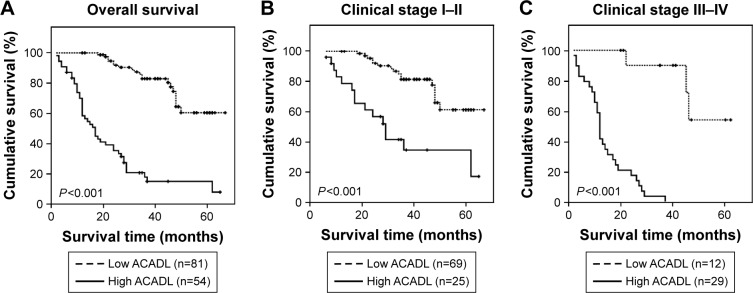
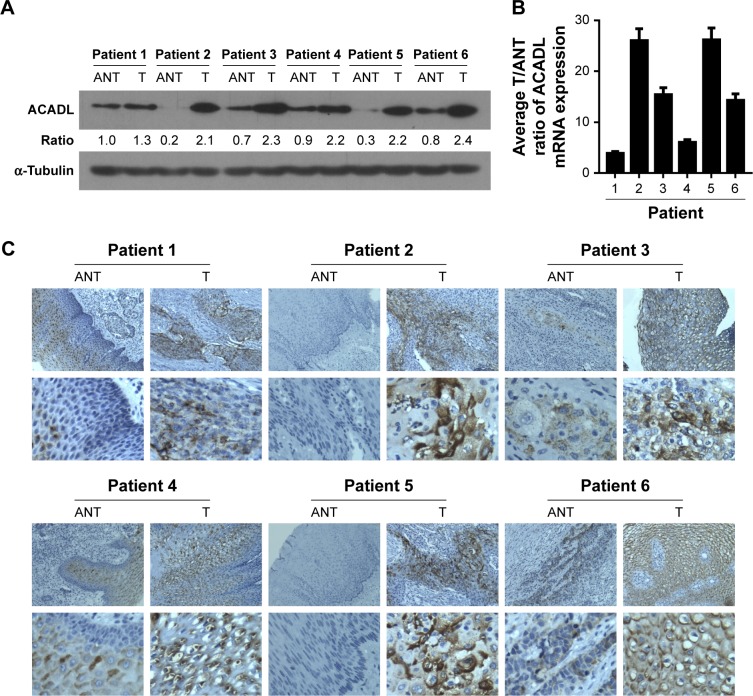
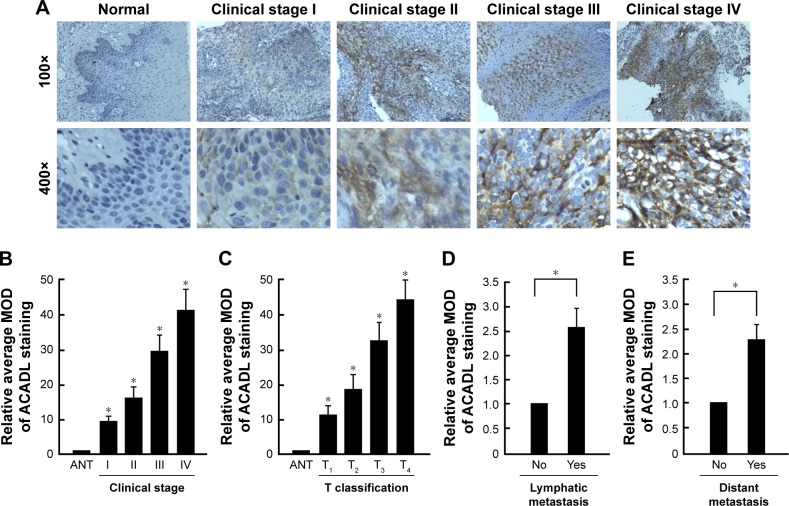
The expression of ACADL was analyzed via real-time PCR and Western blotting to assess mRNA and protein levels in ESCC cell lines and normal esophageal epithelial cells (NEECs), in six paired ESCC tumors and relative normal tissues. Furthermore, immunohistochemical staining was performed on 135 paraffin-embedded ESCC specimens to assess ACADL expression. The clinicopathological significance of ACADL expression was further investigated via survival analysis and Cox regression analysis.
ACADL was found to be markedly upregulated in ESCC cell lines when compared with NEECs. Moreover, various experiments such as quantitative real-time PCR, Western blot, and immunohistochemical analyses all revealed that ACADL expression was increased in all six paired ESCC tumors and matched normal tissues. Furthermore, immunohistochemical analysis revealed an increased level of ACADL protein expression in all 135 paraffin-embedded samples from ESCC patients, which increased with disease progression.
We demonstrated that ACADL is overexpressed in ESCC, both in cell lines and clinical specimens. ACADL is found to be a vital regulator in ESCC progression and can predict a worse outcome for ESCC patients, suggesting that ACADL might be a valuable molecule to be targeted for clinical therapy of ESCC treatment.
酰基辅酶A脱氢酶长链(ACADL)被发现与癌症的恶性进展相关。然而,ACADL在临床治疗中是否发挥作用仍不清楚。本研究将探讨ACADL在食管鳞状细胞癌(ESCC)中的临床病理作用。
通过实时PCR和蛋白质印迹法分析ACADL的表达,以评估ESCC细胞系和正常食管上皮细胞(NEECs)、6对ESCC肿瘤及其相对正常组织中的mRNA和蛋白质水平。此外,对135例石蜡包埋的ESCC标本进行免疫组织化学染色,以评估ACADL的表达。通过生存分析和Cox回归分析进一步研究ACADL表达的临床病理意义。
与NEECs相比,ESCC细胞系中ACADL明显上调。此外,定量实时PCR、蛋白质印迹和免疫组织化学分析等各种实验均显示,6对ESCC肿瘤及其配对的正常组织中ACADL表达均增加。此外,免疫组织化学分析显示,135例ESCC患者石蜡包埋样本中ACADL蛋白表达水平均升高,且随疾病进展而增加。
我们证明ACADL在ESCC细胞系和临床标本中均过表达。ACADL是ESCC进展的重要调节因子,可预测ESCC患者预后较差,提示ACADL可能是ESCC临床治疗中一个有价值的靶向分子。