Xiang Jiali, Wang Shumin, He Yang, Xu Lei, Zhang Shanshan, Tang Zhengyi
Department of Endocrine and Metabolism Disease, Ruijin Hospital Affiliated to Shanghai Jiaotong University School of Medicine, Shanghai Institute of Endocrine and Metabolism Disease, Shanghai, 200025, China.
Diabetes Ther. 2019 Feb;10(1):95-105. doi: 10.1007/s13300-018-0536-8. Epub 2018 Nov 21.
The effect of glycemic control on wound healing in patients with diabetic foot ulcers (DFUs) is inconsistent among different studies. This study was performed to investigate the association between level of hemoglobin A1c (HbA1c) at baseline as well as during treatment and wound healing and mortality in patients with DFU.
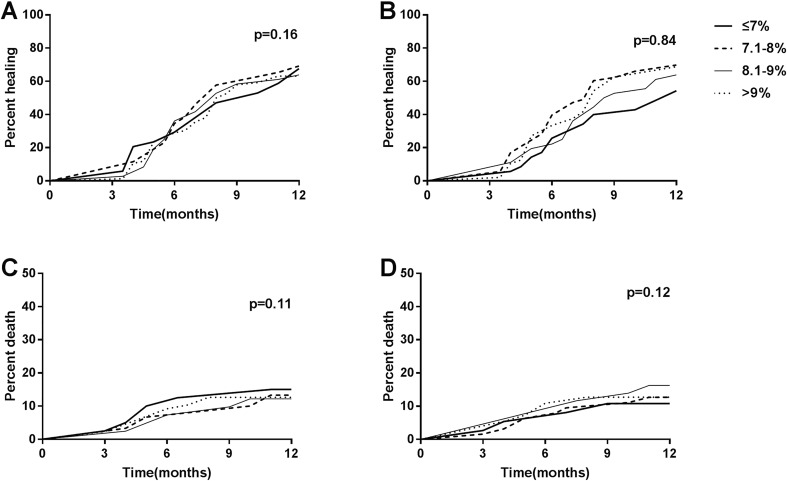
Hospitalized DFU patients were recruited consecutively with their basic clinical data collected and treated according to clinical practice guidelines. These patients were followed-up for 1 year to observe the outcomes, including ulcer healing and death. The associations between baseline HbA1c level or mean HbA1c level during treatment and wound healing as well as mortality were evaluated in univariate and multivariate logistic regression models.
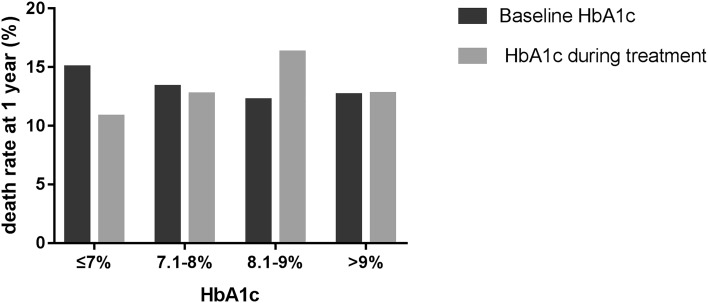
By the end of the follow-up, 40 (13.4%) patients had died. A total of 168 (65.1%) patients achieved ulcer healing in the remaining 258 living participants. Baseline HbA1c was not associated with ulcer healing in unadjusted or adjusted models (P > 0.05). The wound healing rate was higher (OR 2.01, 95% CI 1.02-3.96, P < 0.05) after adjustment when HbA1c was controlled between 7.0% and 8.0% during treatment compared to HbA1c controlled at less than 7.0%. This probability of ulcer healing increased to 3 (OR = 3.01, 95% CI 1.32-6.86, P = 0.01) after adjustment in the subgroup with baseline HbA1c no more than 8.0%. Neither baseline HbA1c nor mean HbA1c during treatment presented any correlation with 1-year death rate.
A reasonable HbA1c target, a range between 7.0% and 8.0% during treatment, could facilitate ulcer healing without increase of mortality in patients with DFU, especially for those with better glycemic control at admission.
不同研究中,血糖控制对糖尿病足溃疡(DFU)患者伤口愈合的影响并不一致。本研究旨在探讨基线及治疗期间糖化血红蛋白(HbA1c)水平与DFU患者伤口愈合及死亡率之间的关联。
连续招募住院DFU患者,收集其基本临床资料,并按照临床实践指南进行治疗。对这些患者进行1年随访以观察结局,包括溃疡愈合和死亡情况。在单因素和多因素逻辑回归模型中评估基线HbA1c水平或治疗期间平均HbA1c水平与伤口愈合及死亡率之间的关联。
随访结束时,40例(13.4%)患者死亡。在其余258名存活参与者中,共有168例(65.1%)患者实现溃疡愈合。在未调整或调整后的模型中,基线HbA1c与溃疡愈合均无关联(P>0.05)。与治疗期间HbA1c控制在低于7.0%相比,当治疗期间HbA1c控制在7.0%至8.0%之间时,调整后伤口愈合率更高(OR 2.01,95%CI 1.02 - 3.96,P<0.05)。在基线HbA1c不超过8.0%的亚组中,调整后溃疡愈合概率增至3倍(OR = 3.01,95%CI 1.32 - 6.86,P = 0.01)。基线HbA1c及治疗期间平均HbA1c均与1年死亡率无相关性。
合理的HbA1c目标,即治疗期间控制在7.0%至8.0%之间,可促进DFU患者溃疡愈合且不增加死亡率,尤其是入院时血糖控制较好的患者。