Bassoli Elena, Sola Antonella, Celesti Mattia, Calcagnile Sandro, Cavallini Carlo
Department of Engineering "Enzo Ferrari", University of Modena and Reggio Emilia, Via P. Vivarelli, 10, 41125 Modena, Italy.
Metal Additive Research Centre, HPE s.r.l., Via R. Dalla Costa, 620, 41122 Modena, Italy.
Materials (Basel). 2018 Nov 22;11(12):2356. doi: 10.3390/ma11122356.
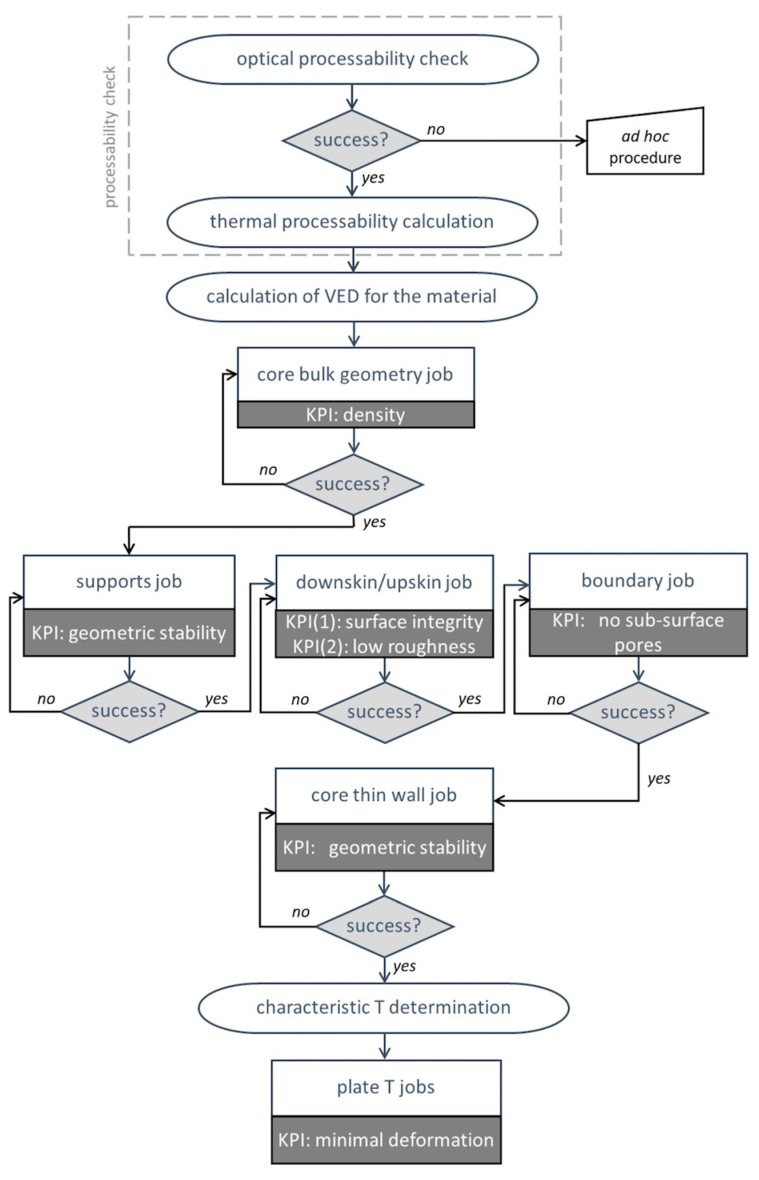
In spite of the fast growth of laser-based powder bed fusion (L-PBF) processes as a part of everyday industrial practice, achieving consistent production is hampered by the scarce repeatability of performance that is often encountered across different additive manufacturing (AM) machines. In addition, the development of novel feedstock materials, which is fundamental to the future growth of AM, is limited by the absence of established methodologies for their successful exploitation. This paper proposes a structured procedure with a complete test plan, which defines step-by-step the standardized actions that should be taken to optimize the processing parameters and scanning strategy in L-PBF of new alloy grades. The method is holistic, since it considers all the laser/material interactions in different local geometries of the build, and suggests, for each possible interaction, a specific geometry for test specimens, standard energy parameters to be analyzed through a design of experiment, and measurable key performance indicators. The proposed procedure therefore represents a sound and robust aid to the development of novel alloy grades for L-PBF and to the definition of the most appropriate processing conditions for them, independent of the specific AM machine applied.
尽管基于激光的粉末床熔融(L-PBF)工艺作为日常工业实践的一部分发展迅速,但由于不同增材制造(AM)机器之间性能的可重复性较差,实现稳定生产受到阻碍。此外,新型原料材料的开发是增材制造未来发展的基础,但由于缺乏成功利用这些材料的既定方法,其发展受到限制。本文提出了一种具有完整测试计划的结构化程序,该程序逐步定义了在新型合金牌号的L-PBF中优化工艺参数和扫描策略应采取的标准化行动。该方法是整体性的,因为它考虑了构建体不同局部几何形状中的所有激光/材料相互作用,并针对每种可能的相互作用,提出了测试试样的特定几何形状、通过实验设计进行分析的标准能量参数以及可测量的关键性能指标。因此,所提出的程序对于为L-PBF开发新型合金牌号以及为其定义最合适的加工条件是一个合理且可靠的辅助工具,与所应用的特定AM机器无关。