Abdelghany Amani M, Rezk Nasser Sadek, Osman Mona Mostafa, Hamid Amira I, Al-Breedy Ashraf Mohammad, Abdelsattar Hoda A
Department of Clinical Pathology, Faculty of Medicine, Ain Shams University, Cairo, Egypt.
Department of Tropical Medicine and Infectious Diseases, Faculty of Medicine, Ain Shams University, Cairo, Egypt.
F1000Res. 2018 Aug 24;7:1339. doi: 10.12688/f1000research.14795.1. eCollection 2018.
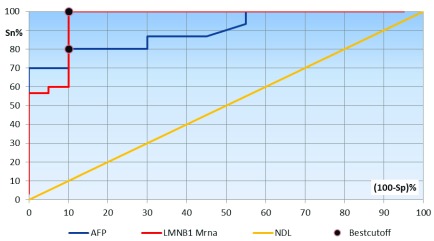
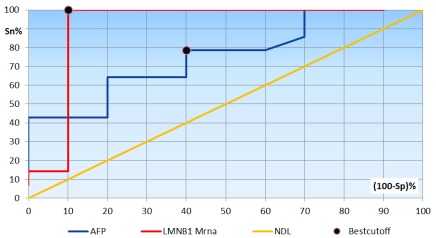
Hepatocellular carcinoma (HCC) is vital medical issue in Egypt. It accounts for 70.48% of all liver tumors among Egyptians. The aim of this study was to determine the diagnostic role of plasma levels of mRNA of lamin B1 by RT-qPCR as an early marker of HCC. This study was conducted at the Clinical Pathology Department in collaboration with the Department of Tropical Medicine and Infectious Diseases at Ain Shams University Hospitals. It included 30 patients with primary HCC and viral cirrhosis (all were hepatitis C virus-positive) (Group I), in addition to 10 patients with chronic liver diseases (Group II) and 10 healthy age- and sex-matched subjects (Group III). Group I was further classified according to the Barcelona-Clinic Liver Cancer Staging System. Serum α-fetoprotein (AFP) chemiluminescent-immunoassays and RT-qPCR analysis of plasma lamin B1 mRNA levels were performed for all participants. AFP and lamin B1 significantly elevated in patients with HCC compared to those in the other studied groups. AFP and lamin B1 status could discriminate group I from group II and III. A significant increase was found among the three Barcelona stages with regards to AFP and lamin B1 levels. A significant decrease was found between group II and stage 0, A and B with regards to AFP and lamin B1. Lamin B1 and AFP could both differentiate HCC patients with one tumor nodule (T1) from those with two or more tumor nodules (T2&Tm), as well as between those with tumor sizes >3 cm and ≤3 cm. Measurement of lamin B1 mRNA is recommended in patients with chronic liver disease with normal serum AFP, especially in known cirrhotic patients that deteriorate rapidly without any apparent etiology.
肝细胞癌(HCC)是埃及一个至关重要的医学问题。它占埃及人所有肝脏肿瘤的70.48%。本研究的目的是通过逆转录定量聚合酶链反应(RT-qPCR)测定层粘连蛋白B1(lamin B1)血浆mRNA水平作为HCC早期标志物的诊断作用。本研究在艾因夏姆斯大学医院临床病理科与热带医学和传染病科合作开展。研究包括30例原发性HCC和病毒性肝硬化患者(均为丙型肝炎病毒阳性)(第一组),此外还有10例慢性肝病患者(第二组)和10例年龄及性别匹配的健康受试者(第三组)。第一组根据巴塞罗那临床肝癌分期系统进一步分类。对所有参与者进行血清甲胎蛋白(AFP)化学发光免疫分析和血浆lamin B1 mRNA水平的RT-qPCR分析。与其他研究组相比,HCC患者的AFP和lamin B1显著升高。AFP和lamin B1状态可将第一组与第二组和第三组区分开来。在巴塞罗那三个分期中,AFP和lamin B1水平有显著升高。在第二组与0期、A期和B期之间,AFP和lamin B1有显著降低。Lamin B1和AFP均可将单个肿瘤结节(T1)的HCC患者与两个或更多肿瘤结节(T2&Tm)的患者区分开来,也可区分肿瘤大小>3 cm和≤3 cm的患者。对于血清AFP正常的慢性肝病患者,尤其是已知肝硬化且无明显病因却迅速恶化的患者,建议检测lamin B1 mRNA。