School of Health Sciences, Swinburne University of Technology, H95 PO BOX 218, Hawthorn, VIC, 3122, Australia.
The Dementia Centre for Research Collaboration, Queensland University of Technology, Brisbane, Australia.
BMC Geriatr. 2018 Nov 23;18(1):287. doi: 10.1186/s12877-018-0966-1.
Residential Aged Care Facilities (RACFs) are moving towards a Consumer Directed Care (CDC) model of care. There are limited examples of CDC in ageing research, and no evaluation of a comprehensive CDC intervention in residential care was located. This study will implement and evaluate a staff training program, Resident at the Center of Care (RCC), designed to facilitate and drive CDC in residential care.
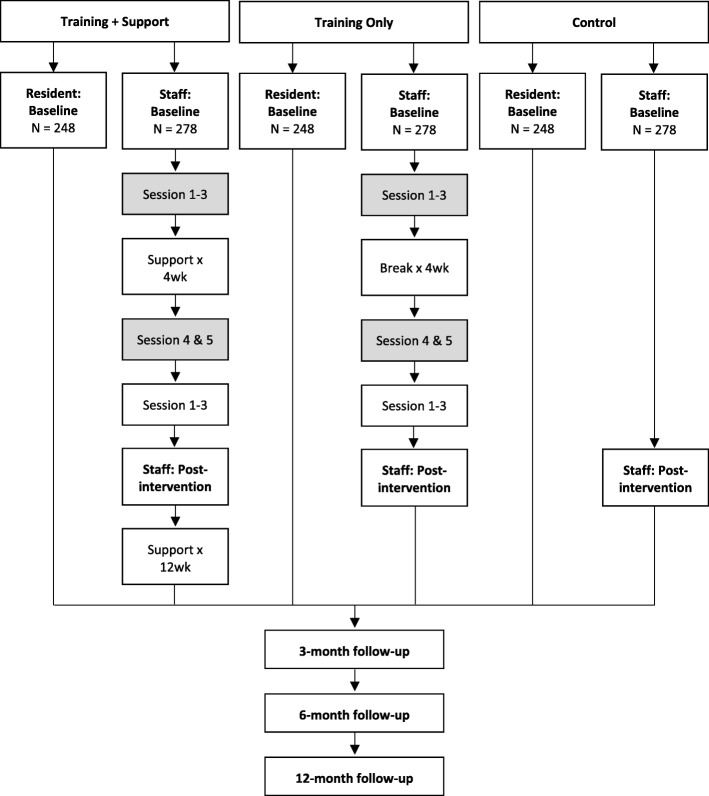
The study will adopt a cluster randomized controlled design with 39 facilities randomly allocated to one of three conditions: delivery of the RCC program plus additional organizational support, delivery of the program without additional support, and care as usual. A total of 834 staff (22 in each facility, half senior, half general staff) as well as 744 residents (20 in each facility) will be recruited to participate in the study. The RCC program comprises five sessions spread over nine weeks: Session 1 clarifies CDC principles; Sessions 2 to 5 focus on skills to build and maintain working relationships with residents, as well as identifying organizational barriers and facilitators regarding the implementation of CDC. The primary outcome measure is resident quality of life. Secondary outcome measures are resident measures of choice and control, the working relationship between resident and staff; staff reports of transformational leadership, job satisfaction, intention to quit, experience of CDC, work role stress, organizational climate, and organizational readiness for change. All measures will be completed at four time points: pre-intervention, 3-months, 6-months, and 12-month follow-up. Primary analyses will be conducted on an intention to treat basis. Outcomes for the three conditions will be compared with multilevel linear regression modelling.
The RCC program is designed to improve the knowledge and skills of staff and encourage transformational leadership and organizational change that supports implementation of CDC. The overarching goal is to improve the quality of life and care of older people living in residential care.
ACTRN12618000779279; Registered 9 May 2018 with the Australian and New Zealand Clinical Trials Registry (ANZCTR; http://www.anzctr.org.au/ ).
养老院正朝着以消费者为导向的护理(CDC)模式转变。老龄化研究中 CDC 的例子有限,也没有找到针对住宅护理中综合 CDC 干预的评估。本研究将实施和评估一项员工培训计划,即“以居民为中心的护理(RCC)”,旨在促进和推动住宅护理中的 CDC。
该研究将采用集群随机对照设计,将 39 家机构随机分配到以下三种条件之一:提供 RCC 计划加额外的组织支持、提供计划而没有额外支持以及常规护理。共有 834 名员工(每家机构 22 名,一半是高级员工,一半是普通员工)以及 744 名居民(每家机构 20 名)将被招募参与研究。RCC 计划包括五个为期九周的课程:第 1 节课阐明了 CDC 的原则;第 2 至 5 节课侧重于建立和维护与居民关系的技能,以及识别有关实施 CDC 的组织障碍和促进因素。主要结果衡量指标是居民的生活质量。次要结果衡量指标是居民的选择和控制措施、居民与员工之间的工作关系;员工报告的变革型领导、工作满意度、离职意向、CDC 经验、工作角色压力、组织氛围以及组织对变革的准备情况。所有措施将在四个时间点进行评估:干预前、3 个月、6 个月和 12 个月随访。主要分析将基于意向治疗原则进行。将使用多层次线性回归模型比较三种条件的结果。
RCC 计划旨在提高员工的知识和技能,并鼓励变革型领导和组织变革,以支持 CDC 的实施。总体目标是提高居住在养老院的老年人的生活质量和护理水平。
ACTRN12618000779279;于 2018 年 5 月 9 日在澳大利亚和新西兰临床试验注册中心(ANZCTR;http://www.anzctr.org.au/ )注册。