
人类癌症转移的胚胎斑马鱼异种移植试验
Embryonic zebrafish xenograft assay of human cancer metastasis.
作者信息
Hill David, Chen Lanpeng, Snaar-Jagalska Ewe, Chaudhry Bill
机构信息
Institute of Cellular Medicine, Newcastle University, UK, Newcastle upon Tyne, NE2 4HH, UK.
Institute of Genetic Medicine, Newcastle University, UK, Newcastle upon Tyne, NE1 3BZ, UK.
出版信息
F1000Res. 2018 Oct 22;7:1682. doi: 10.12688/f1000research.16659.2. eCollection 2018.
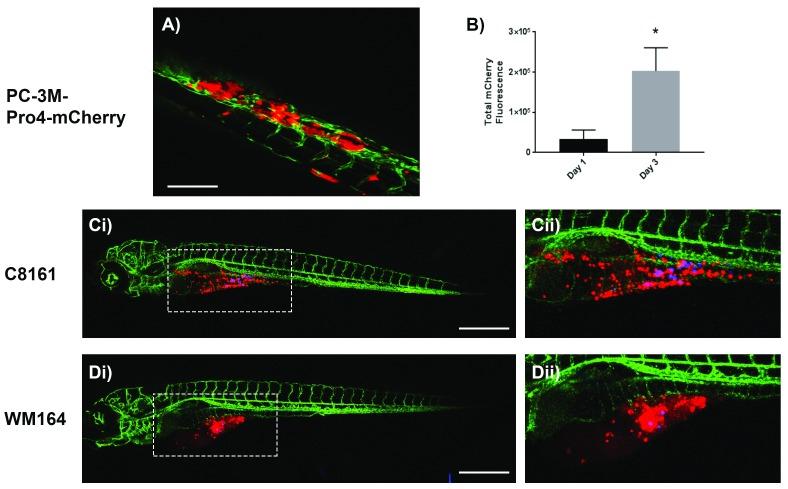
Cancer metastasis is the most important prognostic factor determining patient survival, but currently there are very few drugs or therapies that specifically inhibit the invasion and metastasis of cancer cells. Currently, human cancer metastasis is largely studied using transgenic and immunocompromised mouse xenograft models, which are useful for analysing end-point tumour growth but are unable to accurately and reliably monitor invasion, intravasation, extravasation or secondary tumour formation of human cancer cells. Furthermore, limits in our ability to accurately monitor early stages of tumour growth and detect micro-metastases likely results in pain and suffering to the mice used for cancer xenograft experiments. Zebrafish ( ) embryos, however, offer many advantages as a model system for studying the complex, multi-step processes involved during cancer metastasis. This article describes a detailed method for the analysis of human cancer cell invasion and metastasis in zebrafish embryos before they reach protected status at 5 days post fertilisation. Results demonstrate that human cancer cells actively invade within a zebrafish microenvironment, and form metastatic tumours at secondary tissue sites, suggesting that the mechanisms involved during the different stages of metastasis are conserved between humans and zebrafish, supporting the use of zebrafish embryos as a viable model of human cancer metastasis. We suggest that the embryonic zebrafish xenograft model of human cancer is a tractable laboratory model that can be used to understand cancer biology, and as a direct replacement of mice for the analysis of drugs that target cancer invasion and metastasis.
癌症转移是决定患者生存的最重要预后因素,但目前专门抑制癌细胞侵袭和转移的药物或疗法非常少。目前,人类癌症转移主要使用转基因和免疫缺陷小鼠异种移植模型进行研究,这些模型对于分析终点肿瘤生长很有用,但无法准确可靠地监测人类癌细胞的侵袭、血管内渗入、血管外渗或继发性肿瘤形成。此外,我们准确监测肿瘤生长早期阶段和检测微转移的能力有限,这可能会给用于癌症异种移植实验的小鼠带来痛苦。然而,斑马鱼胚胎作为研究癌症转移过程中复杂多步骤的模型系统具有许多优势。本文描述了一种在受精后5天达到受保护状态之前分析斑马鱼胚胎中人类癌细胞侵袭和转移的详细方法。结果表明,人类癌细胞在斑马鱼微环境中积极侵袭,并在二级组织部位形成转移性肿瘤,这表明转移不同阶段所涉及的机制在人类和斑马鱼之间是保守的,支持将斑马鱼胚胎用作人类癌症转移的可行模型。我们认为,人类癌症的胚胎斑马鱼异种移植模型是一种易于处理的实验室模型,可用于理解癌症生物学,并可直接替代小鼠来分析靶向癌症侵袭和转移的药物。


 Zotero 插件