Dario Maria Augusta, Andrade Tassiane Emanuelle Servare, Dos Santos Claudiney Biral, Fux Blima, Brandão Adeilton Alves, Falqueto Aloísio
Unidade de Medicina Tropical, Universidade Federal do Espírito Santo (UFES), Av. Marechal Campos, 1468, Vitória, ES 29043-900, Brazil.
Núcleo de Entomologia e Malacologia, Secretaria de estado da Saúde (SESA/ES), Rua Pedro Zangradini, 320, Serra, ES 29164-020, Brazil.
Parasite. 2018;25:59. doi: 10.1051/parasite/2018060. Epub 2018 Nov 26.
In rural areas of Espírito Santo state, southeast Brazil, triatomine species attracted by light frequently invade residences. The aim of this study was to investigate the Trypanosoma cruzi discrete typing units (DTUs) harbored by these triatomines.
Triatomine's intestinal contents were examined, inoculated in mice, and the positive samples were cultivated. Flagellates obtained from infected mice hemoculture were submitted to DNA extraction using a salting-out method and to TcSC5D gene amplification. The amplified samples were sequenced, and polymorphism was analyzed for DTU identification.
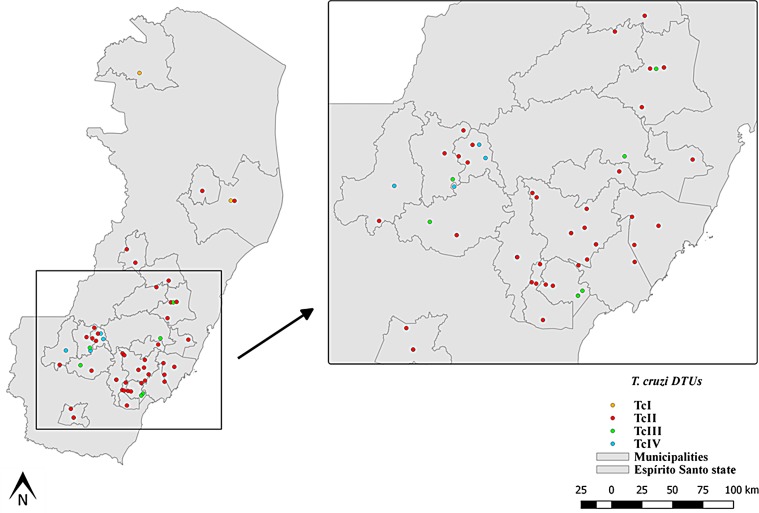
Three hundred and ninety-four triatomines were identified: Triatoma vitticeps (90.03%), Panstrongylus geniculatus (8.89%), Panstrongylus megistus (0.54%), Panstrongylus diasi (0.27%), and Triatoma tibiamaculata (0.27%). Among the specimens, 251/394 (67.65%) presented flagellated forms similar to T. cruzi. After triatomine intestinal content inoculation into mice, 134 mice presented T. cruzi-like trypomastigotes from Tr. vitticeps and P. geniculatus and 89 samples were positive in hemoculture. Sixty-two samples were analyzed for the TcSC5D gene and TcI, TcII, TcIII, and TcIV DTUs were identified.
We observed T. cruzi DTU diversity in Tr. vitticeps and P. geniculatus, which showed the predominance of TcII and occurrence of TcI, TcIII and TcIV. Triatomines presented high T. cruzi infection rates. Since little is known regarding the possible mammalian hosts that maintain the T. cruzi cycle, further studies are necessary to obtain a better understanding of the parasite transmission cycle in this region.
在巴西东南部圣埃斯皮里图州的农村地区,受灯光吸引的锥蝽种类经常侵入住宅。本研究的目的是调查这些锥蝽所携带的克氏锥虫离散型别单位(DTUs)。
检查锥蝽的肠道内容物,接种到小鼠体内,并对阳性样本进行培养。从感染小鼠血液培养物中获得的鞭毛虫采用盐析法进行DNA提取,并进行TcSC5D基因扩增。对扩增后的样本进行测序,并分析多态性以鉴定DTU。
共鉴定出394只锥蝽:黑头锥蝽(90.03%)、膝状锥蝽(8.89%)、大锥蝽(0.54%)、迪亚斯锥蝽(0.27%)和胫斑锥蝽(0.27%)。在这些样本中,251/394(67.65%)呈现出与克氏锥虫相似的鞭毛形态。将锥蝽肠道内容物接种到小鼠体内后,134只小鼠出现了来自黑头锥蝽和膝状锥蝽的克氏锥虫样锥鞭毛体,89个样本在血液培养中呈阳性。对62个样本进行TcSC-5D基因分析,鉴定出TcI、TcII、TcIII和TcIV DTUs。
我们在黑头锥蝽和膝状锥蝽中观察到克氏锥虫DTU多样性,显示出TcII占优势以及TcI、TcIII和TcIV的出现。锥蝽呈现出较高的克氏锥虫感染率。由于对于维持克氏锥虫循环的可能哺乳动物宿主知之甚少,因此需要进一步研究以更好地了解该地区的寄生虫传播循环。