Department of Pediatrics, Division of Pediatric Critical Care, Texas Children's Hospital, Houston, Texas, United States of America.
Department of Pediatrics, Division of Pediatric Critical Care, Riley Hospital for Children at the University of Indiana Health, Indianapolis, Indiana, United States of America.
PLoS One. 2018 Nov 26;13(11):e0207620. doi: 10.1371/journal.pone.0207620. eCollection 2018.
Immunocompromised pediatric patients constitute a growing population that is particularly vulnerable to bacterial infection, necessitating prompt recognition and treatment. This study assessed the utility of interleukin-27 (IL-27) and procalcitonin (PCT) as biomarkers of bacterial infection among immunocompromised pediatric subjects.
This is a single-center prospective cohort study conducted from July 2016 through September 2017, drawing subjects from the inpatient units at Cincinnati Children's Hospital Medical Center (CCHMC), a large, tertiary care children's hospital. Patients were included if they fit the definition of immunocompromised and were under clinical suspicion for infection, defined by the acquisition of a blood culture at any point during the admission. The primary analysis assessed the accuracy of IL-27 to diagnose bacterial infection in immunocompromised pediatric patients, using PCT as a comparator.
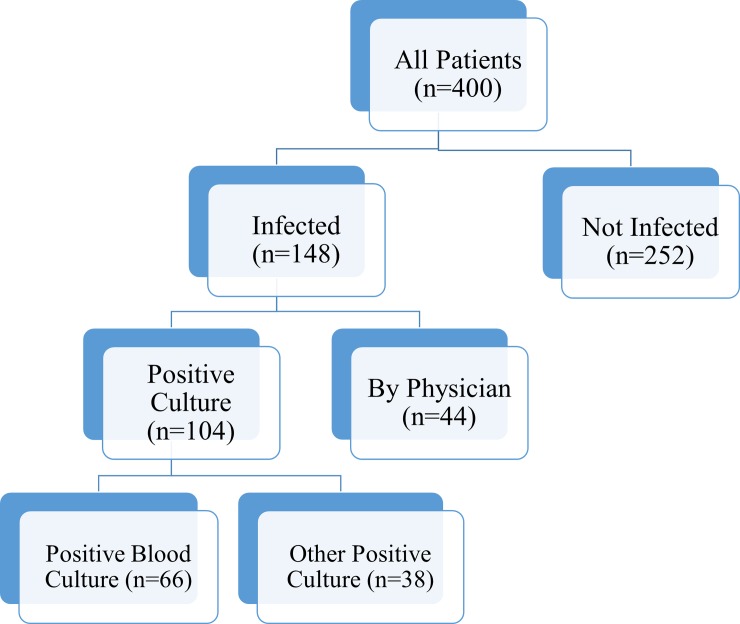
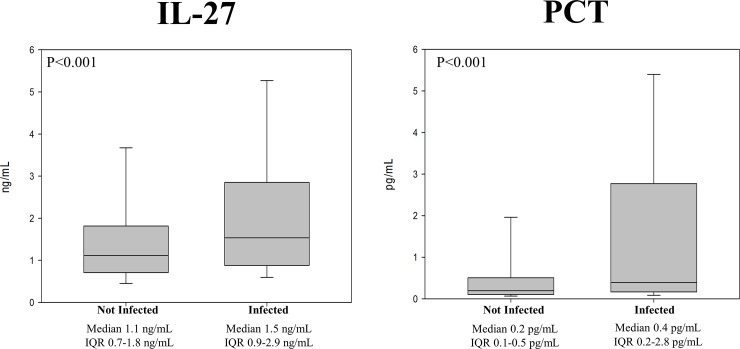
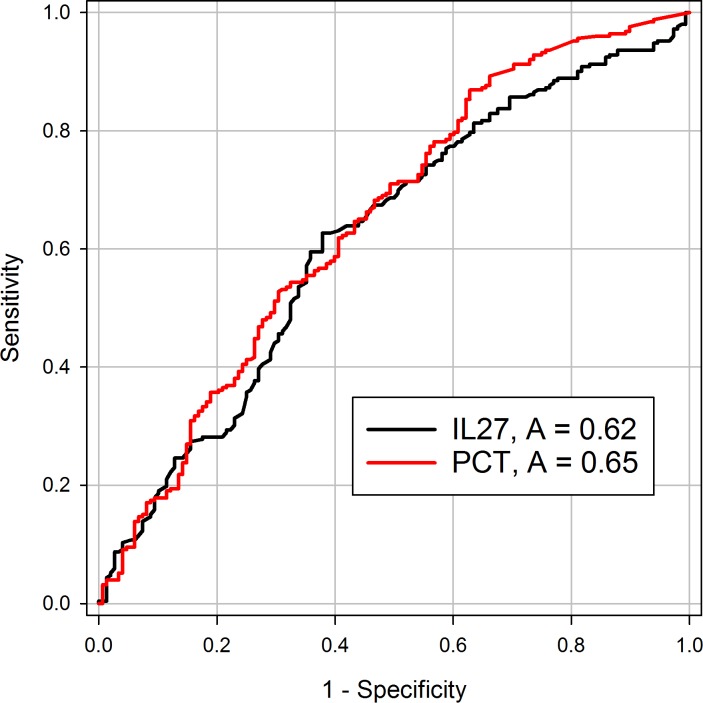
293 patients were recruited, representing 400 episodes of suspected bacterial infection. The median age was 7.8 years (IQR 3.1-13.8 years). Fifty-three percent (n = 213) of the population had a primary oncologic diagnosis, 24% (n = 95) had received a bone marrow transplant, and 21% (n = 85) had received a solid organ transplant. The overall infection rate was 37%, with 70% of those patients having some form of culture positivity. Twenty-eight-day mortality was 5%, 60-day mortality was 9%, with 87% of patients surviving to hospital discharge. The AUC's of the ROC curve to diagnose bacterial infection were 0.62 (0.5-0.68) for IL-27 and 0.65 (0.6-0.73) for PCT. Using the previously determined cutoff of 5.0 ng/mL, the specificity of IL-27 to diagnose bacterial infection reached 94%, with a negative predictive value of 64%.
Despite prior work demonstrating IL-27 and PCT as possible biomarkers of bacterial infection in immunocompromised pediatric patients, we were unable to validate these findings. This illustrates the challenges associated with developing reliable biomarkers of bacterial infection in this vulnerable population.
免疫功能低下的儿科患者群体不断扩大,他们特别容易受到细菌感染,因此需要及时识别和治疗。本研究评估了白细胞介素-27(IL-27)和降钙素原(PCT)作为免疫功能低下儿科患者细菌感染生物标志物的效用。
这是一项单中心前瞻性队列研究,于 2016 年 7 月至 2017 年 9 月期间在辛辛那提儿童医院医疗中心(CCHMC)的住院病房进行,该中心是一家大型的三级儿童医院。如果患者符合免疫功能低下的定义且在住院期间任何时间点均获得血培养,则认为其存在感染的临床疑似病例。主要分析评估了 IL-27 诊断免疫功能低下儿科患者细菌感染的准确性,以 PCT 为比较指标。
共招募了 293 例患者,代表 400 例疑似细菌感染的患者。中位年龄为 7.8 岁(IQR 3.1-13.8 岁)。53%(n=213)的患者有原发性肿瘤诊断,24%(n=95)接受了骨髓移植,21%(n=85)接受了实体器官移植。总体感染率为 37%,其中 70%的患者有某种形式的培养阳性。28 天死亡率为 5%,60 天死亡率为 9%,87%的患者存活至出院。诊断细菌感染的 ROC 曲线的 AUC 为 0.62(0.5-0.68)的 IL-27 和 0.65(0.6-0.73)的 PCT。使用先前确定的 5.0ng/mL 截断值,IL-27 诊断细菌感染的特异性达到 94%,阴性预测值为 64%。
尽管先前的工作表明 IL-27 和 PCT 可能是免疫功能低下儿科患者细菌感染的生物标志物,但我们未能验证这些发现。这说明了在这个脆弱人群中开发可靠的细菌感染生物标志物所面临的挑战。