Third Department of Internal Medicine, Nara Medical University, 840 Shijo-cho, Kashihara, Nara, 634-8522, Japan.
BMC Cancer. 2018 Nov 26;18(1):1164. doi: 10.1186/s12885-018-5099-6.
Insulin resistance (IR) is closely associated with the progression of hepatocellular carcinoma (HCC). Acyclic retinoid (ACR) targets retinoid X receptor α and reportedly prevents HCC recurrence in clinical practice. Angiotensin-II receptor blocker (ARB) can also inhibit experimental hepatocarcinogenesis and HCC development. These are reported to suppress IR-based hepatocarcinogenesis; however, limited data are available regarding the combined effects of both these agents. This study aimed to investigate the combined chemopreventive effect of ACR and ARB on liver tumorigenesis on rats with congenital diabetes.
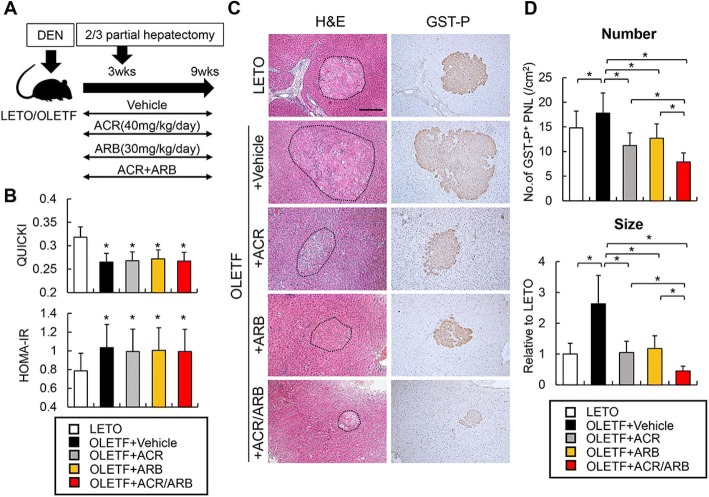
Male diabetic Otsuka Long-Evans Tokushima Fatty (OLETF) and non-diabetic Long-Evans Tokushima Otsuka (LETO) rats underwent 70% partial hepatectomy following a single intraperitoneal injection of diethylnitrosamine to induce hepatocarcinogenesis and the administration of ACR (peretinoin, 40 mg/kg/day), ARB (losartan, 30 mg/kg/day), and a combination of ACR and ARB. Six weeks thereafter, we assessed the size and number of the pre-neoplastic lesions (PNL) as well as the altered angiogenesis, oxidative stress, and chronic inflammation in the liver. Moreover, we assessed the effects exerted by ACR and ARB on in vitro cell growth in human HCC cell lines and human umbilical vascular endothelial cells (HUVECs).
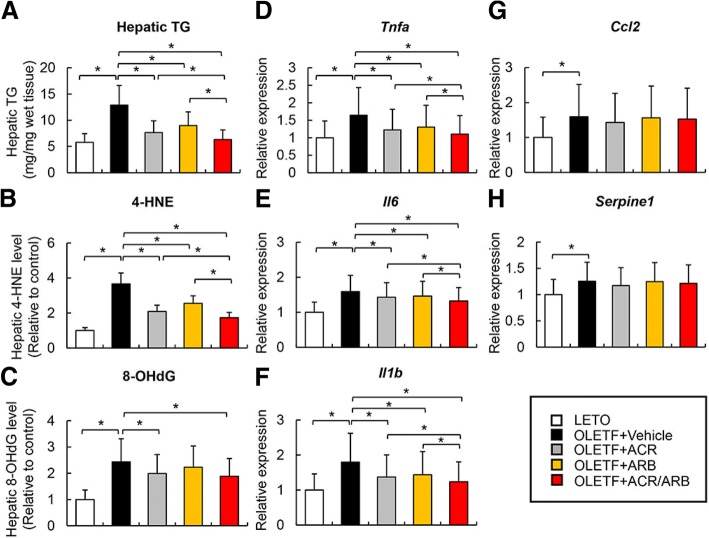
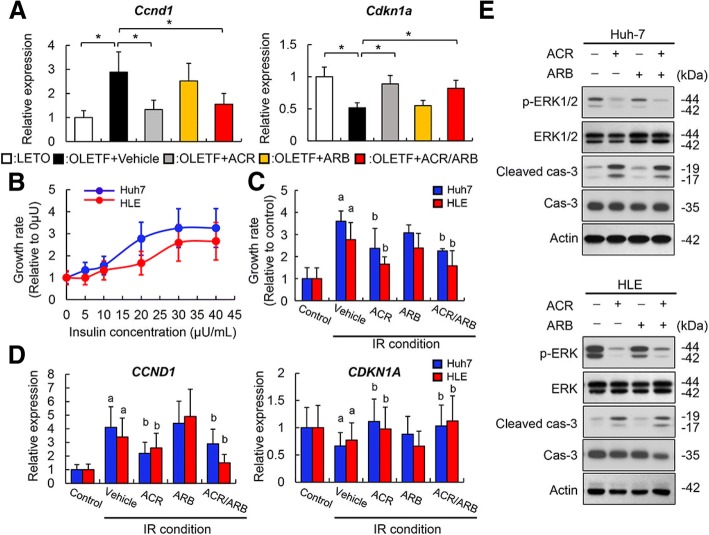
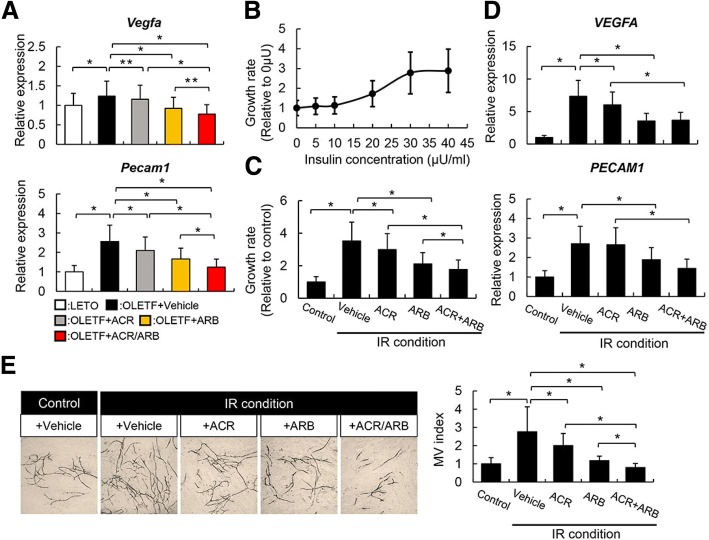
OLETF rats showed increase in the size and number of PNLs compared to LETO rats. ACR suppressed the augmentation in size and number of PNLs in the OLETF rats with suppression of cell growth, intrahepatic angiogenesis, lipid peroxidation, oxidative DNA damage, and proinflammatory cytokine production. Combining ACR with ARB enhanced the tumor-suppressive effect and ameliorated intrahepatic angiogenesis, lipid peroxidation, and proinflammatory status; however, cell growth and oxidative DNA damage remained unchanged. IR-mimetic condition accelerated in vitro proliferative activity in human HCC cells, while ACR inhibited this proliferation with G0/G1 arrest and apoptosis. Furthermore, ACR and ARB significantly attenuated the HUVECs proliferation and tubular formation under the IR-mimetic condition, and a combination of both agents demonstrated greater inhibitory effects on HUVEC growth than each single treatment.
ACR and ARB exert a combined inhibitory effect against IR-based hepatocarcinogenesis by the inhibition of cell growth, intrahepatic angiogenesis, and oxidative stress. Thus, this combination therapy appears to hold potential as a chemopreventive treatment therapy against HCC.
胰岛素抵抗(IR)与肝细胞癌(HCC)的进展密切相关。无环维甲酸(ACR)靶向视黄酸 X 受体 α,并据报道可预防临床实践中的 HCC 复发。血管紧张素 II 受体阻滞剂(ARB)也可以抑制实验性肝癌发生和 HCC 发展。这些药物据报道可抑制基于 IR 的肝癌发生;然而,关于这两种药物联合作用的相关数据有限。本研究旨在探讨 ACR 和 ARB 联合应用对先天性糖尿病大鼠肝肿瘤发生的化学预防作用。
雄性糖尿病 Otsuka Long-Evans Tokushima Fatty(OLETF)和非糖尿病 Long-Evans Tokushima Otsuka(LETO)大鼠接受单次腹腔注射二乙基亚硝胺诱导肝癌发生和 70%部分肝切除术后,给予 ACR(视黄酸乙酯,40mg/kg/天)、ARB(氯沙坦,30mg/kg/天)和 ACR 和 ARB 联合治疗。6 周后,我们评估了前瘤病变(PNL)的大小和数量以及肝脏中改变的血管生成、氧化应激和慢性炎症。此外,我们评估了 ACR 和 ARB 对人 HCC 细胞系和人脐静脉内皮细胞(HUVEC)体外细胞生长的影响。
与 LETO 大鼠相比,OLETF 大鼠的 PNL 大小和数量增加。ACR 抑制了 OLETF 大鼠中 PNL 大小和数量的增加,抑制了细胞生长、肝内血管生成、脂质过氧化、氧化 DNA 损伤和促炎细胞因子的产生。ACR 与 ARB 联合应用增强了肿瘤抑制作用,并改善了肝内血管生成、脂质过氧化和炎症状态;然而,细胞生长和氧化 DNA 损伤保持不变。IR 模拟条件加速了人 HCC 细胞的体外增殖活性,而 ACR 通过 G0/G1 期阻滞和细胞凋亡抑制这种增殖。此外,ACR 和 ARB 在 IR 模拟条件下显著抑制 HUVEC 的增殖和管状形成,并且两种药物的联合应用对 HUVEC 生长的抑制作用大于单一药物的作用。
ACR 和 ARB 通过抑制细胞生长、肝内血管生成和氧化应激,对基于 IR 的肝癌发生发挥联合抑制作用。因此,这种联合治疗方法似乎具有作为 HCC 化学预防治疗的潜力。