Debre Tabor University, College of Health Sciences, Debra Tabor, Ethiopia.
Jimma University, Faculty of Public Health, Human Nutrition Unit, Jimma, Ethiopia.
J Physiol Anthropol. 2018 Nov 26;37(1):26. doi: 10.1186/s40101-018-0185-7.
Measurements of erect height in older people, hospitalized and bedridden patients, and people with skeletal deformity is difficult. As a result, using body mass index for assessing nutritional status is not valid. Height estimated from linear body measurements such as arm span, knee height, and half arm span was shown to be useful surrogate measures of stature. However, the relationship between linear body measurements and stature varies across populations implying the need for the development of population-specific prediction equation. The objective of this study was to develop a formula that predicts height from arm span, half arm span, and knee height for Ethiopian adults and assess its agreement with measured height.
A cross-sectional study was conducted from March 15 to April 21, 2016 in Jimma University among a total of 660 (330 females and 330 males) subjects aged 18-40 years. A two-stage sampling procedure was employed to select study participants. Data were collected using interviewer-administered questionnaire and measurement of anthropometric parameters. The data were edited and entered into Epi Data version 3.1 and exported to SPSS for windows version 20 for cleaning and analyses. Linear regression model was fitted to predict height from knee height, half arm span, and arm span. Bland-Altman analysis was employed to see the agreement between actual height and predicted heights. P values < 0.05 was used to declare as statistically significance.
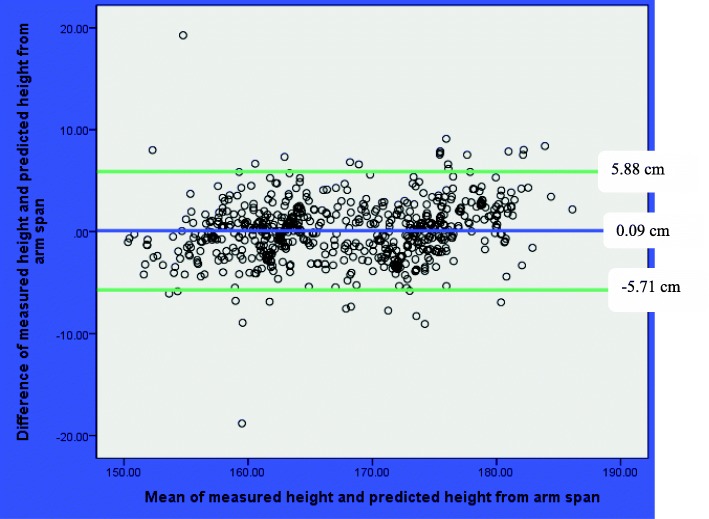
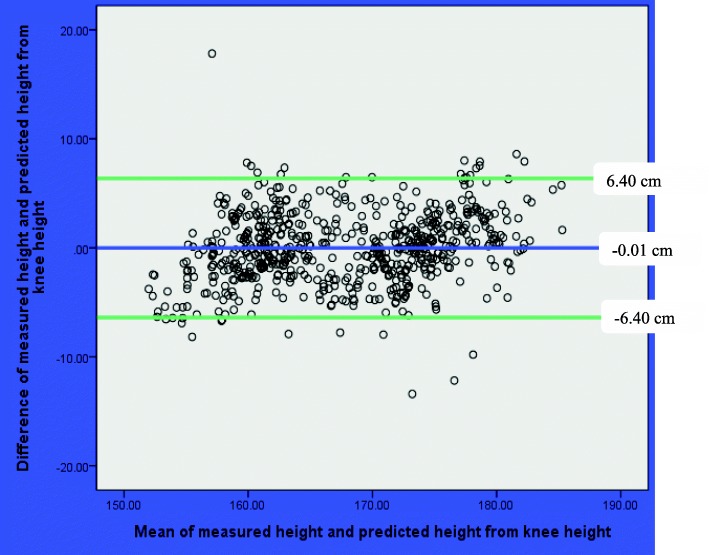
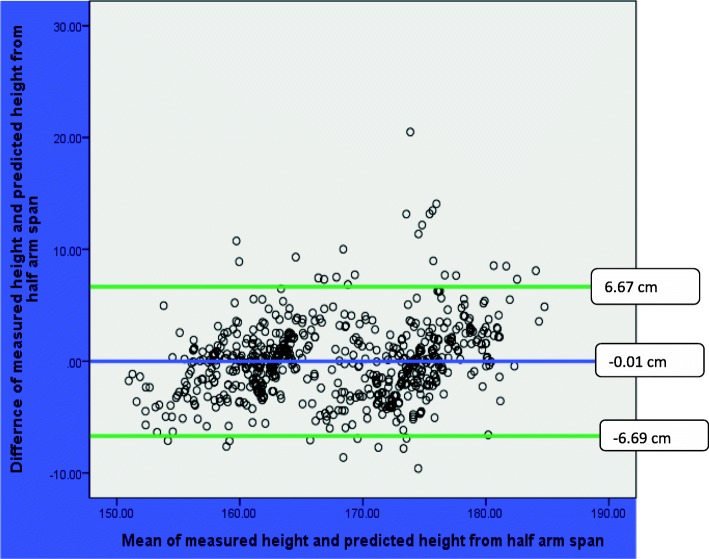
On multivariable linear regression analyses after adjusting for age and sex, arm span (β = 0.63, p < 0.001, R = 87%), half arm span (β = 1.05, p < 0.001, R = 83%), and knee height (β = 1.62, p < 0.001, R = 84%) predicted height significantly. The Bland-Altman analyses showed a good agreement between measured height and predicted height using all the three linear body measurements.
The findings imply that in the context where height cannot be measured, height predicted from arm span, half arm span, and knee height is a valid proxy indicator of height. Arm span was found to be the best predictor of height. The prediction equations can be used to assess the nutritional status of hospitalized and/or bedridden patients, people with skeletal deformity, and elderly population in Ethiopia.
对于老年人、住院卧床患者和骨骼畸形患者,直立身高的测量较为困难。因此,使用身体质量指数评估营养状况并不准确。臂展、膝高和半臂展等线性身体测量值可用于估计身高,这些值被证明是身高的有用替代指标。然而,线性身体测量值与身高的关系因人群而异,这意味着需要开发针对特定人群的预测方程。本研究旨在为埃塞俄比亚成年人制定一个从臂展、半臂展和膝高预测身高的公式,并评估其与实测身高的一致性。
本横断面研究于 2016 年 3 月 15 日至 4 月 21 日在吉姆马大学进行,共纳入 660 名(330 名女性和 330 名男性)年龄在 18-40 岁的研究对象。采用两阶段抽样法选择研究对象。采用访谈式问卷调查和人体测量参数测量收集数据。数据经过编辑后输入 EpiData 版本 3.1,然后导出到 SPSS for windows 版本 20 进行清理和分析。采用线性回归模型预测身高与膝高、半臂展和臂展的关系。Bland-Altman 分析用于评估实际身高与预测身高之间的一致性。P 值<0.05 表示有统计学意义。
多变量线性回归分析调整年龄和性别因素后,臂展(β=0.63,p<0.001,R=87%)、半臂展(β=1.05,p<0.001,R=83%)和膝高(β=1.62,p<0.001,R=84%)均可显著预测身高。Bland-Altman 分析表明,使用三种线性身体测量值均能较好地评估实测身高与预测身高之间的一致性。
本研究结果表明,在无法测量身高的情况下,使用臂展、半臂展和膝高预测的身高是身高的有效替代指标。臂展是预测身高的最佳指标。预测公式可用于评估埃塞俄比亚住院和/或卧床患者、骨骼畸形患者和老年人的营养状况。