Benhaiem Sarah, Marescot Lucile, East Marion L, Kramer-Schadt Stephanie, Gimenez Olivier, Lebreton Jean-Dominique, Hofer Heribert
Department of Ecological Dynamics, Leibniz Institute for Zoo and Wildlife Research, Alfred-Kowalke-Strasse 17, D-10315, Berlin, Germany.
CEFE, CNRS, University Montpellier, University Paul Valéry Montpellier 3, EPHE, IRD, Montpellier, 34090, France.
Commun Biol. 2018 Nov 20;1:201. doi: 10.1038/s42003-018-0197-1. eCollection 2018.
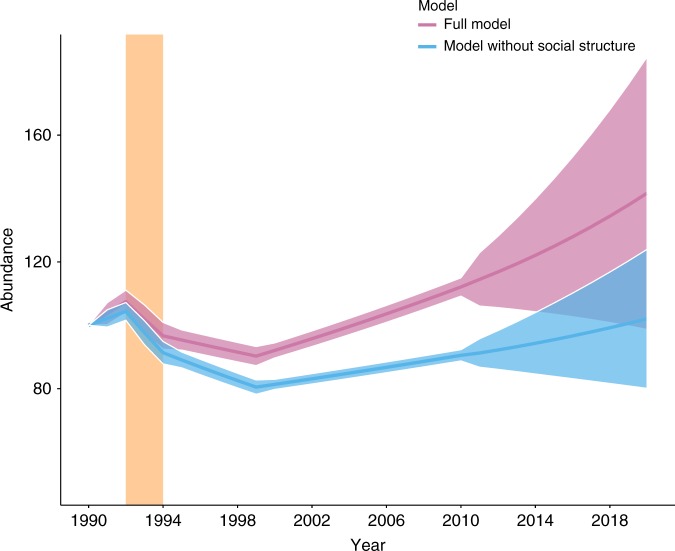
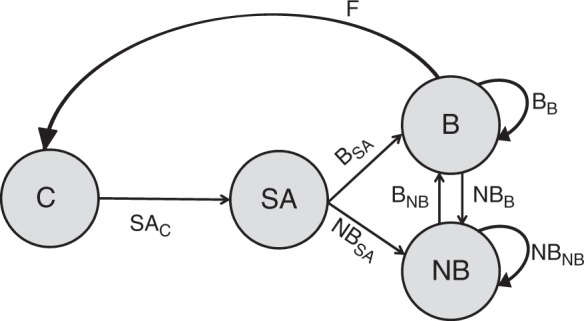
Predicting the impact of disease epidemics on wildlife populations is one of the twenty-first century's main conservation challenges. The long-term demographic responses of wildlife populations to epidemics and the life history and social traits modulating these responses are generally unknown, particularly for -selected social species. Here we develop a stage-structured matrix population model to provide a long-term projection of demographic responses by a keystone social predator, the spotted hyena, to a virulent epidemic of canine distemper virus (CDV) in the Serengeti ecosystem in 1993/1994 and predict the recovery time for the population following the epidemic. Using two decades of longitudinal data from 625 known hyenas, we demonstrate that although the reduction in population size was moderate, i.e., the population showed high ecological 'resistance' to the novel CDV genotype present, recovery was slow. Interestingly, high-ranking females accelerated the population's recovery, thereby lessening the impact of the epidemic on the population.
预测疾病流行对野生动物种群的影响是21世纪主要的保护挑战之一。野生动物种群对流行病的长期人口统计学反应以及调节这些反应的生活史和社会特征通常尚不清楚,特别是对于群居性社会物种而言。在此,我们开发了一个阶段结构矩阵种群模型,以长期预测关键社会捕食者斑鬣狗对1993/1994年塞伦盖蒂生态系统中犬瘟热病毒(CDV)的烈性流行的人口统计学反应,并预测疫情后种群的恢复时间。利用来自625只已知鬣狗的二十年纵向数据,我们证明,尽管种群数量的减少幅度适中,即该种群对出现的新型CDV基因型表现出较高的生态“抵抗力”,但其恢复速度缓慢。有趣的是,地位较高的雌性鬣狗加速了种群的恢复,从而减轻了疫情对种群的影响。