Kim Sunghye, Leng Xiaoyan I, Kritchevsky Stephen B
Department of Internal Medicine, Section of Rheumatology.
Division of Public Health Sciences, Department of Biostatistical Sciences.
Innov Aging. 2017 Aug 30;1(1):igx008. doi: 10.1093/geroni/igx008. eCollection 2017 Mar 1.
Lower muscle and higher fat mass are characteristics of older adults; their physical function is also characterized by slower gait speed and weaker strength. However, the association between specific body composition and physical function is unclear.
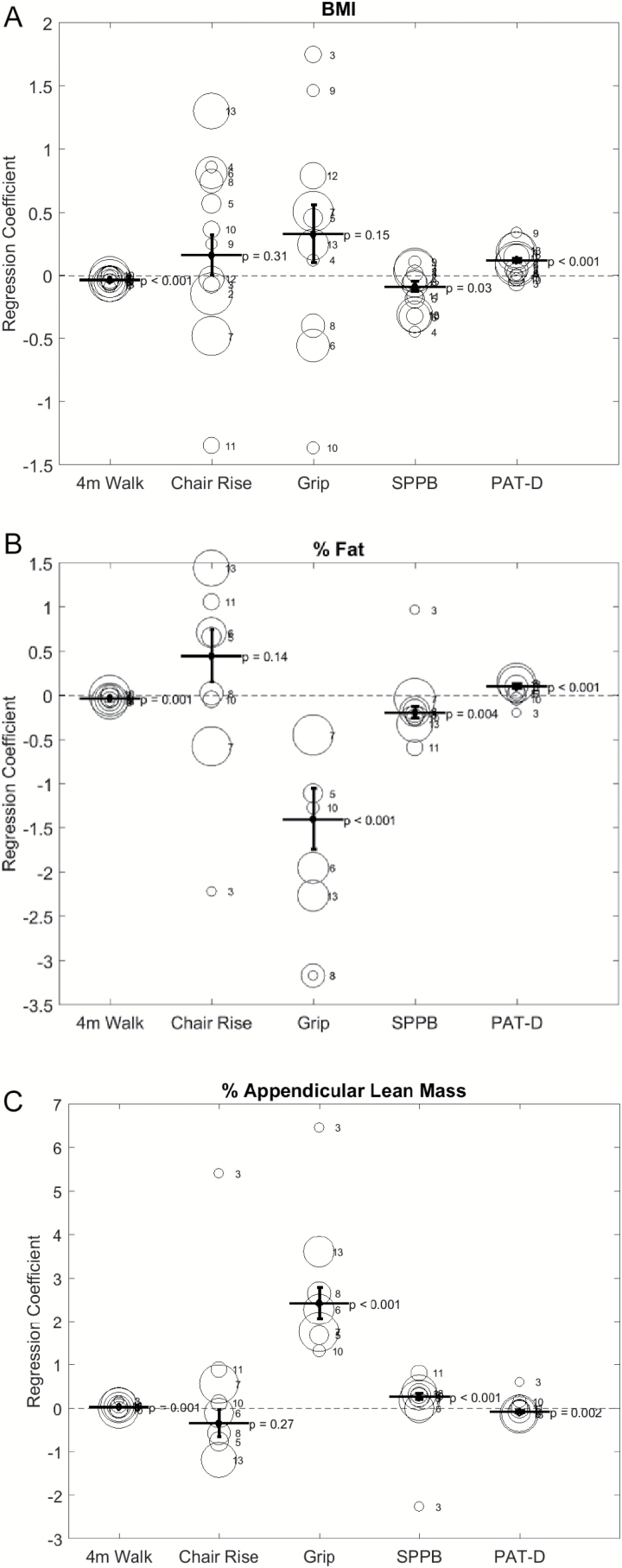
We examined the association between body composition and physical performance using combined cross-sectional data of 1,821 participants from 13 clinical studies at Wake Forest University that used a consistent battery of tests. All participants were ≥60 years old and had one of the following conditions: healthy, osteoarthritis, coronary artery disease, obesity, heart failure, at elevated risk for disability, renal transplantation candidates, heart failure with preserved ejection fraction, moderate self-reported disability, hypertension, diabetes, or coronary artery disease, at high risk for cardiovascular disease. Data at enrollment from each study using uniform tools including body mass index (BMI), dual energy x-ray absorptiometry, physical performance assessment using 4 m walk speed, five chair rise time, handgrip strength, short physical performance battery (17), and Pepper Assessment Tool for Disability were analyzed.
Increased BMI was associated with slower walk speed, lower short physical performance battery, and higher Pepper Assessment Tool for Disability score. Increased percentage of body fat was associated with slower walk speed, lower hand grip strength, lower short physical performance battery scores, and higher Pepper Assessment Tool for Disability scores. Percent appendicular lean mass was associated with faster walk speed, higher handgrip strength, higher short physical performance battery, and lower Pepper Assessment Tool for Disability score. There were no significant discrepancies in relationship between body composition and physical function by gender except gender and BMI on chair-rise time.
Higher BMI and percent body fat were associated with poor physical function while percent appendicular lean mass was associated with better physical function. There was no significant discrepancy in the by gender.
肌肉量减少和脂肪量增加是老年人的特征;他们的身体功能还表现为步态速度较慢和力量较弱。然而,特定身体成分与身体功能之间的关联尚不清楚。
我们使用来自维克森林大学13项临床研究的1821名参与者的综合横断面数据,研究了身体成分与身体表现之间的关联,这些研究使用了一系列一致的测试。所有参与者年龄均≥60岁,且患有以下疾病之一:健康、骨关节炎、冠状动脉疾病、肥胖、心力衰竭、残疾风险升高、肾移植候选者、射血分数保留的心力衰竭、中度自我报告的残疾、高血压、糖尿病或冠状动脉疾病、心血管疾病高风险。使用统一工具对每项研究入组时的数据进行分析,这些工具包括体重指数(BMI)、双能X线吸收法、使用4米步行速度进行身体表现评估、五次从椅子上起身的时间、握力、简短身体表现量表(17)以及佩珀残疾评估工具。
BMI升高与步行速度减慢、简短身体表现量表得分降低以及佩珀残疾评估工具得分升高相关。体脂百分比增加与步行速度减慢、握力降低、简短身体表现量表得分降低以及佩珀残疾评估工具得分升高相关。四肢瘦体重百分比与步行速度加快、握力增强、简短身体表现量表得分升高以及佩珀残疾评估工具得分降低相关。除了性别与从椅子上起身时间的BMI关系外,身体成分与身体功能之间的关系在性别上没有显著差异。
较高的BMI和体脂百分比与身体功能较差相关,而四肢瘦体重百分比与较好的身体功能相关。在性别方面没有显著差异。