Weijenberg Roxane A F, Delwel Suzanne, Ho Bach Van, van der Maarel-Wierink Claar D, Lobbezoo Frank
Oral Kinesiology, Academisch Centrum Tandheelkunde Amsterdam, Amsterdam, The Netherlands.
Clinical Neuropsychology, Vrije Universiteit Amsterdam, Amsterdam, The Netherlands.
Gerodontology. 2019 Mar;36(1):2-7. doi: 10.1111/ger.12380. Epub 2018 Nov 27.
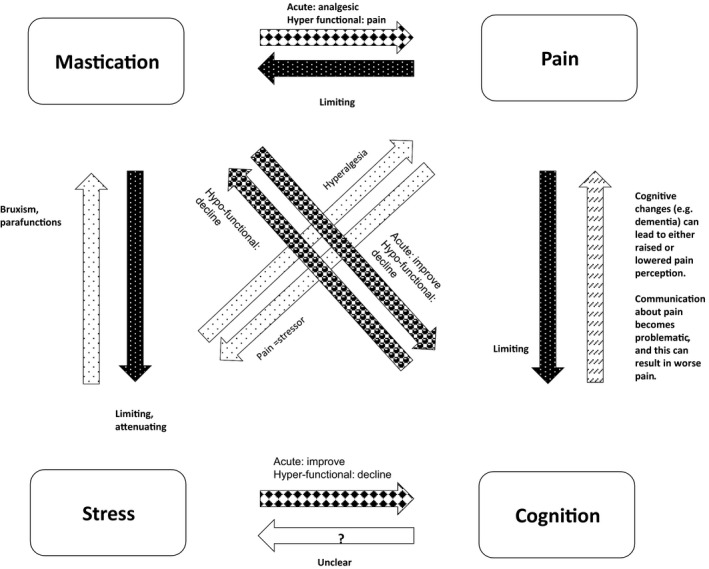
This article explores the multifactorial relationship between mastication and cognition, with a focus on dementia. Older persons, especially those with dementia, are at great risk of suffering from oral health problems such as orofacial pain and loss of natural teeth. A possible explanation could be that the cognitive and motor impairments resulting from dementia cause a decrease in self-care and as such, a worsening of oral health. An alternative explanation is that cognition and oral health influence each other. Animal studies show that a decrease in masticatory activity, for example, due to a soft diet or loss of teeth, causes memory loss and neuronal degeneration. The relationship between mastication and cognition has also been researched in human studies, but a cause-effect relationship has not been proven. It is likely that multiple factors play a role in this relationship, such as self-care, nutrition, stress and pain.
本文探讨咀嚼与认知之间的多因素关系,重点关注痴呆症。老年人,尤其是患有痴呆症的人,极易患上口腔健康问题,如口面部疼痛和牙齿脱落。一种可能的解释是,痴呆症导致的认知和运动障碍会使自我护理能力下降,进而导致口腔健康恶化。另一种解释是,认知和口腔健康相互影响。动物研究表明,例如由于饮食软烂或牙齿缺失导致咀嚼活动减少,会引起记忆力减退和神经元退化。人类研究也对咀嚼与认知之间的关系进行了探究,但尚未证实两者之间存在因果关系。在这种关系中,多种因素可能发挥作用,如自我护理、营养、压力和疼痛。